

On this page
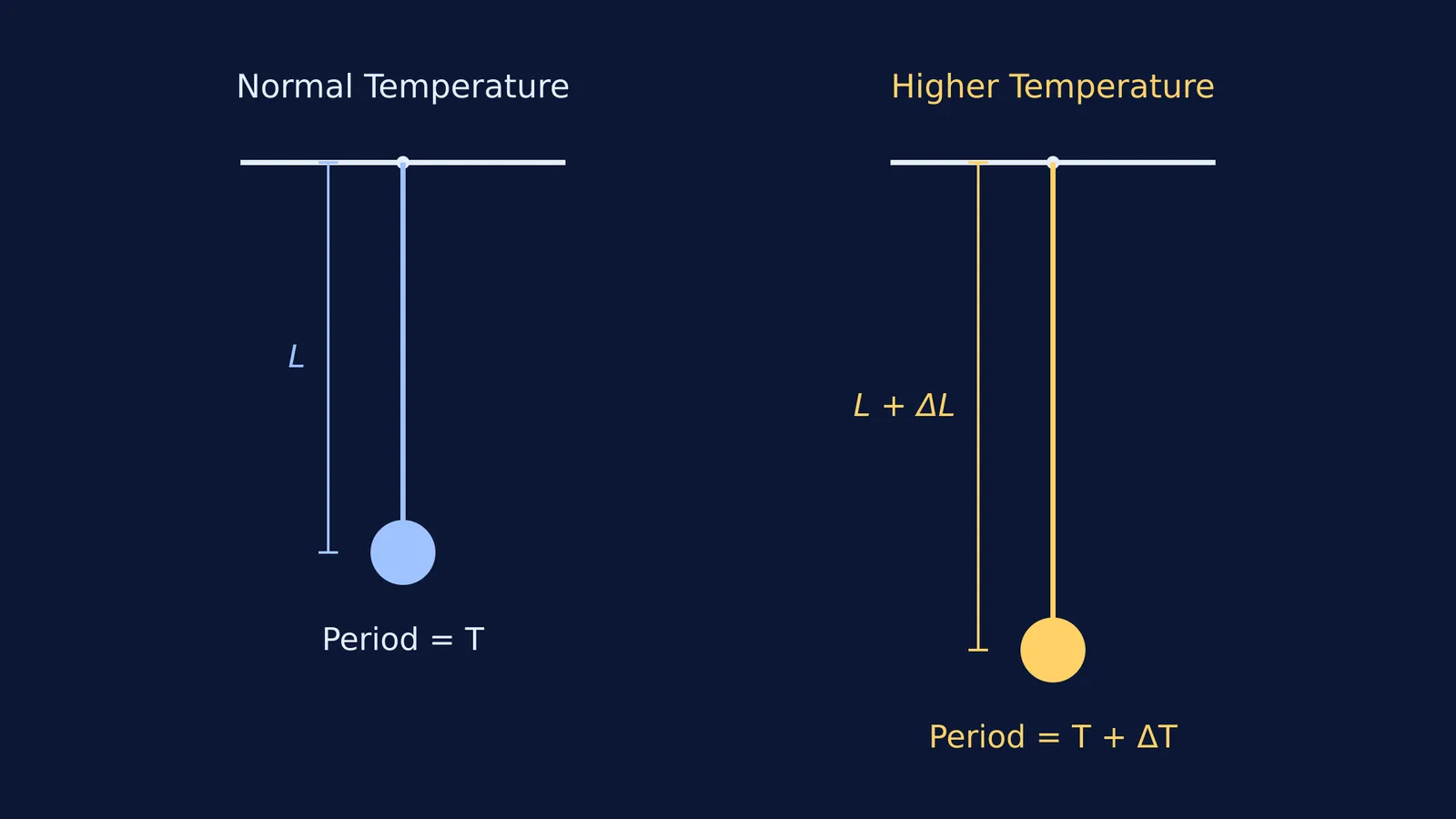
When a pendulum clock runs in a room without climate control, its accuracy drifts with the seasons. The metal rod holding the pendulum expands in the summer heat and contracts in the winter cold. Because the time a pendulum takes to swing depends on its length, this thermal expansion causes the clock to gain or lose time.
Here is exactly how to calculate the error, where the formula comes from, and how clockmakers historically solved it.
Why does a pendulum lose time in summer?
The time a simple pendulum takes to complete one full swing (its period, T) depends on its length (L) and the acceleration due to gravity (g). The formula is:
T = 2π√(L/g)
As the temperature rises, the metal rod of the pendulum undergoes thermal expansion. It gets slightly longer. Because the length L is in the numerator of the formula, an increase in length causes an increase in the period T.
When the period increases, each swing takes longer. The clock mechanism counts swings to measure seconds, so if the swings are slower, the clock displays less time than has actually passed. The clock loses time. Conversely, if the temperature drops and the rod shrinks, the swings speed up, and the clock gains time.
How many seconds does a pendulum clock gain or lose per day?
To find the exact time error, we use the fractional change in the period. For very small changes in length (ΔL), the fractional change in the period (ΔT/T) is approximately half the fractional change in length:
ΔT/T = ½(ΔL/L)
A standard clock relies on a "seconds pendulum", which takes exactly 2 seconds for a full back-and-forth swing (so each single swing takes 1 second). In a 24-hour day, there are 86,400 seconds.
The total time gained or lost in one day (Δt) is the fractional change in the period multiplied by the total seconds in a day:
Δt = (ΔT/T) × 86,400 Δt = ½(ΔL/L) × 86,400 Δt = 43,200 × (ΔL/L)
Because the change in length comes from thermal expansion, we can substitute ΔL/L = αΔθ, where α is the coefficient of linear expansion for the rod's material, and Δθ is the change in temperature. The final formula for time lost per day is:
Δt = 43,200 × α × Δθ
A worked example for steel
Suppose an old grandfather clock uses a steel pendulum rod. The coefficient of linear expansion for steel is α = 11.5 × 10⁻⁶ /°C. If the summer room temperature is 10 °C warmer than the winter room temperature (Δθ = 10 °C), how much time does the clock lose per day?
Using the formula: Δt = 43,200 × (11.5 × 10⁻⁶) × 10 Δt = 4.97 seconds per day
Losing 5 seconds a day might not sound like much, but over a month, the clock will be off by two and a half minutes.
If you are setting up equations like this for homework and get stuck on the proportionality, the Fermi Problem Library breaks down fractional error calculations step by step.
How did clockmakers solve the expansion problem?
Before the invention of modern alloys, clockmakers had to engineer clever ways to keep the center of mass in exactly the same place as temperatures shifted.
In 1721, George Graham invented the mercury pendulum. Instead of a solid weight, the bob was a glass jar filled with liquid mercury. As the heat caused the steel rod to expand downward, it also caused the mercury to expand upward inside the jar. If calibrated perfectly, the two expansions canceled each other out.
A few years later, John Harrison invented the gridiron pendulum. He built a grid of alternating steel and brass rods. Because brass expands more than steel, Harrison arranged the rods so the steel expanded downwards while the brass expanded upwards, keeping the pendulum's effective length constant.
Today, precision mechanical clocks use rods made of Invar, a nickel-steel alloy. Invar has a coefficient of expansion of just 1.2 × 10⁻⁶ /°C, so an Invar pendulum clock loses barely 0.05 seconds per day for every degree of temperature change.
---
*For more on how physical changes alter a system, see our guides on how the seconds pendulum's period changes with length and how stretching a wire changes its resistance.*.


