

On this page
Why could astronomical time no longer keep up?
For centuries, human timekeeping took Earth itself as the master clock. As recounted by the National Physical Laboratory, astronomers defined the second as 1/86,400 of a mean solar day. Early timekeepers, including pendulum clocks described in our guide on thermal expansion in pendulum clocks and John Harrison and the marine chronometer, were calibrated against star transits.
By the late 1930s, quartz resonators revealed that Earth is an unsteady flywheel, as documented by the National Physical Laboratory. Core flows, seasonal winds, and tidal friction cause the day to wander by 1 to 2 milliseconds per day—an instability of one part in 10⁸, accumulating 1 second of error every 3 years.
Astronomers introduced Ephemeris Time in 1956 based on the 1900 tropical year, but measuring it required months of photographing the Moon against background stars. Modern telecommunications and radar required an immediate, laboratory-grade standard.
How did Louis Essen's caesium beam resonator work?
The solution lay in quantum mechanics: atomic energy states are invariant physical constants. In 1955 at the National Physical Laboratory in Teddington, British physicist Louis Essen and Jack Parry built the world's first operational caesium atomic clock, reported in *Nature*.
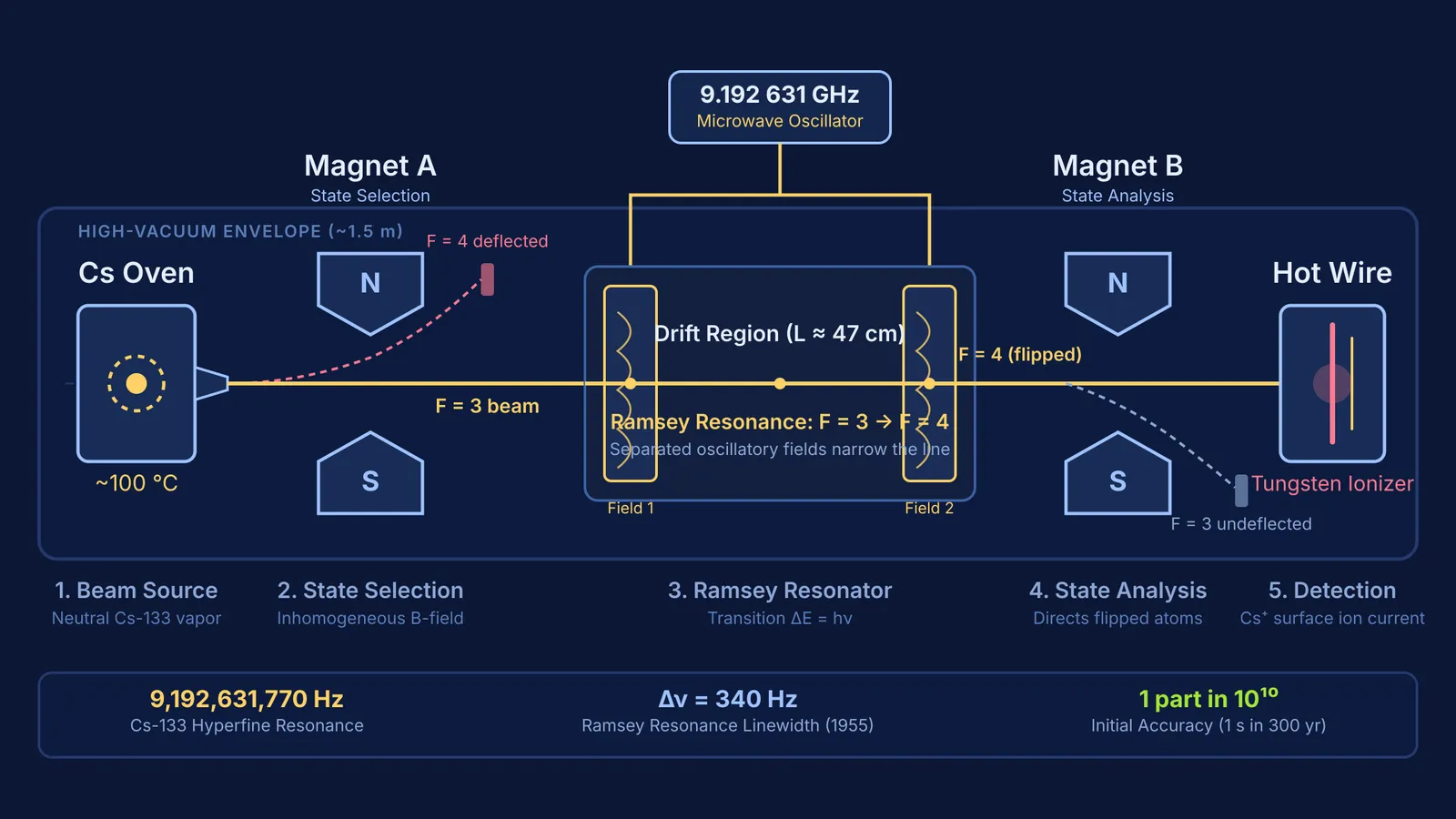
Essen chose caesium-133 for its single stable isotope, high vapour pressure above its 28.4 °C melting point, and well-defined magnetic dipole transition. Enclosed in a 1.5-metre vacuum chamber described in *Nature*, the resonator worked in four stages:
Beam generation: An oven heated liquid caesium to about 100 °C, sending a collimated beam into the vacuum chamber.
State selection (Magnet A): An inhomogeneous electromagnet deflected unwanted states away, guiding lower-state atoms (F = 3, m_F = 0) on-axis.
Ramsey cavity: The atoms traversed a U-shaped cavity using Norman Ramsey's separated oscillatory fields at 9.192 GHz. On resonance (ΔE = hν), microwaves flipped atoms to the higher state (F = 4, m_F = 0).
Detection (Magnet B): A second magnet directed transitioned atoms onto a hot tungsten wire, producing a positive ion current by surface ionisation.
Tuning the microwave source to peak this ion current locked the oscillator to the atomic transition. In *Nature*, Essen and Parry reported a resonance line width of 340 Hz and an initial accuracy of 1 part in 10¹⁰—drifting at most one second in 300 years.
How was the frequency of 9,192,631,770 Hz measured?
To replace astronomical time, scientists had to determine how many atomic cycles matched the established ephemeris second. From 1955 to 1958, Essen and Parry partnered with William Markowitz and R. Glenn Hall at the U.S. Naval Observatory.
Markowitz tracked lunar motion with a dual-rate Moon camera, while NPL calibrated radio time signals across the Atlantic. In *Physical Review Letters*, the team announced that one ephemeris second equalled 9,192,631,770 ± 20 cycles of the caesium-133 ground-state hyperfine transition.
In October 1967, the 13th General Conference on Weights and Measures adopted Resolution 1 of the 13th CGPM, defining the SI second:
"The second is the duration of 9 192 631 770 periods of the radiation corresponding to the transition between the two hyperfine levels of the ground state of the caesium 133 atom."
Much like later breakthroughs linked electrical resistance to fundamental invariants in quantum resistance standards, Essen anchored time to an unalterable quantum constant.
Why does the atomic second matter for modern physics and exams?
Precise time measurement underpins spatial measurement in relativity and wave mechanics. For satellite navigation, a GPS receiver computes position by multiplying transit time Δt by light speed, c ≈ 3 × 10⁸ m/s—a constant Essen measured at NPL, as recorded by the National Physical Laboratory—via Δx = c × Δt. Clock drift alters positioning:
1 millisecond (10⁻³ s): causes an error of 300 kilometres.
1 microsecond (10⁻⁶ s): causes an error of 300 metres.
1 nanosecond (10⁻⁹ s): shrinks error to 0.3 metres (30 centimetres).
Essen later built resonators achieving an accuracy of one part in 10¹², losing one second in 30,000 years, according to the National Physical Laboratory.
If you find it challenging to picture how separated microwave fields drive quantum transitions, the Fermi Simulation Lab provides interactive simulations for ideas that are easier to see than to read. For students practicing numericals on frequency and measurement uncertainty, the Fermi Problem Library offers worked problems with a step-by-step solver that explains the reasoning rather than printing an answer. When reviewing foundational units and atomic structure across your exam syllabus, the Fermi Concept Library maps every concept in physics, chemistry, biology, mathematics and computing.


