On this page
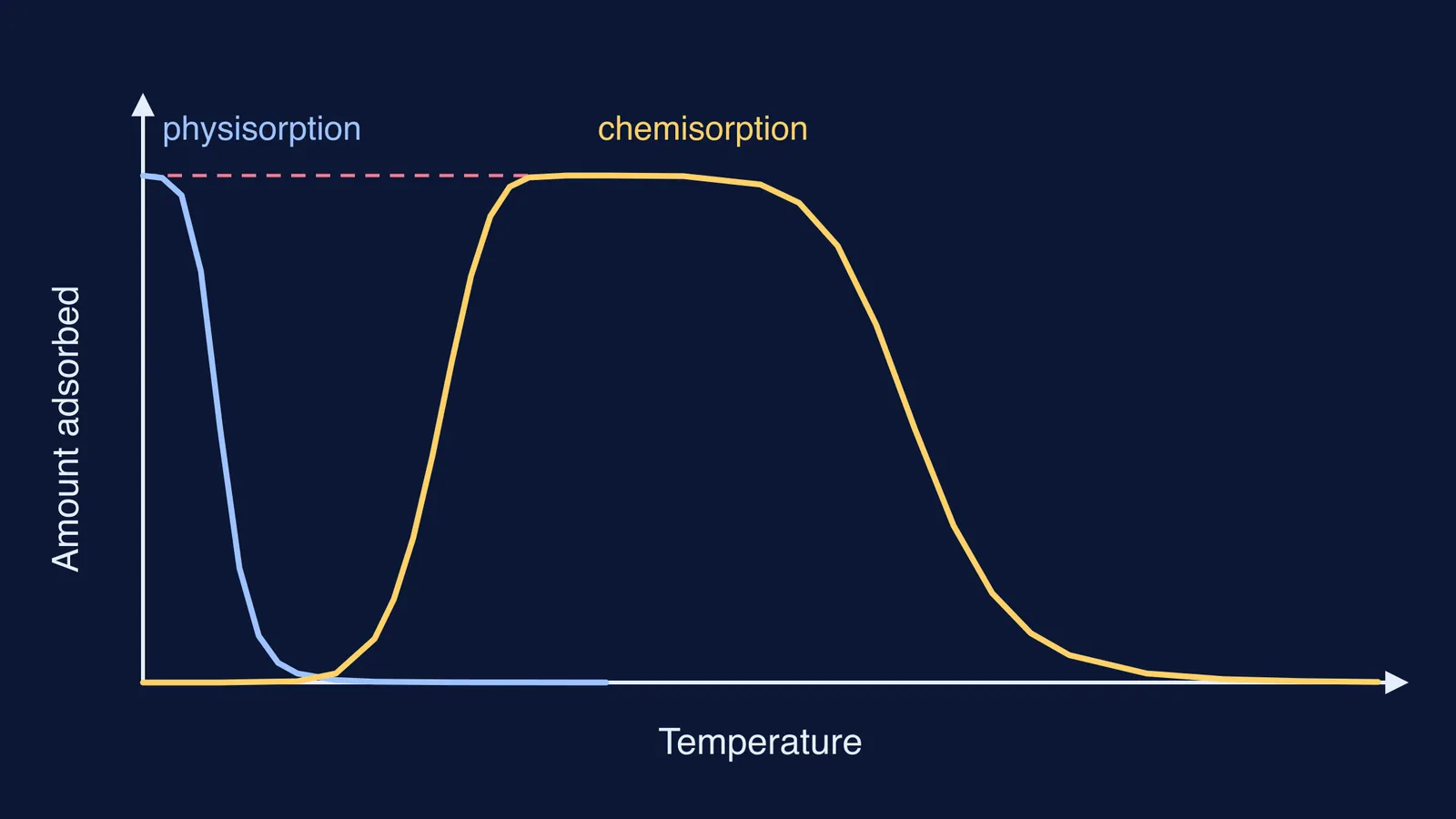
If an exam shows you two graphs of amount adsorbed against temperature and asks which one is chemisorption, the answer is the one with a hump. Here is where the hump comes from, so you can reason it out instead of memorising a picture.
What is the difference between physisorption and chemisorption?
Both are adsorption: gas molecules collecting on the surface of a solid. The difference is the kind of attraction. In physisorption, weak van der Waals forces hold the molecule in a shallow energy well, typically more than 0.3 nm from the surface, according to Roger Nix's surface science notes on potential energy curves/02%3A_Adsorption_of_Molecules_on_Surfaces/2.04%3A_PE_Curves_and_Energetics_of_Adsorption). In chemisorption, the molecule forms a chemical bond with surface atoms, which gives a much deeper well closer in.
Nix's comparison of the two/02%3A_Adsorption_of_Molecules_on_Surfaces/2.02%3A_How_do_Molecules_Bond_to_Surfaces%3F) sets out the contrasts:
Enthalpy: physisorption typically releases 5-40 kJ/mol; chemisorption typically 40-800 kJ/mol, because a real bond forms.
Specificity: physisorption depends only slightly on what the surface is made of; chemisorption varies strongly between materials and even between crystal faces of the same solid.
Reversibility: physisorption is reversible; chemisorption may be irreversible.
Layers: physisorbed gas can build up several layers; chemisorption stops at one layer, a monolayer.
Speed: physisorption is fast and not activated; chemisorption is often an activated process.
You can see both kinds in one real system. A reading on adsorption from St. Albert's College, Ernakulam describes nitrogen on iron: at about −190 °C nitrogen is physisorbed as N2 molecules, at room temperature iron does not adsorb nitrogen at all, and at about 500 °C nitrogen is chemisorbed as separate N atoms.
How does temperature affect physisorption?
Adsorption releases heat, so it is exothermic; the same St. Albert's reading says low temperature favours physisorption and it decreases as temperature rises. That is Le Chatelier's principle: heating an exothermic process pushes the balance back towards the gas, and with no barrier to cross, heat brings no benefit. A plot of amount adsorbed against temperature at constant pressure is called an adsorption isobar, and for physisorption it only falls.
Why does chemisorption first increase and then decrease with temperature?
Two rates compete.
The rising part is kinetics. Many chemisorptions have an activation barrier, Ea. Nix writes the adsorption rate as R = A e^(−Ea/RT) P^x in his notes on the kinetics of adsorption/02%3A_Adsorption_of_Molecules_on_Surfaces/2.03%3A_Kinetics_of_Adsorption). At low temperature few molecules can cross the barrier, so little sticks in the time of an experiment, even though the bonded state is far more stable. Heating speeds this up and the isobar rises.
The falling part is equilibrium. Desorption needs energy roughly equal to the adsorption enthalpy, and its rate also grows exponentially with temperature, as Nix explains in the desorption process/02%3A_Adsorption_of_Molecules_on_Surfaces/2.06%3A_The_Desorption_Process). Once molecules stick quickly enough, the exothermic rule takes over again and heating drives them off.
So the top of the hump is where fast enough to stick meets not yet hot enough to leave.
Worked example: how long does a molecule stay on the surface?
In the desorption process/02%3A_Adsorption_of_Molecules_on_Surfaces/2.06%3A_The_Desorption_Process), Nix gives the average time an adsorbed molecule stays as τ = τ0 exp(−ΔH/RT), with τ0 about 10^−13 s. Take ΔH = −25 kJ/mol for a physisorbed molecule and −150 kJ/mol for a chemisorbed one, both inside the ranges above.
At 300 K, RT = 8.314 × 300 J/mol ≈ 2.494 kJ/mol.
Physisorption: 25 ÷ 2.494 ≈ 10.02, and e^10.02 ≈ 2.3 × 10^4, so τ ≈ 2 × 10^−9 s, a couple of nanoseconds.
Chemisorption: 150 ÷ 2.494 ≈ 60.14, and e^60.14 ≈ 1.3 × 10^26, so τ ≈ 1.3 × 10^13 s, roughly 400,000 years.
Heat the chemisorbed surface to 800 K: RT ≈ 6.65 kJ/mol, 150 ÷ 6.65 ≈ 22.6, so τ ≈ 6 × 10^−4 s, under a millisecond.
The same exponential that holds a chemisorbed layer for ages at room temperature clears it in under a millisecond when hot: the falling side of the hump, in numbers.
How do you answer exam questions on this?
For pick-the-correct-statements questions:
Isobar that only falls: physisorption. Isobar with a maximum: chemisorption.
Multilayer, not specific, reversible, low enthalpy: physisorption.
Monolayer, highly specific, needs activation energy, can split the molecule: chemisorption.
Increases with temperature is true for chemisorption only on the rising side, so be wary of an option that says always.
Both increase with surface area, and both are exothermic in almost every case.
If a related idea such as activation energy or Le Chatelier's principle feels shaky, the Fermi Concept Library covers every concept in physics, chemistry, biology, mathematics and computing. When you get a multi-statement option wrong, the Fermi Problem Library has a step-by-step solver that explains the reasoning, so you can see which statement caught you out.
Next time you see a hump on a temperature graph, ask which rate wins on each side.