On this page
Each blink wipes the front of your eye and resets the thin layer of liquid your vision depends on. How often you blink also changes with what your brain is doing, which matters if you study for hours.
How many times a minute do we blink?
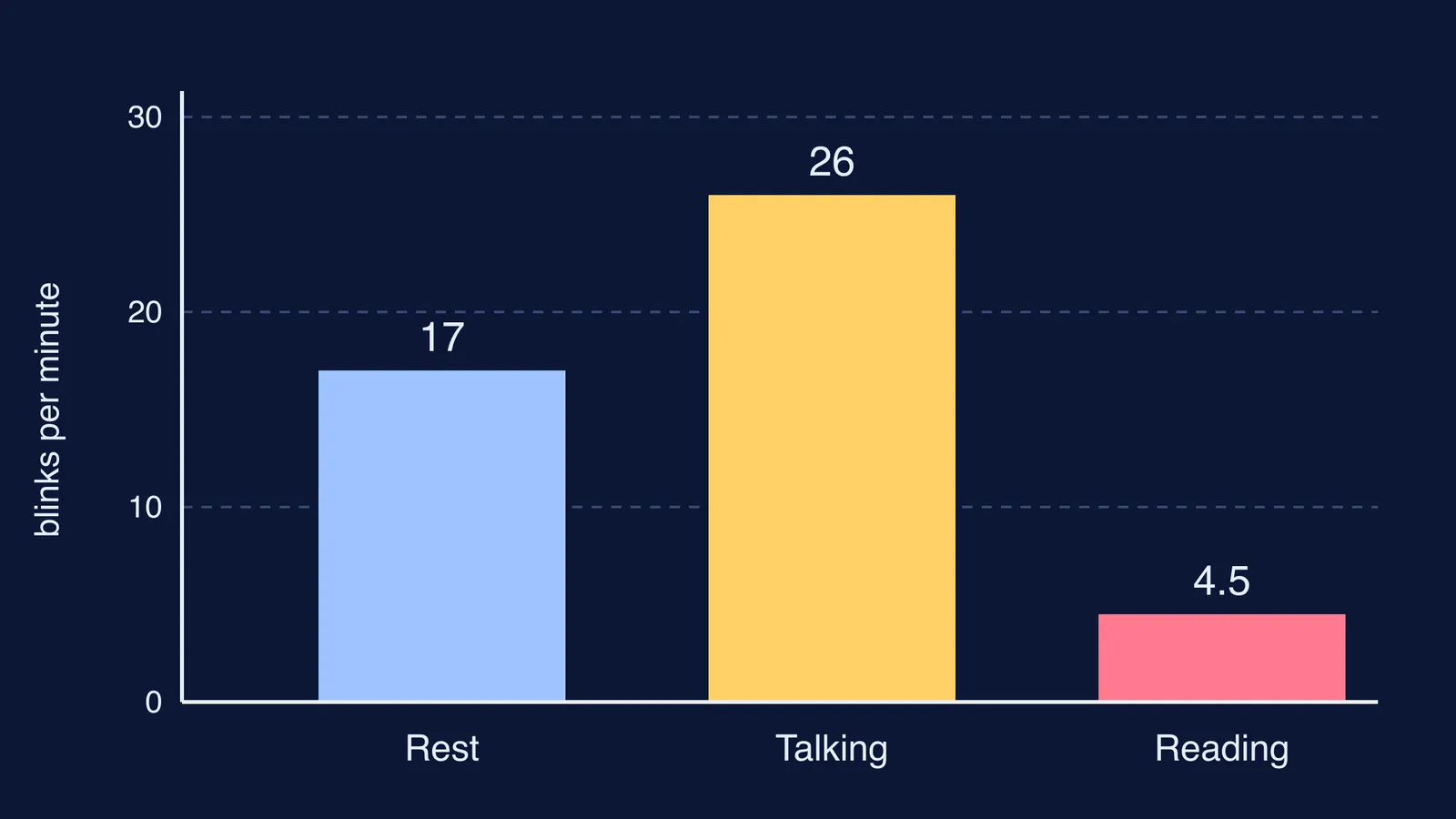
In a 1997 study of 150 healthy volunteers in the journal Movement Disorders, Anna Rita Bentivoglio and colleagues filmed and counted the blinks of people sitting quietly, talking and reading. The average was 17 blinks a minute at rest. It rose to 26 a minute during conversation and fell to 4.5 a minute while reading.
About two in three volunteers (67.3%) followed the same order: most blinks when talking, fewer at rest, fewest when reading. The authors concluded that blink rate is shaped more by mental activity than by age, eye colour or local factors in the eye.
The American Academy of Ophthalmology gives a round figure: we normally blink around 15 times a minute, and that rate can be cut in half when staring at screens or reading.
A worked example: if you blinked at the resting rate of 17 a minute for 16 waking hours, that would be 17 x 60 x 16 = 16,320 blinks a day. Time spent reading pulls the real number down.
What does blinking do for your eyes?
The front of your eye is covered by a thin liquid layer called the tear film. The American Academy of Ophthalmology's EyeWiki page on digital eye strain) explains that blinking redistributes tears, drains old tears and renews the tear film over the eye's surface.
A review of the tear film lists what that layer does. Each blink keeps these jobs going:
Moist: it lubricates the cornea, the clear front window of the eye, and the inside of the eyelids.
Fed: the cornea has no blood vessels, so the tear film supplies it with oxygen, glucose and salts.
Clean: it washes away dust and other foreign material.
Smooth: it keeps a smooth surface for light to refract through.
Light bends as it enters your eye, and a smooth surface bends it evenly so the image stays sharp. As the tear film thins between blinks, the surface can become uneven and the image can blur slightly. A review in The Ocular Surface70233-1) by Robert Montés-Micó and colleagues puts it plainly: the stability of the tear film plays an important role in the optical quality of the eye.
Why do we blink more than we need to?
If blinking were only about wetting the eye, we might blink less. A study in PNAS, published online in December 2012 by Tamami Nakano and colleagues, starts from that puzzle. They scanned people's brains while they watched videos. Just after a spontaneous blink, activity dipped in the dorsal attention network, which handles focus on the outside world, and rose in the default-mode network, which is linked to internal thought. When the researchers blacked out the video for a moment instead, that switch did not happen.
The authors suggest that blinks may be part of how the brain briefly releases attention. That may help explain the reading result above: when you are absorbed in a page, you blink far less.
Is blinking a reflex?
Spontaneous blinks happen without thought, voluntary ones are chosen, and reflex blinks protect the eye when something touches it. That last one is the corneal reflex. A 2021 review in Pain Research and Management describes its path: the trigeminal nerve carries the signal in from the cornea, and a branch of the facial nerve carries the command out to the orbicularis oculi, the ring of muscle that closes the eyelids. Both eyes close, not just the one that was touched.
It follows the same receptor-to-effector route as any reflex, which we lay out in the five components of a reflex arc. Your eyes have another fast reflex for light, explained in why your pupil gets smaller in bright light.
How can you keep your eyes comfortable during long study sessions?
Since reading cuts blinking sharply in the Bentivoglio study, a study plan should build in breaks for your eyes. Here is a simple one:
Count your own blinks for one minute each while resting, talking and reading. Compare them with the study's averages of 17, 26 and 4.5 a minute.
Sit about 25 inches, or an arm's length, from your screen, set so you look slightly down at it, as the American Academy of Ophthalmology advises.
Every 20 minutes or so, get up, stretch and look at something far away, another American Academy of Ophthalmology tip for students.
At each break, try a few slow, full blinks. EyeWiki) notes that computer use is linked to incomplete blinks, where the upper lid does not cover the whole cornea.
The Academy says devices will not damage your eyes permanently, though long staring can cause temporary discomfort. For the separate worry about screen distance, see whether sitting close to the TV damages eyesight. If dryness, redness, pain or blurred vision keeps coming back, see an eye doctor.
Refraction, the reason a smooth tear film matters, is easier to see than to read. The Fermi Simulation Lab has interactive simulations for ideas like that, and the Fermi Concept Library covers every concept in physics, chemistry, biology, mathematics and computing, each with its own lesson.
Next time you read for an hour, count a minute of blinks. It is a small experiment with a real study behind it.