On this page
Your fingers brush a hot tawa and your hand is back before you have said a word. That movement runs along a reflex arc, and the textbook answer names five parts in a fixed order. Here is the hot-plate example through all five, plus a flow line and checklist for your diagram.
What are the five components of a reflex arc, in order?
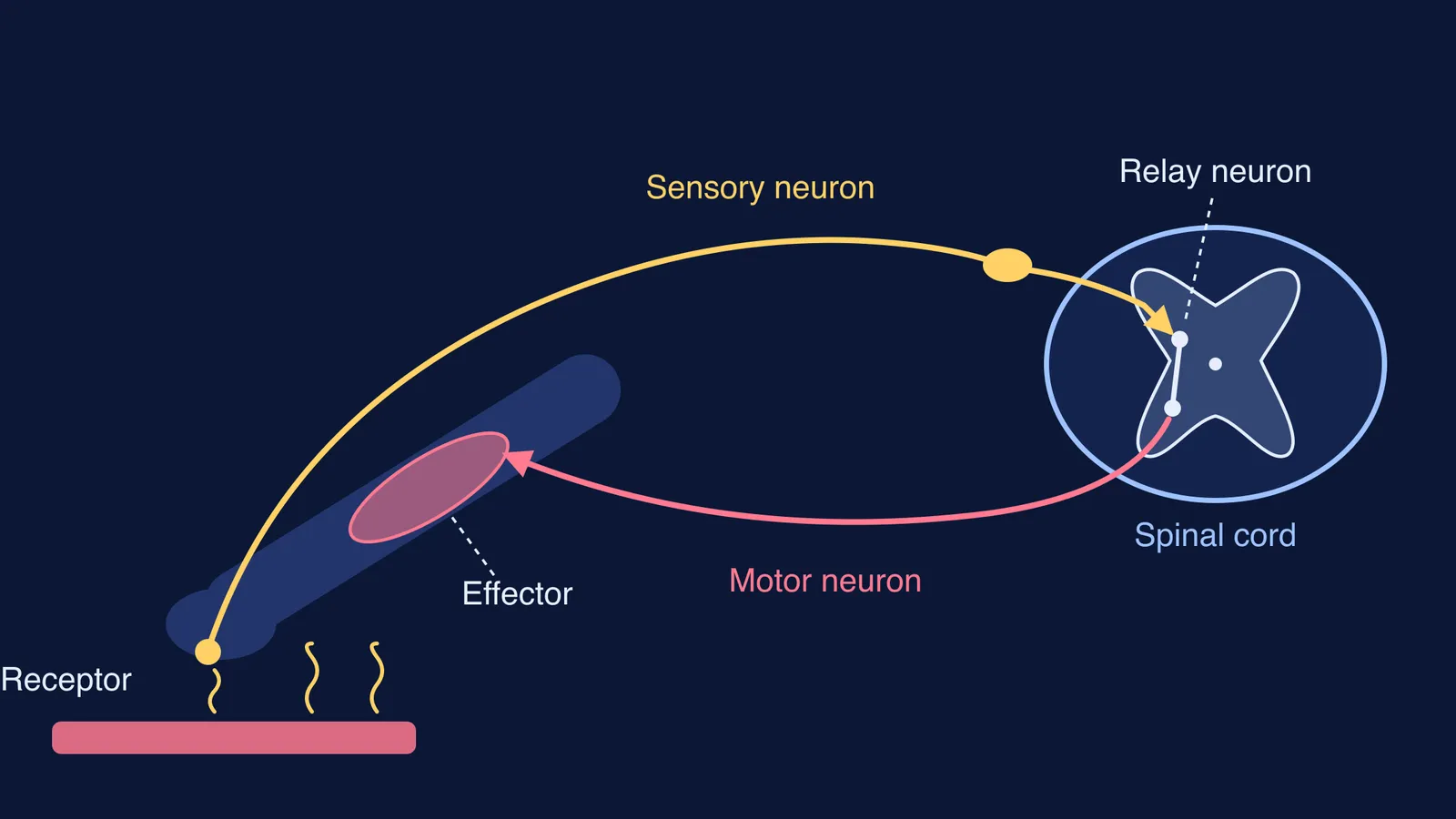
The NCERT Class 10 Science chapter Control and Coordination shows a hand over a hot vessel in its reflex arc figure (Figure 6.2) and labels the five parts of the arc: heat and pain receptors in the skin, a sensory neuron, a relay neuron in the spinal cord, a motor neuron, and the muscle in the arm as the effector (NCERT Class 10 Science, Chapter 6). In the order the signal travels:
Receptor: heat and pain receptors in the skin detect the stimulus.
Sensory neuron: carries the impulse from the receptor into the spinal cord.
Relay neuron: sits inside the spinal cord and connects the sensory neuron to the motor neuron.
Motor neuron: carries the impulse out of the spinal cord to the muscle.
Effector: the arm muscle that contracts and moves the hand away.
The relay neuron is also called an interneuron; in the withdrawal reflex, the sensory neuron synapses with an interneuron in the spinal cord, which then synapses with a motor neuron that excites the muscle (Kenhub, The withdrawal reflex). If the difference between the two outer neurons still feels blurry, our guide to how sensory and motor neurons carry signals in opposite directions sorts it out.
What happens in the hot-plate reflex, step by step?
Here is the whole arc as one line, the version worth writing under any diagram:
Hot plate (stimulus) → receptor in skin → sensory neuron → relay neuron in spinal cord → motor neuron → effector (arm muscle) → hand pulls away (response)
In more detail, receptors in the skin sense extreme temperature and the early signs of tissue damage, the signal travels along the sensory fibre through the dorsal spinal root into the spinal cord, and a motor neuron excites the biceps brachii, which bends the elbow and pulls the hand off the stove (OpenStax, Anatomy and Physiology 2e).
The real circuit is busier than the five-box version. In the withdrawal reflex, the sensory fibres synapse with a variety of interneurons, which drive the flexor muscle to contract while inhibitory interneurons hold back the opposing extensor muscle (Somatic reflexes, adapted from OpenStax). The NCERT figure draws a single relay neuron, so that is the version to reproduce in a board answer.
Compare this with the knee jerk. The stretch reflex is monosynaptic, so it has no relay neuron between the sensory and motor neurons (Somatic reflexes, adapted from OpenStax). Our post on why a tap below the knee makes your leg kick walks through that shorter arc.
Why does the reflex arc pass through the spinal cord, not the brain?
NCERT's answer is about time. Thinking about the heat and deciding to move would need signals to travel to the brain and back, and if all of that had to happen when you touch a hot object, you could get burnt (NCERT Class 10 Science, Chapter 6). Nerves from all over the body meet in a bundle in the spinal cord on their way to the brain, so the reflex connection is made there. The same chapter adds that the information still goes on to reach the brain.
The brain is informed, not consulted. Our explainer on voluntary, involuntary and reflex actions sets out how the three kinds of circuit differ.
How do you draw and label the reflex arc in an exam?
Check your diagram against this list:
Draw the hand over the hot object, one arm muscle and a spinal cord cross-section.
Put arrows on both neurons: towards the spinal cord on the sensory neuron, away from it on the motor neuron.
Place the relay neuron inside the spinal cord, joining the two.
Label all five parts, with the specifics: "Receptor (heat or pain receptors in skin)" and "Effector (muscle in arm)".
Write the flow line under the diagram.
For a short "Explain a reflex arc with an example" question, a model answer could read: "A reflex arc is the pathway of a reflex action. When the hand touches a hot plate, heat receptors in the skin are stimulated. A sensory neuron carries the impulse to the spinal cord, where a relay neuron passes it to a motor neuron. The motor neuron carries the impulse to the arm muscle (effector), which contracts and pulls the hand away. The information also goes on to reach the brain."
If you can name the parts but not say why each sits where it does, the Fermi Concept Library gives every concept in biology its own lesson and its place in the map. And if a diagram question keeps tripping you up, Fermi's AI tutor can draw the figure and check your understanding as it goes.
Tonight, draw the arc from memory and check it against the list above.