On this page
Many families have heard it: "Sit back, you'll ruin your eyes." Close viewing can make your eyes tired and dry, and a child who keeps creeping towards the screen may be telling you something about their eyesight.
Does sitting close to the TV damage your eyes?
The American Academy of Ophthalmology (AAO) lists it as a myth: sitting very close to the television "may cause eye strain or give you a headache," but "it will not damage vision in children or adults" (AAO, eye myths and facts).
The AAO also says long hours at a phone or computer will not permanently damage your eyes, though they may feel uncomfortable (AAO, computers, digital devices and eye strain).
Why do your eyes feel tired after close viewing?
Two things happen: your eyes work harder to focus, and at screens you blink less.
Focusing first. To see something near, the lens inside your eye changes shape and becomes more powerful. This is called accommodation, and our explainer on how the eye's lens changes shape for near vision walks through it. Optical power is measured in dioptres, and one dioptre equals one reciprocal metre (Dioptre, Wikipedia).
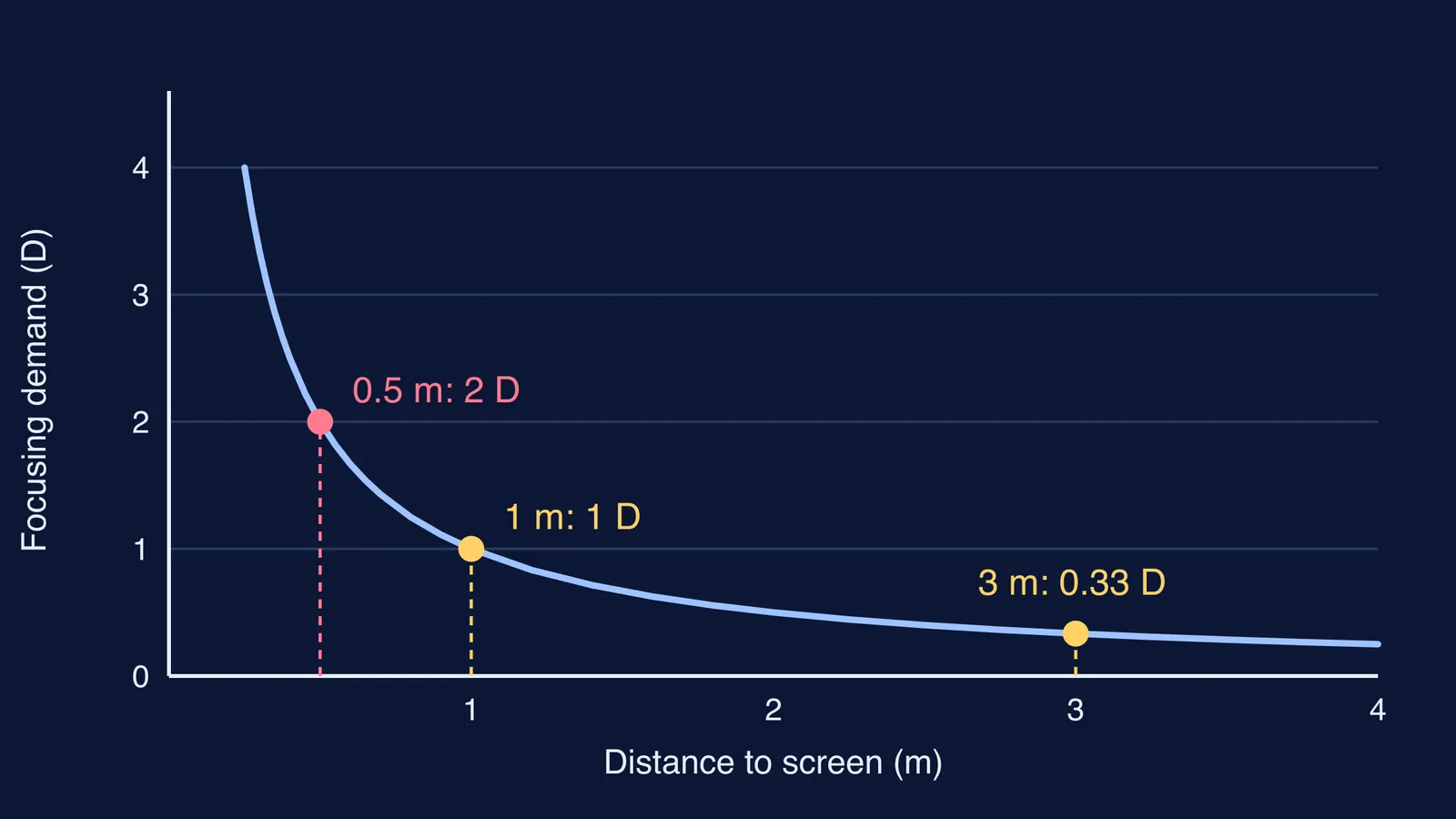
A worked example: for an eye that sees distant things clearly without glasses, the extra focusing needed is roughly 1 divided by the distance in metres.
TV at 3 m: 1 / 3 = about 0.33 dioptres
TV at 1 m: 1 / 1 = 1 dioptre
TV at 0.5 m: 1 / 0.5 = 2 dioptres
Moving from 3 m to 0.5 m asks your eye for six times the focusing effort. That is still well within a teenager's range, which is about 11 to 16 dioptres at age 15 (Dioptre, Wikipedia). Long stretches of any close work, such as reading or sewing, can leave eyes achy, the AAO's eye strain guide says. Still, retina specialist Sunir Garg told the AAO it is not clear that screen distance is the culprit in digital eye strain (AAO, January 2024).
Then blinking. Humans normally blink about 15 times a minute, but only about 5 to 7 times a minute at screens, according to the AAO's guide to digital eye strain. Fewer blinks let the eye surface dry out, which can sting or blur.
Why do children sit so close to the TV?
The AAO notes that children have a heightened ability to focus on nearby objects, so sitting close may simply feel comfortable to them (AAO, eye myths and facts).
The same page adds a warning: habitually sitting close to the TV may signal that the person is nearsighted and needs glasses. The WHO says uncorrected refractive error remains a leading cause of vision impairment in children and adults in all countries (WHO fact sheet on blindness and vision impairment). An eye test with an ophthalmologist or optometrist settles the question; our guide to the BSc Optometry eye care degree explains what optometrists do.
Does screen time cause myopia?
This is less settled. Dr Garg notes a possible link between close-up work and myopia, but says there isn't enough information to prove it (AAO, January 2024). The same article says children should spend one to two hours a day in natural light to lower their risk of myopia.
The evidence for going outdoors is clearer. In a randomised trial of about 1,900 six-year-olds in 12 primary schools in Guangzhou, China, adding one 40-minute outdoor class to each school day (and encouraging outdoor play after school) cut the three-year rate of new myopia to 30.4%, against 39.5% in schools that carried on as usual (He et al., JAMA, 2015).
Like the idea that carrots help you see in the dark, the TV warning wraps some sense in a myth: what helps is breaks and daylight, not a fixed distance.
How can you look after your eyes during screen time?
A checklist for TV, phones and online classes, drawn from the AAO's eye strain guide unless noted:
Look away often. Look at something in the distance for a bit; ad breaks are natural cues.
Blink on purpose. A sticky note on the screen can remind you.
Match brightness to the room. A screen glowing brighter than its surroundings makes eyes work harder.
Sit at arm's length from a computer, about 25 inches, with your gaze slightly downward.
Go outside every day: the AAO advises one to two hours in natural light for children.
Book an eye test if your child always sits close to the TV, since that can signal nearsightedness (AAO).
If your child keeps edging forward, try this instead of a scolding: "You're not in trouble. Can you read the channel name from the sofa?" If they can't, book the eye test.
If your teenager would rather see an idea than read about it, the Fermi Simulation Lab has interactive simulations for the ideas that are easier to see than to read. Then look out of the window for a minute.