

On this page
In short
India faces a massive shortage of eye care professionals, needing 115,000 trained optometrists but having fewer than 50,000. A Bachelor of Optometry (B.Optom) is a five-year path after 12th to a clinical or retail career, while ophthalmology requires a longer medical degree and surgical training.
India is facing a quiet crisis in eye care. The country requires 115,000 four-year trained optometrists to provide comprehensive care for its population, but currently has roughly 40,000 to 50,000 practicing professionals.
For students finishing their 12th standard in the science stream (PCB or PCM), this gap represents a major career opportunity. But the path to becoming an eye care professional can be confusing. What exactly is a BSc in Optometry, and how does it differ from becoming an ophthalmologist?
What is a BSc Optometry degree?
A Bachelor of Optometry (now standardized as B.Optom) is a professional degree that trains you to examine eyes, diagnose vision problems and prescribe corrective lenses.
Under the National Commission for Allied and Healthcare Professions (NCAHP) Act of 2021, the education and roles for optometrists in India have been formally standardized. The degree is a five-year commitment: four years of academic study followed by one year of mandatory clinical internship.
To be eligible, you need to have completed your 12th standard with science subjects. While admission traditionally depended on board marks or university-specific tests, some states and institutions are increasingly using NEET-UG scores for entry. You will study subjects like ocular anatomy, visual optics, dispensing optics and pathology.
How does optometry differ from ophthalmology?
While both professionals work together in eye hospitals, their training, daily work and legal scope of practice are very different.
Training duration: The path to becoming an ophthalmologist is significantly longer. It requires clearing NEET-UG, completing a 5.5-year MBBS degree, and then doing a three-year postgraduate degree (MS, MD or DNB) in ophthalmology. A B.Optom takes exactly five years.
Scope of work: Optometrists are primary eye care providers. They perform refraction tests, prescribe spectacles and contact lenses, manage binocular vision issues and detect eye diseases early. They do not perform surgery.
Ophthalmologists are medical doctors and surgeons. Their daily work involves diagnosing complex medical conditions and performing intricate surgeries such as cataract removals, LASIK and retinal repairs.
If you are a biology student using the Fermi Concept Library to explore human anatomy, ophthalmology is one of the many specialisations available after an MBBS. Optometry is a direct, dedicated route to eye care right after 12th.
What skills do you need to succeed?
What makes a good optometrist? Beyond the academic requirements, the job requires a specific mix of technical and interpersonal skills.
Physics and mathematics: Optometry is applied physics. You need to be comfortable calculating focal lengths, understanding refractive indices and working with the geometry of lenses.
Communication: A large part of the job involves explaining complex vision problems to patients in simple terms. You will often work with elderly patients or young children, requiring patience and clear communication.
Attention to detail: Writing an accurate prescription or fitting a contact lens requires precision. A small error in a prescription can cause headaches and eye strain for the patient.
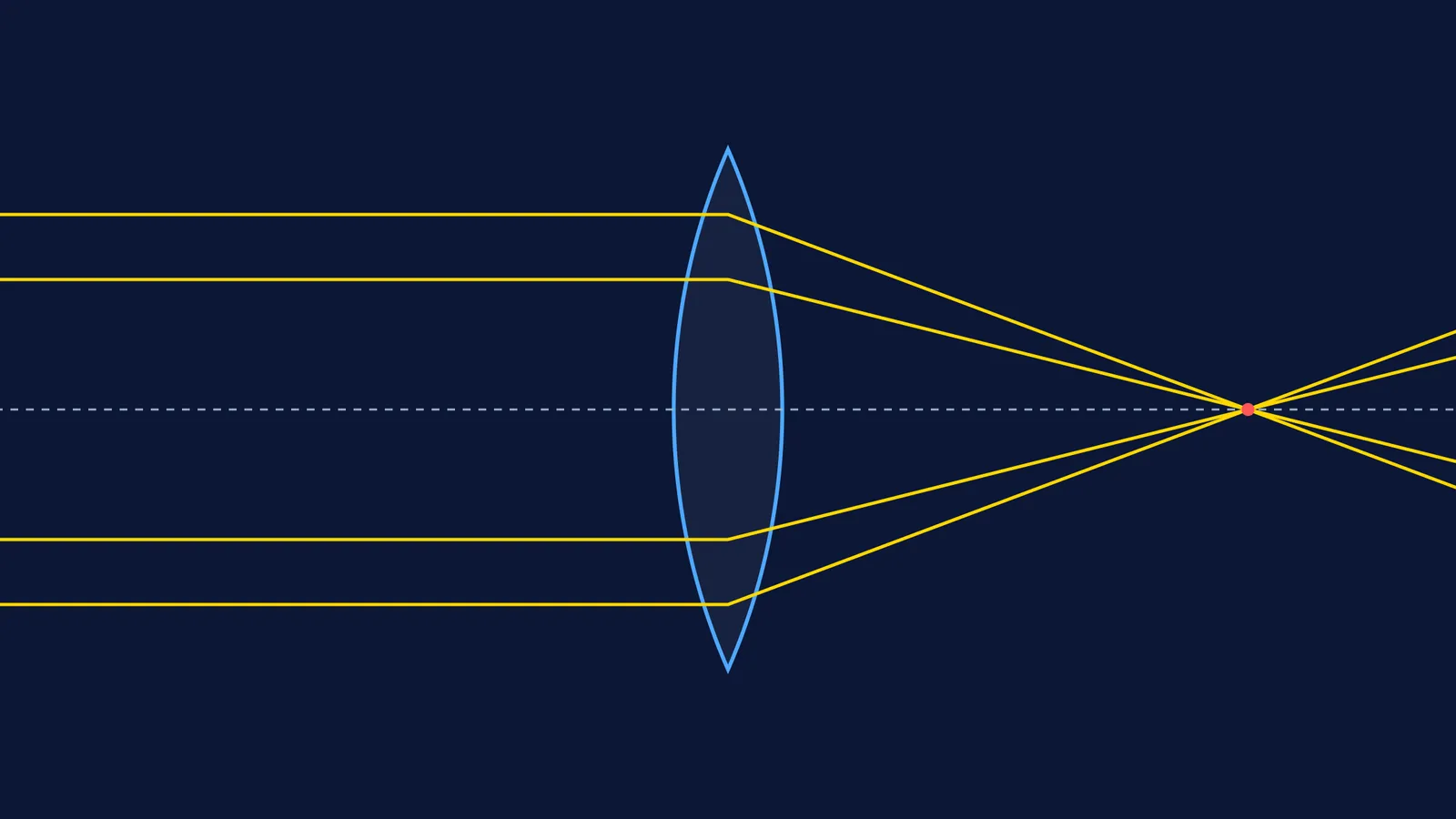
If you are currently studying optics in Class 10 or 12, pay close attention. The rules you learn for ray diagrams are the exact rules you will use to design corrective lenses.
What are the career roles after graduation?
One of the unique advantages of a B.Optom degree is the variety of workplaces it opens up, allowing you to choose an environment that suits your personality.
Hospital clinics: Many optometrists work in large eye hospitals, conducting the initial examinations, measuring intraocular pressure and mapping the retina before the patient sees the surgeon. This is a highly clinical role focused on patient care and disease detection.
Retail and corporate: The optical retail sector in India is expanding rapidly. Optometrists manage refraction and lens fitting at corporate chains, combining clinical work with retail management and customer service.
Independent practice: After gaining experience, optometrists can set up their own vision care clinics and optical shops, becoming entrepreneurs in their communities.
Whether you are studying the Dispersion of white light by a glass prism or revising the anatomy of the human eye, the fundamental physics remains the same. The optics you learn for your board exams, such as Tracing a ray through a glass slab, are exactly the principles you will use every day to correct someone's vision. If you struggle to picture how lenses bend light, the Fermi Simulation Lab lets you interact with ray diagrams in real time, making the concepts easier to see and apply in both exams and clinical practice.


