

On this page
In 1940, Royal Air Force pilot John Cunningham was shooting down German bombers in the dark with unprecedented accuracy (Smithsonian Magazine). The British government told the public that his secret was simple: eating an enormous amount of carrots. They even gave him the nickname "Cat's Eyes."
Generations of parents have since repeated the claim that carrots give you exceptional night vision. Like many enduring myths, it is a blend of a genuine biological fact and a very successful military deception.
Where did the carrot myth come from?
The truth behind Cunningham's 20 kills—19 of which were at night—was not his diet, but the invention of Airborne Interception (A.I.) radar (Smithsonian Magazine). First deployed in 1940, this top-secret technology allowed RAF pilots to detect enemy planes long before they were visible.
To hide the existence of onboard radar during the Blitz, the Ministry of Information launched a propaganda campaign claiming that the pilots' success was due to a carrot-heavy diet. This cover story served a dual purpose: by 1942, the UK had a 100,000-ton surplus of carrots, and the campaign encouraged the public to eat them as a substitute for rationed goods. The Ministry of Food even introduced recipes for carrot pudding and marmalade to help families substitute for sugar.
How does the eye actually see in the dark?
While the promise of "super" vision was propaganda, the science linking carrots to eyesight is completely real. The connection lies in the retina, which contains two main types of photoreceptor cells: cones for colour and bright light, and rods for low light.
Inside your rod cells is a light-sensitive pigment called rhodopsin, or "visual purple". When light hits a rod cell, rhodopsin undergoes a chemical change that triggers an electrical signal to your brain. This molecule is made of a protein called opsin bound to retinal, which is a form of vitamin A. Carrots are rich in beta carotene, which the human body converts directly into vitamin A. Without a constant supply of this vitamin to rebuild bleached rhodopsin, the rods cannot function properly, leading to a condition known as nyctalopia, or night blindness.
If you find it difficult to picture how light behaves as it enters the eye, Light in Class 8: laws of reflection, mirrors, and the human eye is a good starting point. For more advanced ideas, the Fermi Simulation Lab has interactive simulations for the ideas that are easier to see than to read.
Will eating more carrots improve my vision?
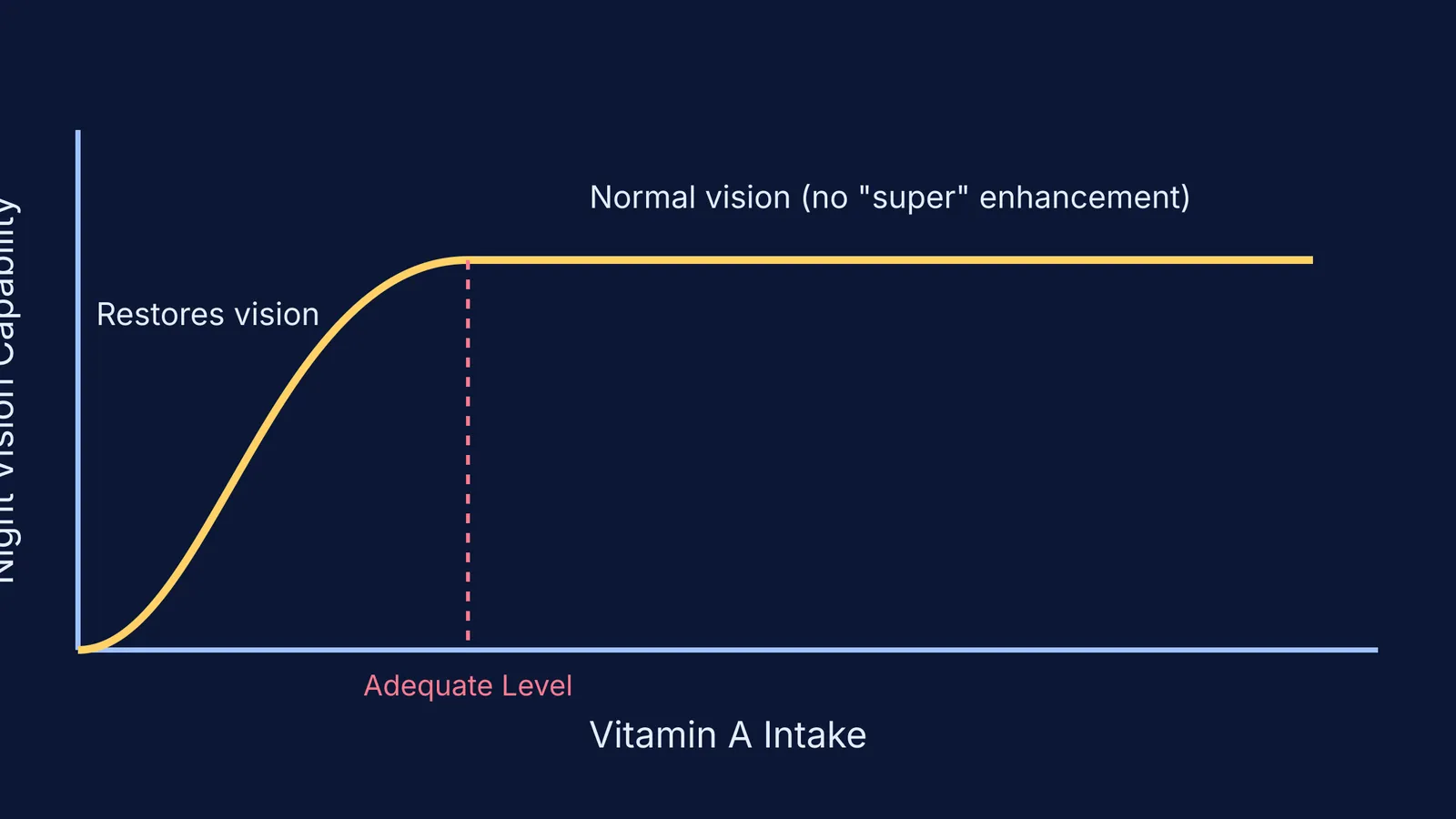
If you suffer from night blindness due to a poor diet, consuming vitamin A can reverse the deficiency and restore your normal low-light vision. However, eating carrots will not strengthen the eyesight of a healthy person who already has adequate vitamin A levels. As the Smithsonian notes, eating excess carrots cannot help you see better in the dark any more than eating blueberries will turn you blue.
You can review the chemical structures of these essential nutrients in Vitamins in Class 12 chemistry: fat- and water-soluble types.
How can you protect your eyes during exam prep?
While you cannot eat your way to superhuman vision, you can protect your eyes during long study sessions.
Follow the 20-20-20 rule: Every 20 minutes, look at something 20 feet away for at least 20 seconds to relax your eye muscles (Healthline).
Match your lighting: Ensure your room lighting is as bright as your screen. Studying in a dark room forces your pupils to constantly adjust between the bright screen and the dark surroundings.
Blink consciously: We blink far less often when reading screens, leading to dry eyes.
Check your prescription: If you find yourself squinting or suffering from headaches, have your vision checked. You can read more about how glasses correct these issues in The human eye and its defects: myopia, hypermetropia and lenses.


