

On this page
Most mistakes in reflection questions come from measuring the angle from the wrong line. This post explains the two laws of reflection, concave and convex mirrors and lenses, works two angle problems, and explains where the human eye has gone in the new books.
What does the current Class 8 book cover?
NCERT's Class 8 book is now Curiosity, marked "Reprint 2026-27". Chapter 10, "Light: Mirrors and Lenses", covers spherical mirrors, the images they form, the laws of reflection and lenses. The older Class VIII book's "Light" chapter also had the laws of reflection, multiple images, the human eye and Braille.
The human eye is not in Curiosity Class 8. In NCERT's current books it is taught in Class 10, in "The Human Eye and the Colourful World". If your school still uses the older Class 8 book, you will study the eye this year. Check with your teacher.
What are the laws of reflection?
Curiosity's activity shines a thin beam from a torch, through a slit, onto a plane mirror. You draw the mirror, the incident ray and the reflected ray. Then you draw the normal: a line at 90° to the mirror where the ray hits it.
The angle of incidence (i) is between the incident ray and the normal.
The angle of reflection (r) is between the reflected ray and the normal.
First law: the angle of incidence equals the angle of reflection.
Second law: the incident ray, the normal at the point of incidence and the reflected ray all lie in the same plane. The book shows this by bending a sheet of chart paper: the reflected beam disappears from the bent part and comes back when you flatten it.
If light falls along the normal, both angles are zero and the ray bounces straight back. The book adds that both laws hold for all mirrors, plane and spherical.
How do concave and convex mirrors differ?
A spherical mirror's reflecting surface is part of a sphere.
A concave mirror curves inwards. Close up, it gives an enlarged, upright image; move the object farther away and the image turns upside down. Curiosity lists its uses as reflectors of torches, headlights of cars and scooters, and the dentist's mirror.
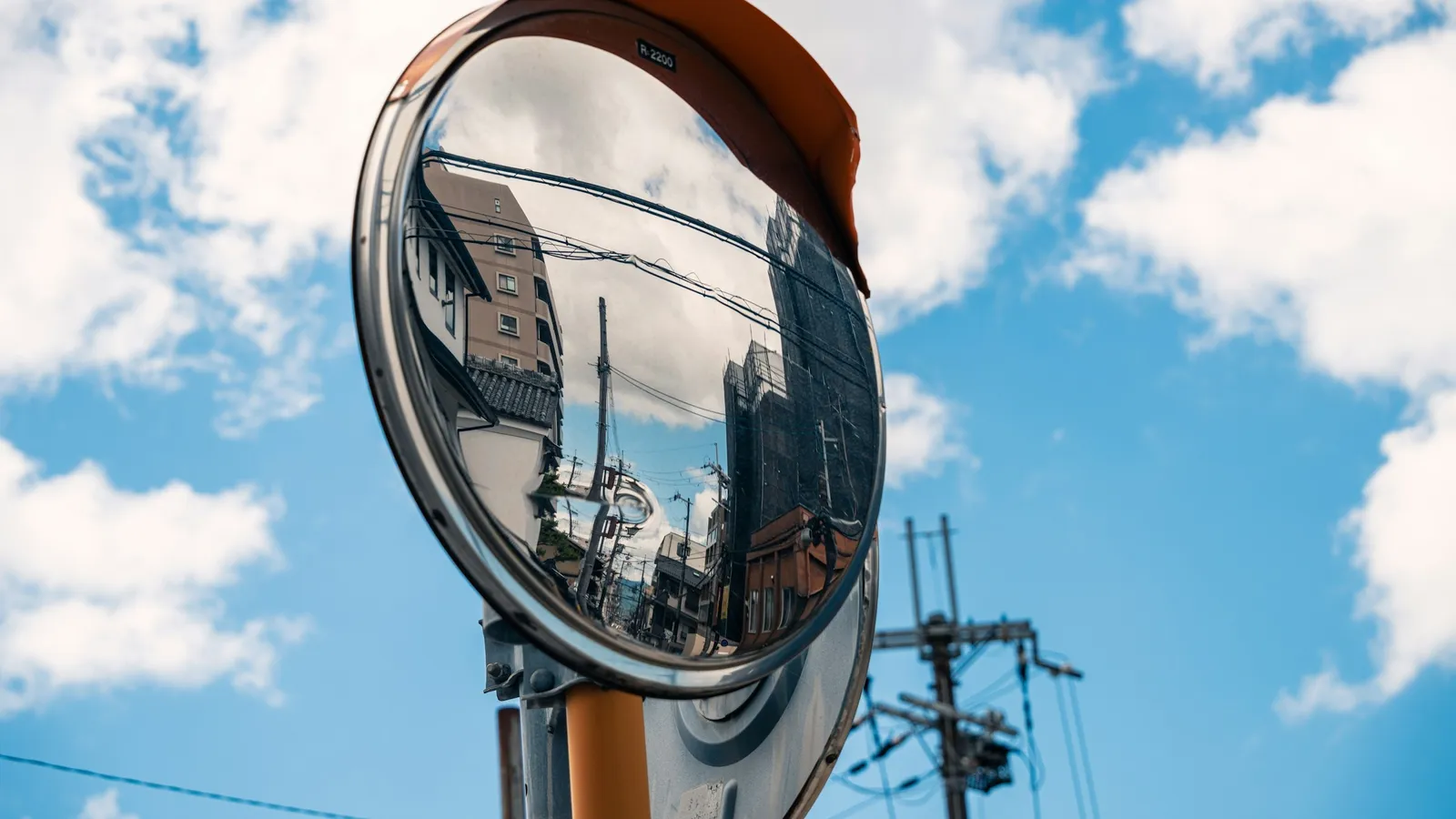
A convex mirror curves outwards. It always forms an upright, smaller image and shows a wider area, which is why it is used as a vehicle's side-view mirror and at sharp bends on roads.
The book notes that lateral inversion, left appearing as right, is seen in all three types of mirror. When parallel beams hit a concave mirror they converge, and on a convex mirror they spread out.
What are lenses?
A lens is a piece of transparent material with curved surfaces. Unlike a mirror, it lets light pass through. A convex lens is thicker in the middle than at the edges; a magnifying glass is one. A concave lens is thicker at the edges.
Worked example 1: an angle given from the mirror
A ray strikes a plane mirror making an angle of 25° with the mirror's surface. Find the angle of reflection and the angle between the incident and reflected rays.
The normal is at 90° to the mirror, so the angle of incidence = 90° − 25° = 65°.
By the first law, the angle of reflection = 65°.
Angle between incident and reflected rays = 65° + 65° = 130°.
The trap is to answer 25°. That is the angle with the mirror, not the normal.
Worked example 2: two mirrors at an angle
The older chapter has you hinge two plane mirrors at a right angle and count the images of a coin. A useful rule is: number of images = (360° ÷ angle between mirrors) − 1, which works cleanly when 360° divided by the angle gives an even number.
At 90°: 360 ÷ 90 = 4, so 4 − 1 = 3 images. This matches what you see in the activity.
At 60°: 360 ÷ 60 = 6, so 6 − 1 = 5 images.
The same idea of repeated reflections is used in a kaleidoscope, which the older chapter shows you how to make.
Which mistakes cost marks?
Measuring angles from the mirror instead of the normal.
Mixing up concave and convex uses. Headlights and dentists use concave mirrors; side-view mirrors use convex.
Forgetting the second law. It is a full law, not a side note.
Thinking curved mirrors break the laws. They follow both laws at every point.
A practice routine for this chapter
Day 1: Draw a ray diagram for i = 40° and label the normal and both angles.
Day 2: Look at a steel spoon from both sides. Note where the image is upright, enlarged or smaller, and which side acts as concave and which as convex.
Day 4: Solve: a ray makes 50° with the mirror. Find i, r and the angle between the rays (answers: 40°, 40°, 80°).
Day 7: Explain to someone why trucks use convex side mirrors.
When ray diagrams feel abstract, the Fermi Simulation Lab has interactive simulations for ideas that are easier to see than read. When you reach Class 10, our guide to reflection and refraction takes the next step.
Tonight, draw one ray diagram with a protractor and check that your two angles match.


