On this page
If you can draw ethane's Newman projection, butane is the same picture with one hydrogen on each carbon swapped for a methyl group. Now the two CH3 groups can sit far apart, side by side, or directly in line, and each arrangement costs a different amount of energy. Below you will draw the four forms, rank them, and rebuild each energy from four small numbers. If ethane is still shaky, start with our guide to ethane's staggered and eclipsed Newman projections.
What are the conformations of n-butane?
A conformation is one of "the different arrangements of atoms that result from bond rotation", as OpenStax Organic Chemistry, section 3.6 defines it. For butane we look straight down the C2–C3 bond. The front carbon (C2) is the centre of a circle, the back carbon (C3) hides behind it, and each carries one CH3 and two H.
Track the dihedral angle between the two CH3 groups as you turn the back carbon:
180°, anti: the methyls point in opposite directions, as far apart as possible.
120°, eclipsed: each methyl lines up behind or in front of a hydrogen.
60°, gauche: staggered, but the two methyls are neighbours.
0°, fully eclipsed: methyl sits directly in front of methyl.
Keep turning and 240° is eclipsed again and 300° is gauche again. One full turn passes through anti once, gauche twice, eclipsed twice and fully eclipsed once.
To draw them in an exam, put the three front bonds as a Y meeting at the centre and the three back bonds coming out from the rim. In staggered forms (anti, gauche) each back bond sits halfway between two front bonds. In eclipsed forms the back bonds sit directly behind the front ones; draw them slightly offset so the examiner can see both.
Why is anti butane more stable than gauche?
Two kinds of strain decide the order. Torsional strain is the extra energy of eclipsed bonds: ethane has a 12 kJ/mol barrier to rotation, about 4.0 kJ/mol for each H–H eclipsing, according to OpenStax section 3.6. Steric strain is "the repulsive interaction that occurs when atoms are forced closer together than their atomic radii allow", in the words of OpenStax section 3.7.
Gauche butane has no eclipsed bonds, so it has no torsional strain. What it has is two bulky methyls only 60° apart, and that crowding makes gauche 3.8 kJ/mol higher in energy than anti, per OpenStax section 3.7. Anti has neither problem, which is why it is the lowest-energy form.
How do you calculate the energy of each butane conformation?
OpenStax section 3.7 lists the cost of each interaction:
H/H eclipsed: 4.0 kJ/mol, torsional strain.
H/CH3 eclipsed: 6.0 kJ/mol, mostly torsional strain.
CH3/CH3 eclipsed: 11 kJ/mol, torsional and steric strain.
CH3/CH3 gauche: 3.8 kJ/mol, steric strain.
Now count what you see in each Newman drawing and add:
Eclipsed (120°): two H/CH3 pairs and one H/H pair, so 6.0 + 6.0 + 4.0 = 16 kJ/mol.
Fully eclipsed (0°): one CH3/CH3 pair and two H/H pairs, so 11 + 4.0 + 4.0 = 19 kJ/mol.
Gauche (60°): nothing eclipsed, one CH3/CH3 gauche contact, so 3.8 kJ/mol.
Anti (180°): no strain beyond the reference, so 0.
Both eclipsed totals match the values OpenStax reports, 16 and 19 kJ/mol. Count the pairs in your own drawing, then add; the same bookkeeping works for propane, 2-methylbutane and other open-chain alkanes.
What does the butane energy diagram look like?
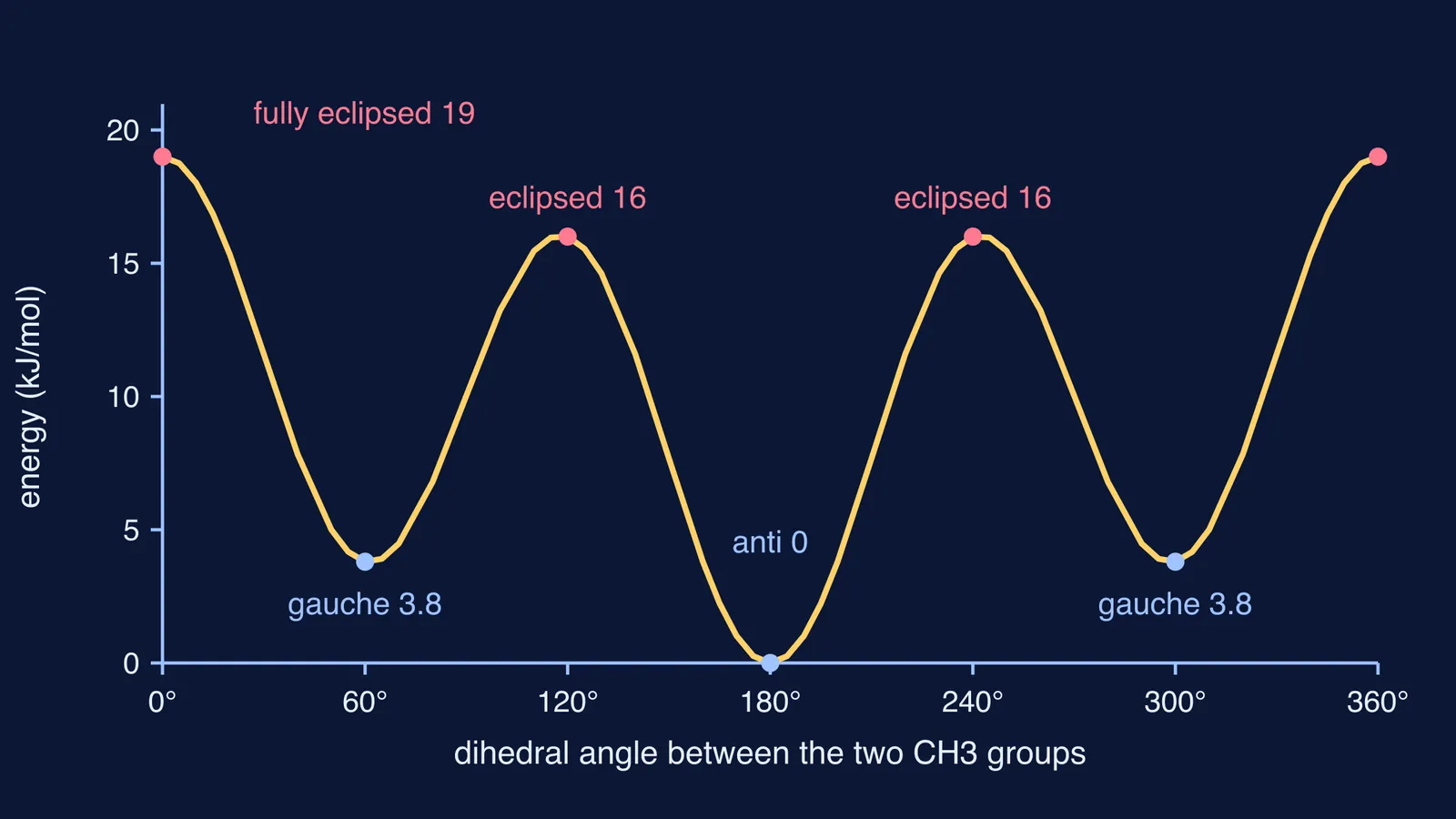
Plot energy against the dihedral angle and you get the curve in the diagram at the top of this post. It starts at 19 kJ/mol at 0°, falls to 3.8 at 60°, rises to 16 at 120° and drops to 0 at 180°, then repeats in mirror image back to 360°. The three valleys are the staggered forms and the three peaks are the eclipsed forms, all with values from OpenStax section 3.7.
These barriers are low, so the forms turn into one another constantly; OpenStax notes that "all conformers are in equilibrium", with a larger share of molecules in the more stable one. For a rough share, use the Boltzmann factor for the 3.8 kJ/mol gap at 298 K: each gauche form is e^(−3800 / (8.314 × 298)) ≈ 0.22 times as populated as anti. There are two gauche forms, so anti holds about 1 / (1 + 0.43) ≈ 70% of molecules. This quick estimate ignores finer effects, but it shows why "most stable" does not mean "only".
Because they interconvert so fast, butane's conformers cannot be isolated and kept in separate bottles. If that distinction trips you up, read conformation vs configuration. Strain bookkeeping also explains rings: see why angle strain makes cyclopropane so reactive.
How should you revise butane conformations?
Draw all four Newman forms from memory and label each dihedral angle.
Circle every eclipsed pair and every gauche CH3/CH3 contact.
Add the interaction costs and check you get 0, 3.8, 16 and 19.
Sketch the energy curve from 0° to 360° without looking, peaks and valleys in the right places.
Repeat steps 1 to 3 for 2-methylbutane looking down C2–C3.
If a step stops making sense, the Fermi Concept Library covers every concept in chemistry, and the Fermi Problem Library has worked problems with a step-by-step solver that explains the reasoning rather than printing an answer.