

On this page
In organic chemistry, the reactivity of a ring-shaped molecule depends heavily on its geometry. While most open-chain alkanes are quite stable and unreactive, small rings like cyclopropane can pop open easily when exposed to reagents like hydrogen or bromine. To understand why cyclopropane is so much more reactive than a six-carbon ring like cyclohexane, we have to look at the angles between their atoms.
Why does angle strain make cyclopropane unstable?
The carbon atoms in alkanes and cycloalkanes are sp³ hybridized. This means their electron orbitals naturally point toward the corners of a tetrahedron, seeking a bond angle of exactly 109.5° 2).
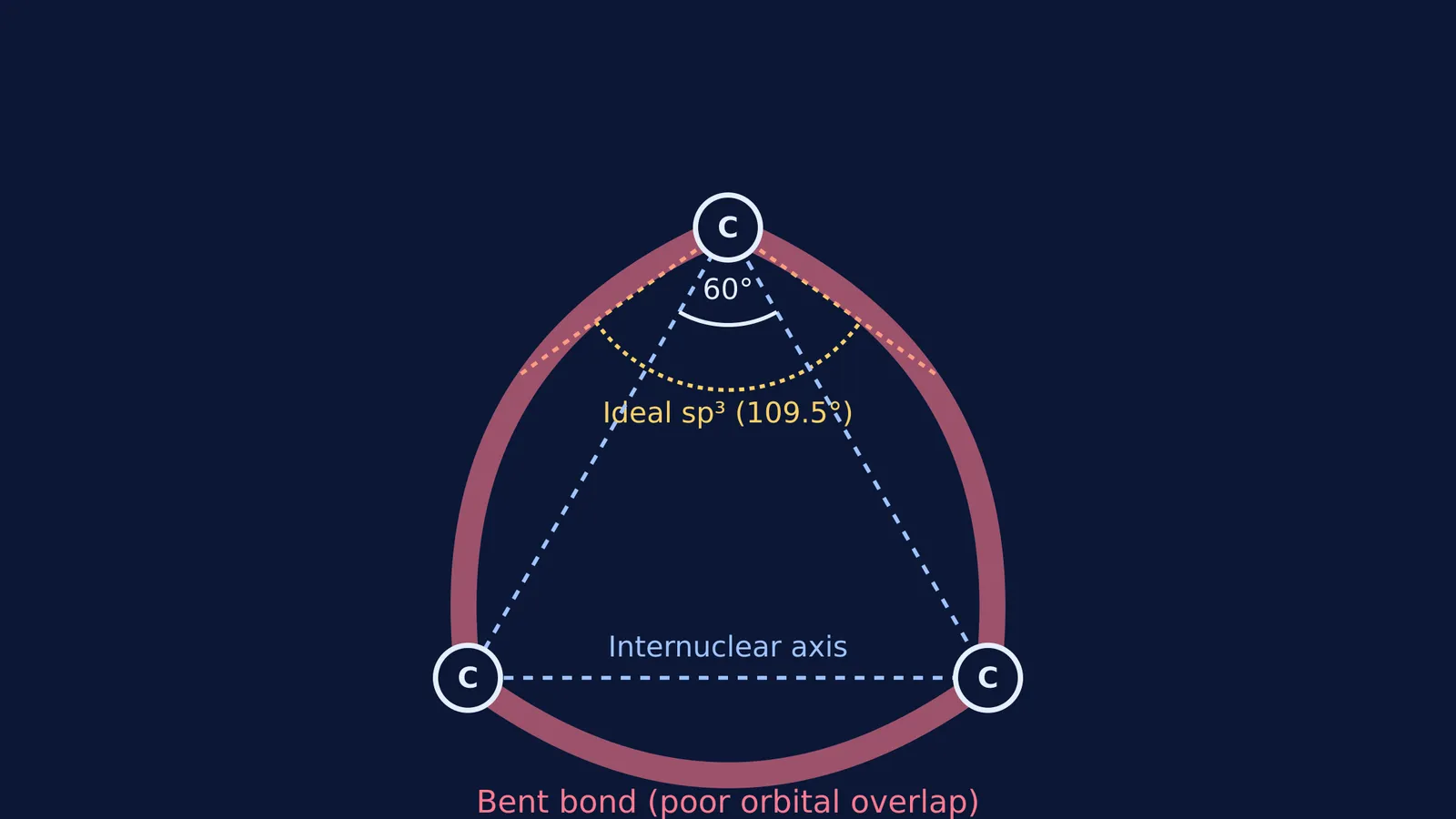
Because cyclopropane (C3H6) has only three carbon atoms, they must sit flat in a single plane, forming an equilateral triangle. Geometry dictates that the angles inside an equilateral triangle are exactly 60° 1. This massive deviation from the preferred 109.5° creates severe instability, which chemists call angle strain, or Baeyer strain (named after the pioneer who first described it, Adolf von Baeyer).
According to the Wikipedia article on Ring Strain, cyclopropane holds 27.5 kcal/mol of strain energy 1. This trapped energy acts like a compressed spring, giving the molecule a strong thermodynamic drive to break its ring and relieve the pressure. When exposed to bromine gas, cyclopropane undergoes a rapid ring-opening addition reaction to form 1,3-dibromopropane. In contrast, an unstrained ring will only react with halogens under harsh conditions to undergo substitution.
What are bent bonds in cyclopropane?
A strong covalent bond forms when two atomic orbitals overlap head-on. But in cyclopropane, the carbon nuclei are separated by a 60° angle 1, while the orbitals are still trying to point outward at roughly 109.5°.
Because the orbitals cannot point directly at each other, they overlap at an angle, bulging outward from the straight line between the two carbon nuclei. These curved regions of electron density are known as "bent bonds" or "banana bonds". Because they do not overlap as effectively as a normal straight sigma bond, bent bonds are weaker and much easier for attacking chemicals to break.
Why is cyclohexane strain-free?
If cyclohexane (C6H12) were a flat, regular hexagon, its internal angles would be 120° 1, which would also cause significant angle strain.
However, cyclohexane does not stay flat. To relieve the pressure, the ring puckers into a 3D zigzag shape, most commonly the "chair conformation". By folding up and down, every single carbon atom in the cyclohexane chair achieves a perfect 109.5° angle.
Because its angles match the ideal tetrahedral geometry exactly, cyclohexane has practically zero angle strain. In fact, its total strain energy is an incredibly low 0.1 kcal/mol 1. Furthermore, just as open-chain alkanes like butane twist into staggered shapes to minimise repulsion, the cyclohexane chair staggers every single one of its C-H bonds, eliminating torsional strain entirely. Without any trapped strain to relieve, cyclohexane is as stable and unreactive as a normal straight-chain alkane.
Mastering ring conformations
Visualising how a flat 2D drawing twists into a 3D puckered shape can be difficult. If you want to explore the chair conformation and see how the angles resolve themselves, you can visit the Concept Library, which covers the geometry of ring systems in detail. And if you are struggling with a tricky problem about relative stabilities or Baeyer strain, Fermi's AI tutor can work out what you already know and draw the molecules step-by-step with you on a shared whiteboard.


