

On this page
Stereochemistry begins with three-dimensional geometry: molecules with identical molecular formulas and atomic connectivity can still arrange their atoms differently in space. According to the IUPAC Compendium of Chemical Terminology, or Gold Book, conformation refers to spatial arrangements of atoms that interconvert simply by rotations about formally single bonds. These non-isolable arrangements are called conformers or rotamers.
By contrast, the IUPAC Gold Book definition of stereochemical configuration denotes the permanent spatial arrangement that distinguishes stereoisomers whose differences are not due to conformational changes. In the stereochemistry recommendations by G. P. Moss in Pure and Applied Chemistry, interconverting configurational isomers requires breaking and reforming covalent bonds. This principle originated when Jacobus Henricus van 't Hoff showed that tetrahedral carbon fixes four bonds in definite directions, as chronicled in our history of Van 't Hoff and the tetrahedral carbon.
Why can enantiomers be isolated while conformers cannot?
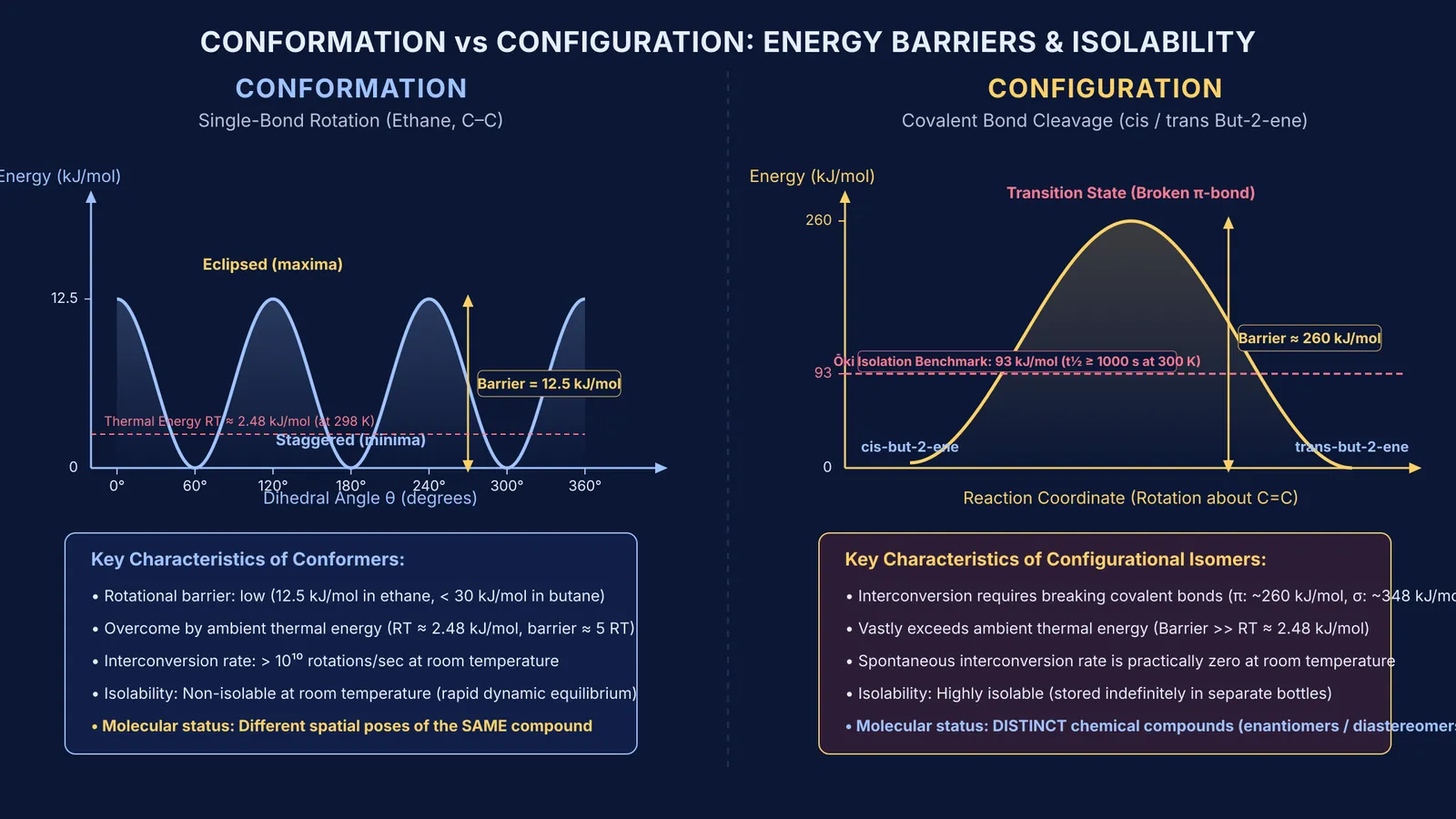
The physical consequence of this bond-breaking divide is isolability. Whether you can store a stereoisomer in a bottle depends on the thermodynamics and kinetics of its interconversion at room temperature. In the NCERT Class 11 Chemistry textbook, thermal energy at 298 K is dictated by RT, roughly 2.48 kJ/mol.
In ethane, the energy difference between the staggered and eclipsed forms is only 12.5 kJ/mol, as catalogued in the same NCERT Class 11 Chemistry curriculum. Because this 12.5 kJ/mol torsional barrier is merely five times thermal RT, ethane rotates tens of billions of times per second. Thermal collisions continuously knock molecules across the barrier, making it impossible to isolate staggered ethane in one flask and eclipsed in another.
Enantiomers and diastereomers follow the opposite rule. As explained in our guide to counting stereoisomers from chiral centres, optical isomers like (R)- and (S)-lactic acid differ in spatial handedness around a chiral carbon. Inverting that stereocenter requires cleaving a carbon-carbon sigma bond, with a dissociation energy of roughly 348 kJ/mol in the NCERT chemistry curriculum. Similarly, cis-trans conversion in but-2-ene requires breaking a pi bond, demanding roughly 260 kJ/mol. Because room-temperature thermal energy of 2.48 kJ/mol cannot break covalent bonds, enantiomers and geometric isomers remain stable indefinitely in separate bottles.
Where does the boundary between conformation and configuration blur?
While single-bond rotation usually produces fleeting conformers, sterically crowded systems create an important bridge: atropisomerism. In ortho-substituted biphenyls or 1,1'-bi-2-naphthol (BINOL), bulky groups collide when the central single bond rotates through a coplanar transition state.
In Topics in Stereochemistry, chemist Michinori Ōki established the benchmark for isolating conformers. Ōki demonstrated that for rotational forms to qualify as isolable atropisomers, they must have a half-life of at least 1000 seconds (about 16.7 minutes) at a given temperature. At 300 K, this corresponds to an activation barrier of approximately 93 kJ/mol. When steric hindrance raises the rotational barrier above 93 kJ/mol, the conformers can be resolved and stored at room temperature, behaving like configurational enantiomers despite no bonds breaking.
Visualizing how steric strain hinders rotation in 3D is challenging on a flat page. The Fermi Simulation Lab provides interactive simulations for ideas that are easier to see than to read, letting you twist dihedral angles and inspect steric clashes in real time.
How do you test whether isomers are conformers or configurations in exams?
In exams like JEE Advanced and NEET-UG, stereochemistry questions often present two projections and ask for their relationship. You can classify any pair using this four-step diagnostic protocol:
Constitution test: Check that both drawings have identical connectivity. If connections differ, they are constitutional isomers, like the butane and isobutane examples in structural isomers of butane.
Bond rotation test: Hold one carbon steady and rotate around the linking single bond. If you can superimpose the structures purely by rotating without detaching atoms, they are conformers (such as anti and gauche butane).
Bond cleavage test: If rotation cannot superimpose them, check if swapping two substituents on a stereocenter interconverts them. If covalent bonds must break, they are configurational isomers.
Symmetry and isolation test: If bonds must break, determine whether they are non-superimposable mirror images (enantiomers) or non-mirror images (diastereomers). If no bonds break but steric bulk raises the rotational barrier past Michinori Ōki's 93 kJ/mol atropisomerism benchmark, classify them as atropisomers.
When tackling complex stereochemistry problems under exam time limits, targeted practice prevents misidentifying 2D projections. The Fermi Problem Library offers worked problems with a step-by-step solver that explains the reasoning rather than printing an answer. To explore how stereoisomerism links to organic mechanisms and thermodynamics, the Fermi Concept Library covers every concept in physics, chemistry, biology, mathematics and computing, each with its own lesson and its place in the map.


