On this page
Roll a marble down a straight ramp, then down a curved one that starts and ends at the same heights. Gravity does exactly the same work on it both times. That fact sits behind most "find the speed at the bottom" questions in Class 11 and JEE Main, and you can prove it in a few lines.
What does path independent mean for gravity's work?
It means the work gravity does between two points depends only on where you start and where you finish, not on the route. OpenStax University Physics states that the work done by a constant force of gravity on an object depends only on the object's weight and the difference in height through which the object is displaced. With y measured upward, that work is W = −mg(y_B − y_A), so for a drop of h it is W = +mgh.
A force with this property is called conservative. In the same textbook's words, the work done by a conservative force is the same for any path connecting two points, and its work around any closed path is zero.
How do you prove it on a straight slope?
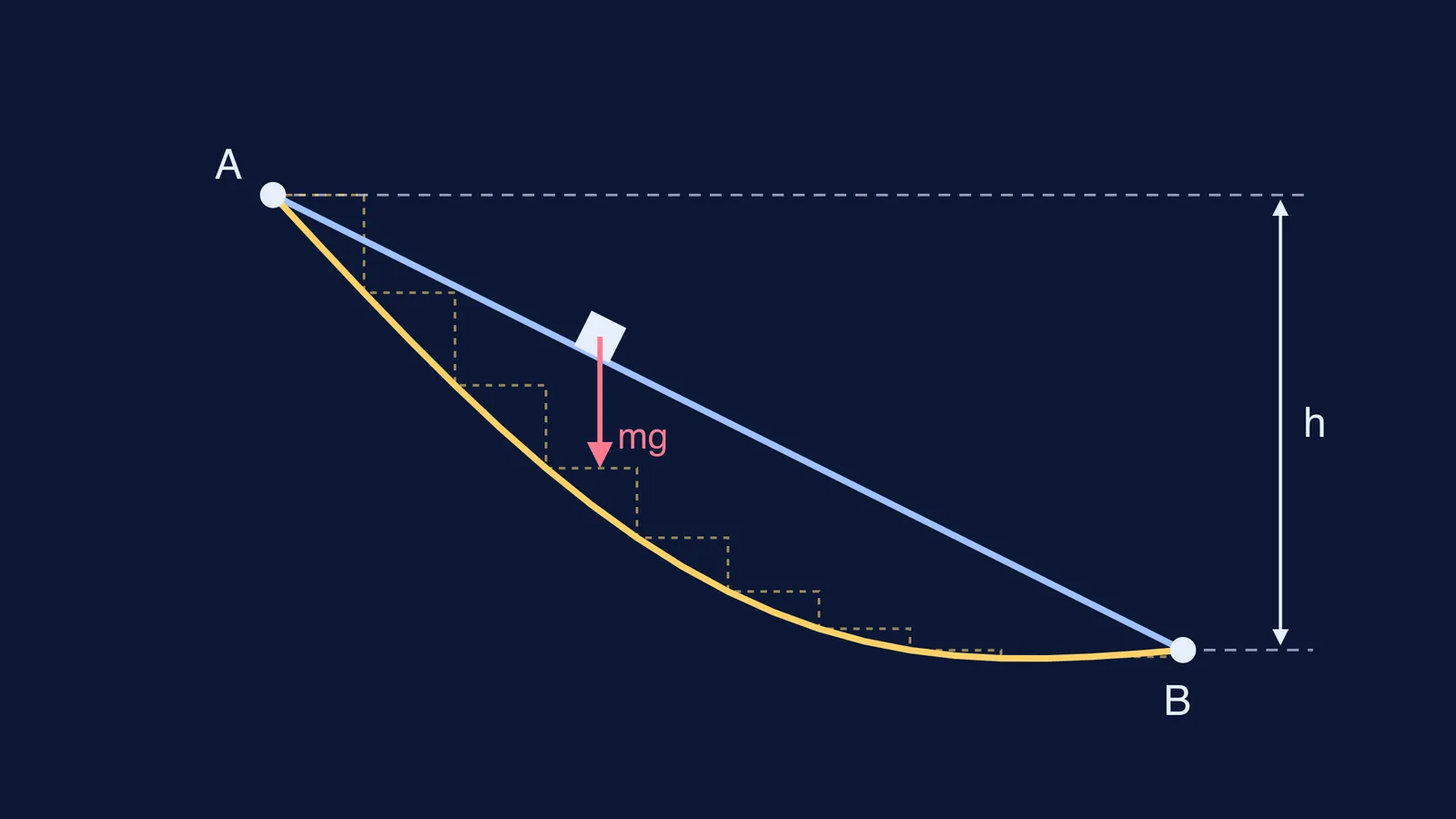
Take a block sliding from A to B down an incline of length L at angle θ to the horizontal. The vertical drop is h = L sin θ.
Gravity is mg, pointing straight down.
The displacement is L, along the slope.
The angle between them is 90° − θ, because the slope is θ from the horizontal and the weight is 90° from it.
Work is force times displacement times the cosine of the angle between them: W = mgL cos(90° − θ).
Since cos(90° − θ) = sin θ, W = mg(L sin θ) = mgh.
A short steep slope and a long gentle one give the same answer for the same h. If the cos(90° − θ) step feels shaky, our post on work done by a force at an angle works through 0°, 60° and 90°.
Why does a curved track give the same answer?
On a curve the angle changes at every point, so one cosine will not do. Instead, cut the path into tiny steps. Each step dr has a horizontal part dx and a vertical part dy, with up as positive. Gravity is −mg in the vertical direction and zero horizontally, so the dot product for one step is dW = F · dr = (0)(dx) + (−mg)(dy) = −mg dy.
The horizontal part contributes nothing, because gravity has no horizontal component. Add the steps from A to B and only the vertical parts survive: W = −mg(y_B − y_A). The shape of the curve never enters. This is the line integral W = ∫ F · dr from OpenStax section 7.1, evaluated for a constant force.
If the track dips below B before rising to it, gravity does extra positive work on the way down and takes exactly that much back as negative work on the way up. The dashed staircase in the diagram above shows the same idea: the flat treads cost nothing, and the risers add up to h.
Worked example: one drop, two tracks
A 2 kg ball starts at rest at A, 5 m above B. Take g = 9.8 m/s², and use W = −mg(y_B − y_A) from OpenStax.
Straight slope at 30°: length L = h / sin 30° = 10 m, so W = mgL cos 60° = 2 × 9.8 × 10 × 0.5 = 98 J.
Curved track of any shape from A to B: W = mgh = 2 × 9.8 × 5 = 98 J.
If both tracks are frictionless, the ball slides without rolling and the normal force is perpendicular to the motion, so it does no work and all 98 J becomes kinetic energy: ½ × 2 × v² = 98, which gives v ≈ 9.9 m/s at B on either track. The arrival time depends on the path; the speed at B does not.
Which forces are not path independent?
Friction is the common exception. Kinetic friction always opposes the motion, so the energy it removes grows with the distance travelled, and a longer path loses more energy. HyperPhysics defines a conservative force as one for which the work done in moving between two points is independent of the path taken, and friction fails that test. That is why "frictionless" matters in the example above, and why leaving out friction's work is among the work-energy mistakes that quietly cost marks.
Path independence is also what lets you define potential energy, with a zero level you are free to pick; see why the zero of potential energy can go anywhere.
To check your reasoning on a track or incline problem, the Fermi Problem Library has worked problems with a step-by-step solver that explains the reasoning rather than printing an answer. To revise conservative forces and potential energy as connected ideas, the Fermi Concept Library gives each concept its own lesson and its place in the map.
Next time a problem shows a twisting track, find the two heights first.