On this page
A gas goes from state A to state B. You are asked for the work done, the heat absorbed and the change in internal energy. Two of those answers depend on how the gas got there; one does not. Knowing which is which settles a whole family of JEE and board questions.
Why do work and heat depend on the path?
The work done by a gas is the area under its curve on a pressure-volume (PV) diagram. Two different curves between the same end points enclose different areas, so they give different work. OpenStax University Physics states it directly: thermodynamic work is path dependent, and you cannot find the work between two equilibrium states without knowing the path.
Heat follows from the first law, ΔU = Q − W, with W the work done by the gas. OpenStax's first-law chapter notes that Q and W both depend on the path, but their difference Q − W does not. If W changes from one path to another and ΔU does not, Q has to change by exactly the same amount.
Why is internal energy a state function?
A state function is a quantity whose value depends only on the state of the system, not on how it reached that state; OpenStax gives internal energy and potential energy as examples.
For an ideal gas the reason is concrete. Its internal energy depends only on temperature, so ΔU = nCvΔT holds for any process, as OpenStax's chapter on heat capacities shows. Fix the start and end states and you have fixed both temperatures, and so ΔU. If you want the longer version of that argument, read why ΔU = nCvΔT holds for every ideal gas process.
Think of a trek: the height gained from base camp to summit is fixed, but the distance walked depends on the trail. Height is like U; distance is like W.
Worked example: three paths, one ΔU
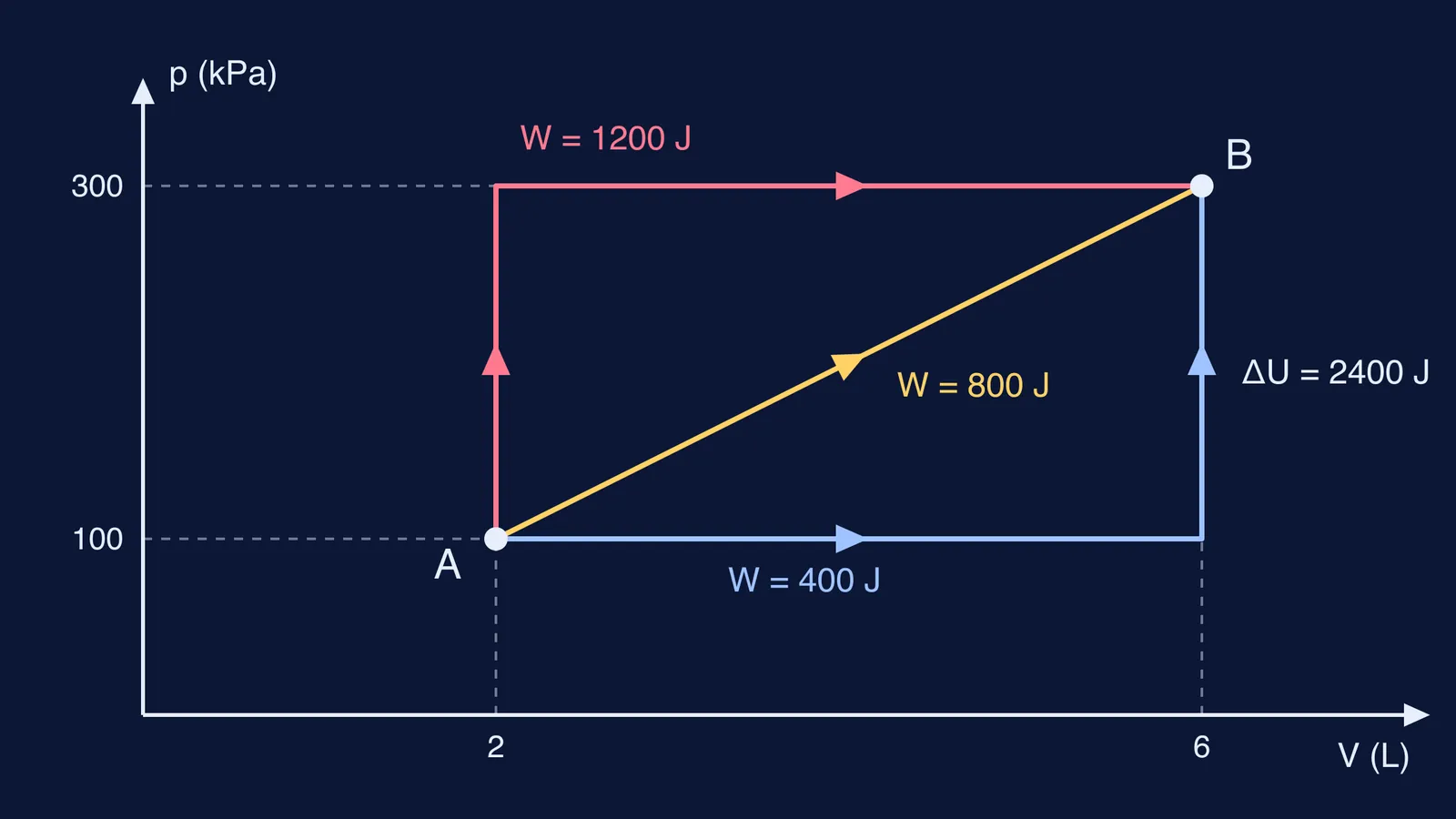
Take a monatomic ideal gas, for which Cv = (3/2)R and Cp = (5/2)R (OpenStax). It starts at A (100 kPa, 2 L) and ends at B (300 kPa, 6 L). A useful shortcut: 1 kPa × 1 L = 1 J, and since pV = nRT, ΔU = (3/2)Δ(pV).
At A, pV = 200 J. At B, pV = 1800 J. So ΔU = (3/2)(1800 − 200) = 2400 J, whichever path the gas takes.
Up, then across. Raise pressure at constant volume to 300 kPa (no work), then expand at 300 kPa from 2 L to 6 L. W = 300 × 4 = 1200 J. Q = ΔU + W = 3600 J.
Straight line from A to B. The area under it is a trapezium: W = (100 + 300)/2 × 4 = 800 J. Q = 3200 J.
Across, then up. Expand at 100 kPa from 2 L to 6 L, then raise pressure at constant volume. W = 100 × 4 = 400 J. Q = 2800 J.
Check path 3 the long way. The isobaric step takes pV from 200 J to 600 J, so Q = (5/2)(400) = 1000 J. The isochoric step takes pV from 600 J to 1800 J, so Q = (3/2)(1200) = 1800 J. Total 2800 J, matching the first-law answer.
Work ranges from 400 J to 1200 J and heat from 2800 J to 3600 J, yet Q − W is 2400 J every time.
To practise the sign side of this, work through these first-law ΔU = q + w numericals.
What happens when the path is a closed loop?
Go out by path 1 and come back along path 3 in reverse, and the gas ends where it started, so ΔU = 0 and Q = W for the cycle. The loop runs clockwise, so the net work done by the gas is positive and equals the enclosed area: 1200 − 400 = 800 J. Our guide to reading net work from the loop on an indicator diagram covers clockwise versus anticlockwise loops.
A four-step check for any PV question
Mark the start and end states. Find ΔU from them alone (nCvΔT, or (3/2)Δ(pV) for a monatomic gas).
Find W as the signed area under the path: positive when volume increases, zero at constant volume.
Get Q from the first law, never by guessing.
If two paths share the same end points, check that Q − W is the same for both. If not, an area or a sign is wrong.
If a question goes wrong at step 2 or 3, the Fermi Problem Library has worked problems with a step-by-step solver that explains the reasoning rather than printing an answer. And when a PV diagram is easier to see than to read, the Fermi Simulation Lab has interactive simulations for exactly that kind of idea.
Next time a question gives you two routes between the same states, compute ΔU first. It is the one number the route cannot change.