

On this page
When students first encounter heat capacities in Class 11 physics, molar heat capacity at constant volume, Cv, is introduced through an isochoric process. At constant volume, the work done dW = P dV is zero. By the First Law of Thermodynamics, dQ = dU + dW, so heat supplied directly equals internal energy change: dQ = n Cv dT = dU.
Because of this derivation, many students preparing for JEE and NEET assume that Cv applies exclusively when volume is constant. When faced with an isobaric expansion, an isothermal process, or an adiabatic change, they hesitate to use n Cv ΔT, asking how a constant-volume parameter can apply when volume changes.
This confusion stems from viewing Cv merely as heat transfer rather than as a fundamental state property. Thermodynamically, Cv is the partial derivative of internal energy with respect to temperature at constant volume: Cv = (1/n) (∂U/∂T)_v. While heat transfer Q depends on the path, internal energy U is a state function. In the Fermi Concept Library, which maps every concept in physics, chemistry, biology, mathematics and computing, students can explore how state functions and path functions differ across thermal physics.
Why is internal energy a function of temperature alone?
To see why Cv applies to every ideal gas process, examine the gas at the molecular scale. In the kinetic theory of gases, an ideal gas consists of point particles with zero intermolecular forces. Because there are no intermolecular attractions or repulsions, internal potential energy Up is zero.
Internal energy U therefore consists entirely of molecular kinetic energy. By the equipartition theorem, each active degree of freedom contributes (1/2) k_B T of energy per molecule, where k_B is Boltzmann's constant and T is temperature in kelvins. For one mole of gas with f degrees of freedom, the molar internal energy is U_m = (f/2) R T, where the universal gas constant R = 8.314 J/(mol·K) (CODATA, NIST). Internal energy depends strictly on temperature, independent of volume or pressure.
James Prescott Joule verified this property in 1845. In his paper published in the *Philosophical Magazine* (Joule, 1845), Joule connected two copper vessels—one with air at 22 atmospheres and one evacuated—in a water bath. Opening the valve let the gas expand freely into the vacuum without doing work (W = 0) and without exchanging heat (Q = 0). The bath temperature did not change, confirming that (∂U/∂V)_T = 0. We discuss this experiment in our guide to the free expansion of an ideal gas.
How does the state function property prove ΔU = nCvΔT?
Writing internal energy as a function of temperature and volume, U = U(T, V), gives the total differential:
dU = (∂U/∂T)_v dT + (∂U/∂V)_T dV
Because Joule's law establishes that (∂U/∂V)_T = 0 for an ideal gas, the volume term drops out completely:
dU = (∂U/∂T)_v dT = n Cv dT
Integrating between initial temperature T1 and final temperature T2 yields:
ΔU = ∫ n Cv dT = n Cv ΔT
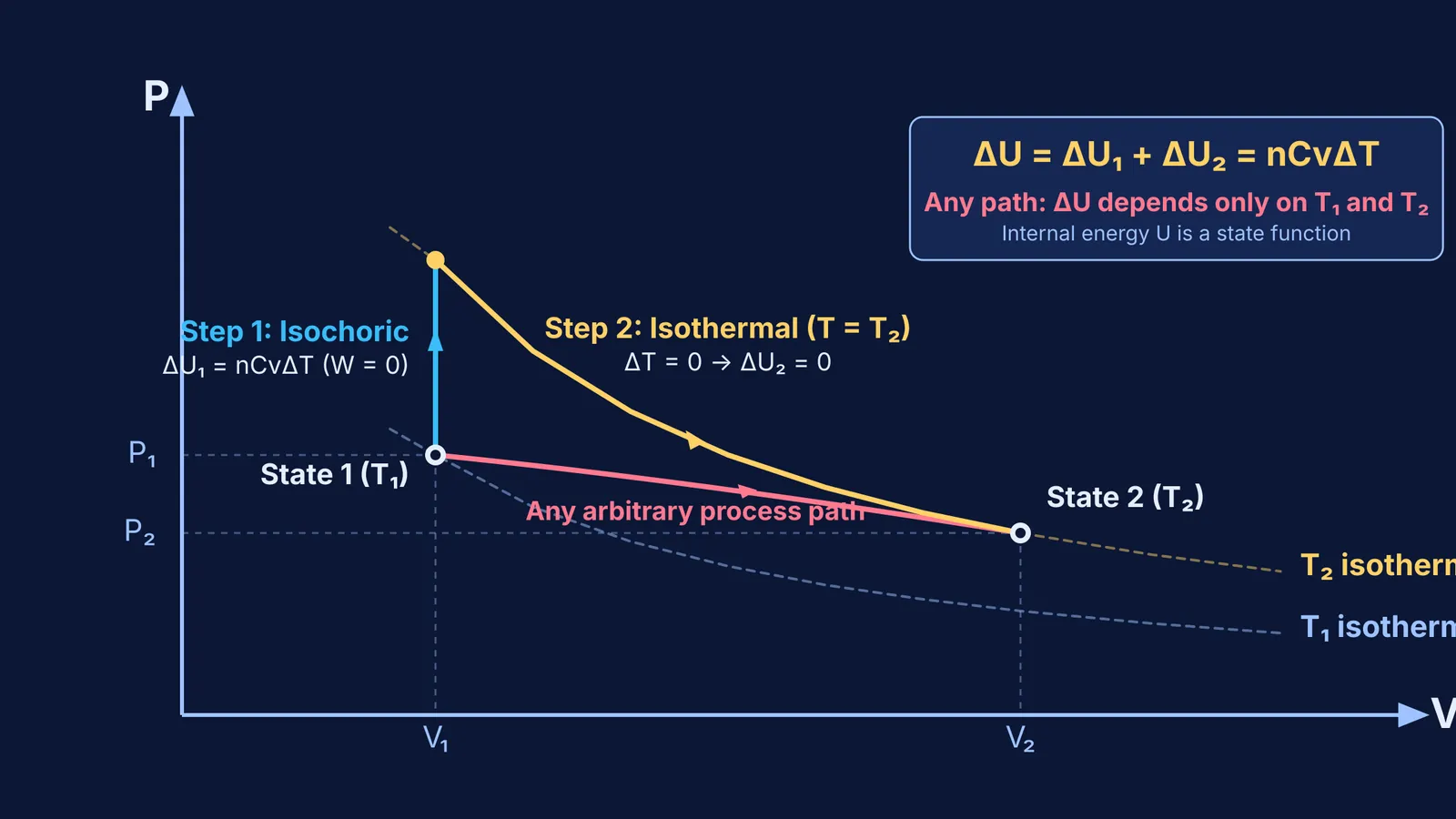
Because U is a state function, ΔU depends only on initial and final states. On an indicator diagram, any arbitrary process between State 1 (P1, V1, T1) and State 2 (P2, V2, T2) can be replaced by an equivalent two-step path:
An isochoric step from (P1, V1, T1) to (P_mid, V1, T2), where ΔU_1 = n Cv (T2 - T1).
An isothermal step from (P_mid, V1, T2) to (P2, V2, T2), where ΔU_2 = 0 because temperature is constant.
The total change is ΔU = ΔU_1 + ΔU_2 = n Cv ΔT + 0 = n Cv ΔT. Any path connecting the same isotherms shares this value, as shown in our guide to degrees of freedom in the kinetic theory of gases.
How does this work in an isobaric expansion?
To see why Cv governs internal energy during expansion, consider an isobaric example from the NCERT Class 11 Physics curriculum. Suppose 1.0 mole of a monatomic gas (f = 3, Cv = 1.5 R, Cp = 2.5 R) expands at 1.0 × 10⁵ Pa from 0.020 m³ to 0.040 m³.
From PV = nRT, the initial and final temperatures are T1 ≈ 240.56 K and T2 ≈ 481.12 K, giving a temperature rise of ΔT = 240.56 K.
Now calculate the energy exchanges:
Work done: W = P ΔV = 1.0 × 10⁵ Pa × 0.020 m³ = 2000 J.
Heat absorbed: Q = n Cp ΔT = 1.0 mol × 2.5 × 8.314 J/(mol·K) × 240.56 K = 5000 J.
Internal energy from the First Law: ΔU = Q - W = 5000 J - 2000 J = 3000 J.
Computing ΔU directly with our formula yields: ΔU = n Cv ΔT = 1.0 mol × 1.5 × 8.314 J/(mol·K) × 240.56 K = 3000 J.
Both calculations agree. The heat supplied (5000 J) exceeds ΔU because 2000 J is spent on expansion work. This difference is Mayer's relation, Cp - Cv = R, established by Julius Robert von Mayer in 1842 (Mayer, 1842). For more examples, see our guide to heat in isobaric and isochoric processes.
When solving thermodynamic cycles, distinguishing state functions from path variables avoids calculation traps. The Fermi Problem Library provides worked problems with a step-by-step solver that explains the reasoning rather than printing an answer, helping students master physical fundamentals before exam day.


