

On this page
According to a 2004 study published in the American Journal of Physics, only 20% or fewer of university physics students were able to make effective use of the first law of thermodynamics after instruction. The confusion often stems from the competing definitions of heat and work.
In chemistry, solving First Law of Thermodynamics numericals requires a firm grasp of the IUPAC sign convention. Once you understand what the signs physically represent, predicting whether internal energy increases or decreases becomes intuitive.
The IUPAC sign convention: ΔU = q + w
In older physics textbooks, work is often defined as work done *by* the system. However, the modern standard in chemistry follows the IUPAC (International Union of Pure and Applied Chemistry) convention.
Under the IUPAC Gold Book definition for heat, heat (q) is positive when energy is transferred to the system from the surroundings. When the system releases heat (an exothermic process), q is negative.
Similarly, the IUPAC Gold Book defines work (w) as positive when work is done *on* the system by the surroundings. When the system does work on the surroundings, w is negative.
Because both heat added to the system and work done on the system increase its internal energy (ΔU), the First Law of Thermodynamics is written as:
ΔU = q + w
If you are exploring the concepts behind the state functions that govern these changes, the Fermi Concept Library maps out internal energy, enthalpy and entropy.
Gas expansion vs compression
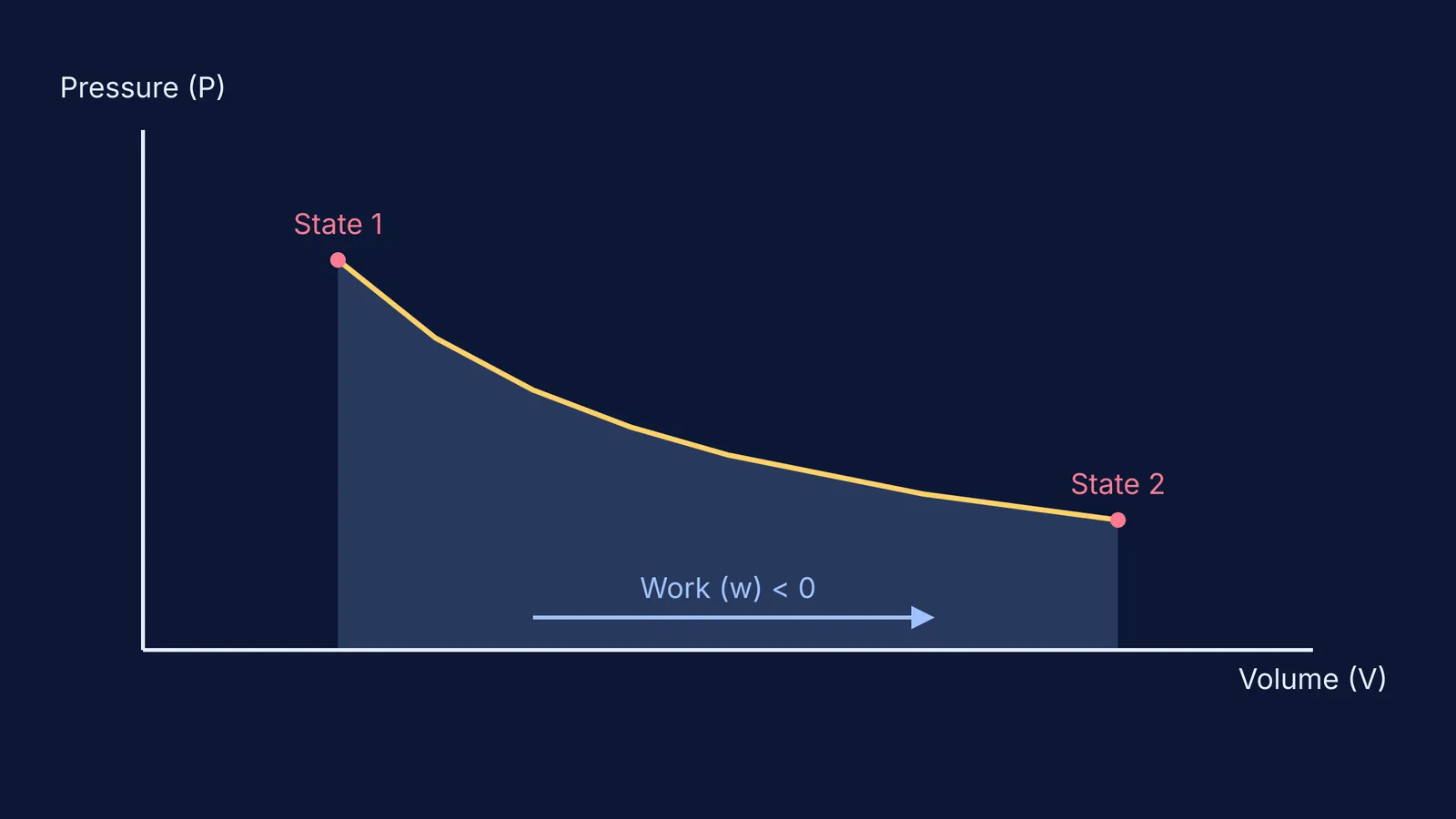
In chemical thermodynamics, work is most frequently P-V work, which occurs when a gas changes volume against an external pressure. The formula for this work is w = −P_ext ΔV.
When a gas expands, its volume increases (ΔV > 0), making the work negative (w < 0). This makes physical sense under the IUPAC convention: the gas is spending energy to push the surroundings away, so energy leaves the system.
When a gas is compressed, its volume decreases (ΔV < 0), making the work positive (w > 0). The surroundings are forcing energy into the system. If the gas expands into a vacuum where P_ext = 0, you have a free expansion of an ideal gas: why work and ΔU are both zero.
Which of the four sign combinations do students mix up?
Many students correctly memorise ΔU = q + w but struggle to predict whether the internal energy will rise or fall when heat and work have opposite signs.
Heating and compressing (q > 0, w > 0): Heat is added and the surroundings do work on the gas. Both processes add energy, so ΔU definitively increases.
Cooling and expanding (q < 0, w < 0): Heat is lost and the gas does work on the surroundings. Both processes remove energy, so ΔU definitively decreases.
Heating and expanding (q > 0, w < 0): You supply heat, but the gas uses some or all of it to do work. Does ΔU increase or decrease? It depends on which value has the larger magnitude.
Cooling and compressing (q < 0, w > 0): Heat is removed, but the surroundings add energy by compressing the gas. Again, the sign of ΔU depends entirely on whether the heat lost is greater than the work gained.
How to solve ΔU = q + w numericals?
When tackling exam problems, you must assign the correct signs before putting numbers into the First Law equation. If you are calculating the heat of a reaction at constant volume rather than pressure, you might use a bomb calorimeter: measuring ΔU and converting it to ΔH.
Problem: A gas absorbs 300 J of heat and expands against a constant external pressure of 1 atm, changing its volume from 2 L to 4 L. Find the change in internal energy (ΔU). (Given: 1 L atm ≈ 101.3 J).
Step 1: Determine heat (q) The gas absorbs heat, so energy is entering the system. Therefore, q = +300 J.
Step 2: Determine work (w) The gas expands, so it does work on the surroundings. w = −P_ext ΔV w = −1 atm × (4 L − 2 L) w = −2 L atm Convert this to Joules: w = −2 × 101.3 J = −202.6 J.
Step 3: Calculate ΔU ΔU = q + w ΔU = 300 J + (−202.6 J) = 97.4 J.
The internal energy increases by 97.4 J because the heat added was greater than the energy spent on expansion.
When these concepts are tested graphically, you will need to find the net work in a cycle: reading the loop on an indicator diagram. For more practice with thermodynamics sign conventions, you can use the Fermi Problem Library, where the step-by-step solver explains the reasoning behind each formula and keeps your signs straight.


