

On this page
Ethyne (acetylene) is the simplest alkyne, containing a carbon-carbon triple bond and linear geometry. In school laboratories, ethyne is generated on demand by hydrolysing solid calcium carbide rather than drawn from compressed cylinders. Mastering this preparation requires controlling the vigorous reaction, scrubbing gaseous impurities, and verifying gas purity through confirmatory tests.
How does calcium carbide react with water to yield ethyne?
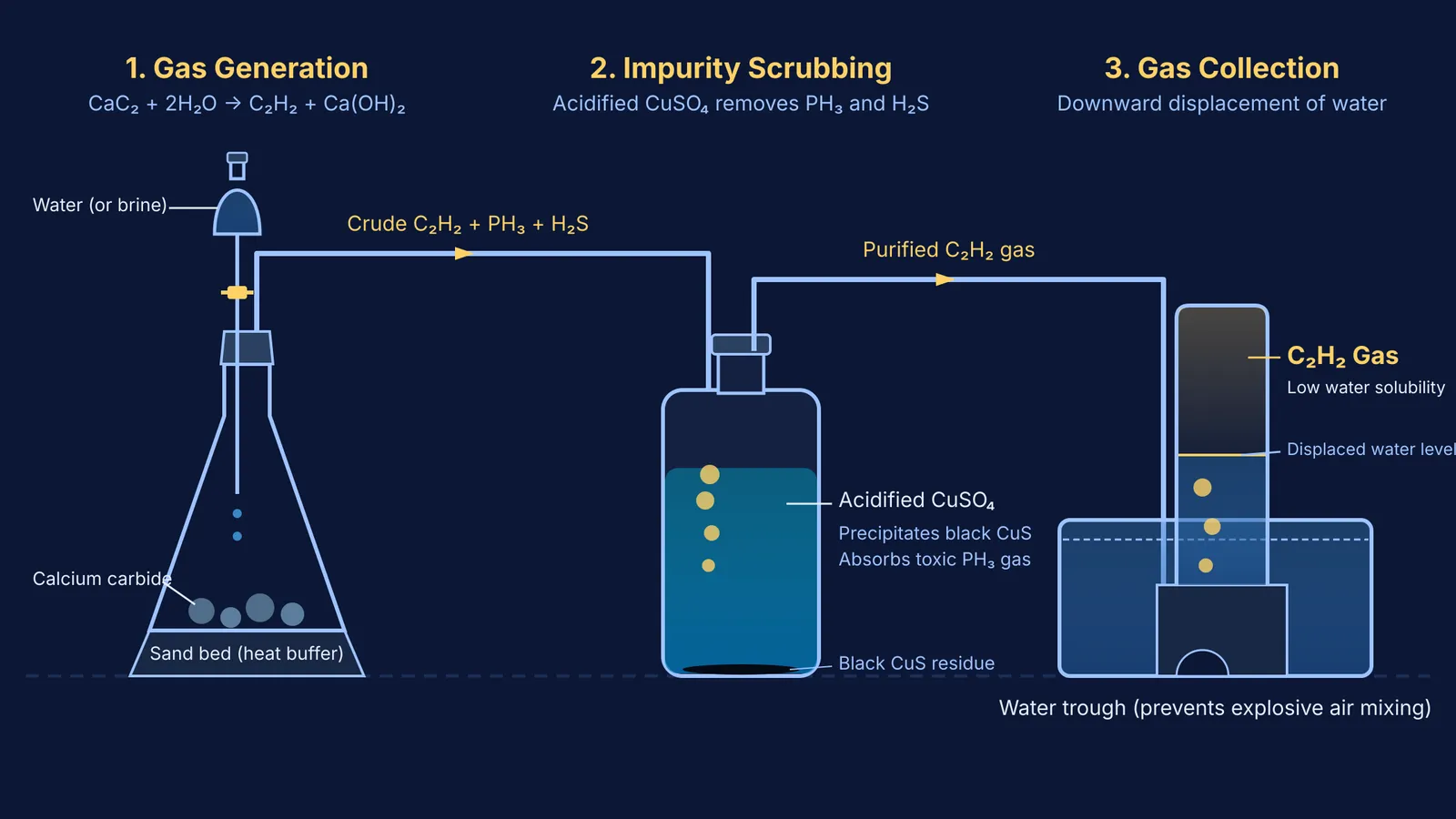
The primary reaction is the hydrolysis of solid calcium carbide by cold water. Calcium carbide (CaC₂) contains calcium cations (Ca²⁺) and dicarbide acetylide anions ([C≡C]²⁻). Water transfers protons rapidly to the carbide, producing ethyne gas and calcium hydroxide:
CaC₂(s) + 2H₂O(l) → Ca(OH)₂(aq) + C₂H₂(g)
As documented in Crawford and Kiefer, 2016 in the *Journal of Chemical Education*, this hydrolysis is strongly exothermic. To protect glassware from cracking, lump carbide sits on a layer of clean, dry sand inside a flat-bottomed flask.
Water is added dropwise from a dropping funnel with a stopcock to regulate gas evolution. Saturated sodium chloride solution (brine) is often used instead of pure water to moderate the reaction rate. Stoichiometrically, 64.10 g of pure calcium carbide yields 26.04 g of ethyne (documented in the NIST Chemistry WebBook), occupying 22.4 L at standard temperature and pressure. This builds directly upon principles in homologous series and carbon compounds.
Why does crude ethyne smell of garlic, and how is it scrubbed?
According to data compiled in PubChem, pure ethyne is a colourless gas with a faint ethereal odour. In the laboratory, however, the evolved gas carries a sharp, garlic-like smell.
This odour comes from impurities in commercial calcium carbide. Produced by heating quicklime with coke in an electric arc furnace at approximately 2,000 °C, commercial carbide contains trace calcium phosphide (Ca₃P₂) and calcium sulphide (CaS). These impurities hydrolyse alongside carbide:
Ca₃P₂(s) + 6H₂O(l) → 3Ca(OH)₂(aq) + 2PH₃(g)
CaS(s) + 2H₂O(l) → Ca(OH)₂(aq) + H₂S(g)
Phosphine (PH₃) imparts the garlic odour, while hydrogen sulphide (H₂S) adds a rotten-egg smell. Both gases are toxic, and phosphine containing diphosphane can ignite spontaneously in air.
To scrub these contaminants, the crude gas bubbles through acidified copper(II) sulphate (CuSO₄) solution. Copper ions react with hydrogen sulphide to precipitate black copper(II) sulphide:
H₂S(g) + CuSO₄(aq) → CuS(s) + H₂SO₄(aq)
Acidified copper sulphate also absorbs phosphine as copper phosphide while neutralising trace ammonia. Ethyne does not react with the copper solution, emerging purified.
How is ethyne gas collected over water?
Purified ethyne passes through a delivery tube into a pneumatic trough, where it is collected in inverted gas jars by downward displacement of water.
This method works because ethyne is only sparingly soluble in water, dissolving at roughly 1.2 g/L at room temperature, as recorded in PubChem. Ethyne cannot be collected by air displacement: its molar mass (26.04 g/mol) is very close to that of air (28.97 g/mol), and it forms explosive mixtures with air across a wide flammability range from 2.5% to 81% by volume. Collecting over water prevents premature mixing with atmospheric oxygen.
For students balancing gas volumes, reaction stoichiometry, and molar conversions across experiments, the Fermi Problem Library provides worked problems with a step-by-step solver that explains the reasoning rather than printing an answer.
How do you confirm ethyne with bromine and ammoniacal silver nitrate?
Once collected, ethyne is verified through two diagnostic reactions:
Bromine unsaturation test: When ethyne bubbles through reddish-brown bromine in carbon tetrachloride (Br₂ in CCl₄), the colour disappears as bromine adds across the triple bond:
HC≡CH + Br₂ → CHBr=CHBr
CHBr=CHBr + Br₂ → CHBr₂–CHBr₂
This confirms unsaturation, mirroring the addition seen in hydration of alkynes to aldehydes and ketones.
Ammoniacal silver nitrate test: Ethyne's sp-hybridised carbons have 50% s-character, making terminal hydrogens weakly acidic (pKa ≈ 25, as recorded in PubChem). Bubbling ethyne into ammoniacal silver nitrate yields a heavy white precipitate of silver acetylide:
HC≡CH + 2AgNO₃ + 2NH₄OH → Ag–C≡C–Ag(s) + 2NH₄NO₃ + 2H₂O
This reaction distinguishes terminal alkynes from alkenes and internal alkynes, as detailed in our guide on acidity of terminal alkynes.
In a 2023 study in the *Journal of Chemical Education*, Borkar, 2023 demonstrated how controlled calcium carbide hydrolysis dispels fuel misconceptions. To connect reaction pathways with orbital hybridisation diagrams, the Fermi Concept Library covers every concept in chemistry, each with its own lesson and its place in the map.
What laboratory checklist ensures safety and high gas purity?
Following classroom protocols (Crawford and Kiefer, 2016), follow this four-point safety checklist before generating ethyne:
Apparatus setup: Bed the generating flask with 2 cm of clean sand, ensure bungs fit tightly, and extinguish all nearby open flames.
Wash bottle: Fill the bottle with freshly prepared 5% copper(II) sulphate acidified with dilute sulphuric acid, ensuring the inlet dips well below the surface.
Purging air: Add water dropwise from the funnel. Discard the first gas jar collected over water, which contains displaced air from the apparatus.
Disposal: Decompose wet silver acetylide test residues with dilute nitric acid immediately, and quench spent carbide flask residue in excess water under a fume hood.


