On this page
This proof is Question 10 of the Miscellaneous Exercise on Chapter 4, Complex Numbers and Quadratic Equations, in the NCERT Class 11 Mathematics textbook. It looks like heavy algebra, but it is only three moves: expand, match, divide.
What does the question actually ask?
You are told that cubing the complex number x + iy gives u + iv, where x, y, u and v are real. You must show that u/x + v/y = 4(x² − y²). The expression only makes sense when x ≠ 0 and y ≠ 0, because you divide by them, so say so in your first line.
Two facts from the NCERT chapter on complex numbers do most of the work. First, i² = −1, so i³ = −i. Second, two complex numbers a + ib and c + id are equal if a = c and b = d. The same chapter also lists (z₁ + z₂)³ = z₁³ + 3z₁²z₂ + 3z₁z₂² + z₂³ among the identities that hold for all complex numbers, so you may use the ordinary cube expansion.
How do you expand (x + iy)³?
Put z₁ = x and z₂ = iy in the cube identity and simplify one power of i at a time:
(x + iy)³ = x³ + 3x²(iy) + 3x(iy)² + (iy)³
= x³ + 3ix²y + 3x(i²y²) + i³y³
= x³ + 3ix²y − 3xy² − iy³
= (x³ − 3xy²) + i(3x²y − y³)
The last line collects the terms without i into one bracket and the terms with i into another.
How do you match the real and imaginary parts?
You now have (x³ − 3xy²) + i(3x²y − y³) = u + iv. Since x and y are real, both brackets are real numbers, so the left side is already in the form a + ib. Equal complex numbers have equal real parts and equal imaginary parts, so:
u = x³ − 3xy²
v = 3x²y − y³
If this step still feels shaky, our guide to finding x and y by equating real and imaginary parts practises it on simpler, linear examples first.
Why does it simplify to 4(x² − y²)?
Divide each result by the variable it shares:
u/x = (x³ − 3xy²)/x = x² − 3y²
v/y = (3x²y − y³)/y = 3x² − y²
Add them: u/x + v/y = (x² − 3y²) + (3x² − y²) = 4x² − 4y² = 4(x² − y²). Hence proved.
The divisions come out clean for a reason, not by luck. The real part u collects the terms with an even power of iy (the 0th and 2nd), so each of them still has at least one x. The imaginary part v collects the odd powers (the 1st and 3rd), so each has at least one y. Seeing that pattern helps when the exercise is changed to (x + iy)⁵ or (x − iy)³.
How can you check the answer with numbers?
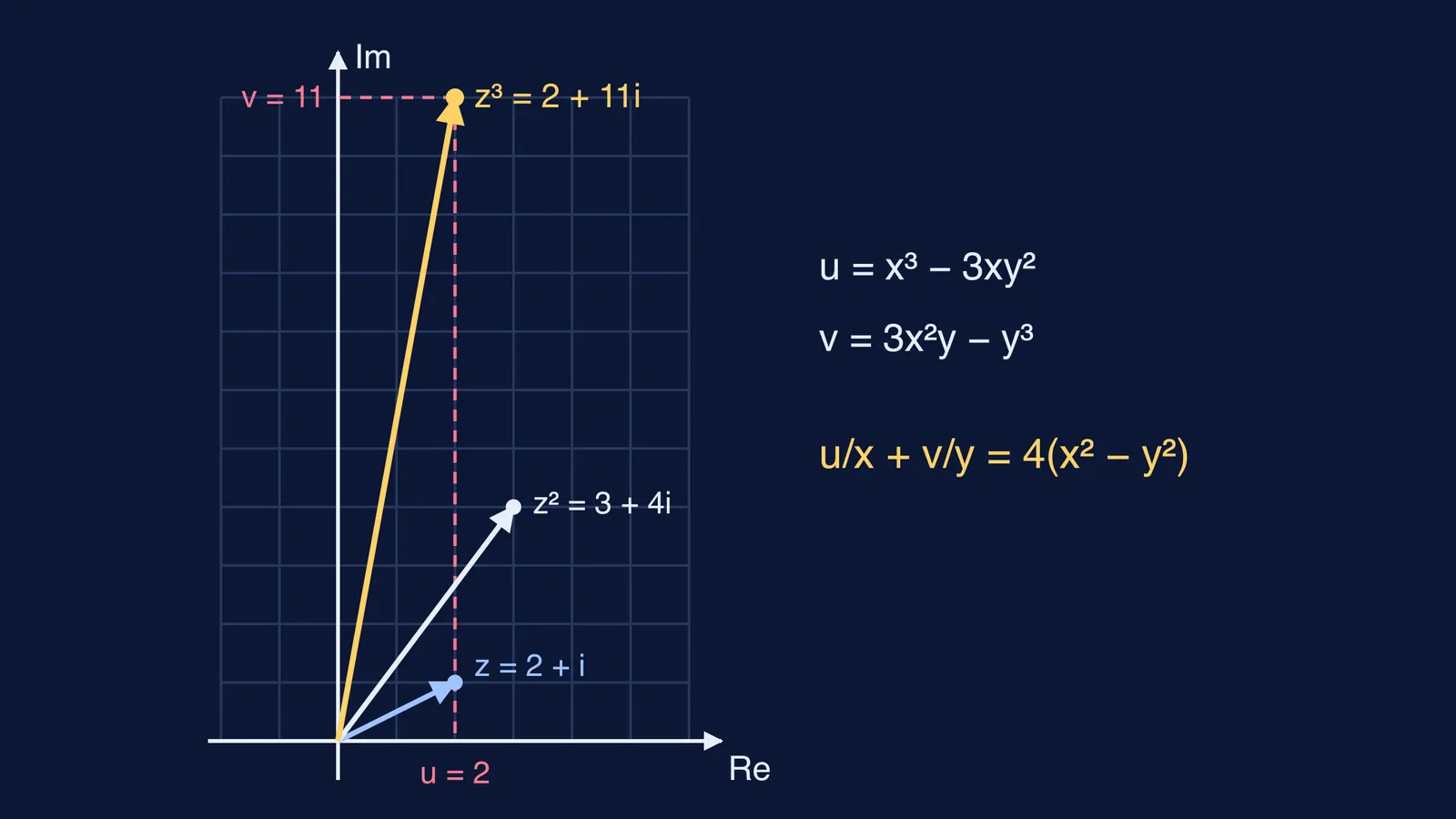
Try x = 2 and y = 1. Then (2 + i)² = 4 + 4i + i² = 3 + 4i, and (2 + i)³ = (3 + 4i)(2 + i) = 6 + 3i + 8i + 4i² = 2 + 11i. So u = 2 and v = 11.
The formulas agree: u = 8 − 6 = 2 and v = 12 − 1 = 11. The left side is 2/2 + 11/1 = 12, and the right side is 4(4 − 1) = 12.
A quick check like this catches a sign error before you hand in the page. The picture at the top plots this example on the Argand plane; for more on reading complex numbers as points and arrows, see complex numbers for JEE as a geometry tool.
What should a complete written answer include?
Use this checklist when you write it out in a test:
State that x ≠ 0 and y ≠ 0.
Write the cube identity before substituting x and iy.
Show i² = −1 and i³ = −i where you use them.
Group the result as a real part plus i times an imaginary part.
Write "equating real and imaginary parts" in words, then give u and v.
Divide, add and factor, and end with the exact expression the question asks for.
The same method, putting z = x + iy and matching parts, solves a whole family of questions; our post on solving equations in complex numbers by putting z = x + iy shows more of them.
When you are stuck on a step, the Fermi Problem Library has worked problems with a step-by-step solver that explains the reasoning rather than printing an answer. If the gap is the idea of a complex number itself, the Fermi Concept Library gives every concept in mathematics its own lesson.
Next time you see a power of x + iy, expand it, match it, divide it, and check it with x = 2, y = 1.