

On this page
When you solve equations involving complex numbers, you often reach a stage where you have an expression with both real and imaginary terms on each side. A single complex equation actually contains two separate pieces of information. To find unknown values like x and y, you turn that one complex equation into two ordinary real equations.
A 2015 study published in the Physics Education Research Conference Proceedings found that 45% of surveyed physics students made basic calculation errors when finding the norm of a complex number (Smith et al., 2015). Keeping your real and imaginary parts strictly separated prevents algebraic slips.
Here is how to extract your unknowns by equating real and imaginary parts.
Why can you equate real and imaginary parts?
A complex number has the form a + ib, where a is the real part and b is the imaginary part. On the Argand plane, a is the horizontal coordinate and b is the vertical coordinate.
Two complex numbers are exactly equal if and only if they represent the exact same point on this two-dimensional plane. Because the real axis (horizontal) and imaginary axis (vertical) are completely independent directions, you cannot use a change in the real part to make up for a difference in the imaginary part. This means their real parts must match exactly, and their imaginary parts must match exactly.
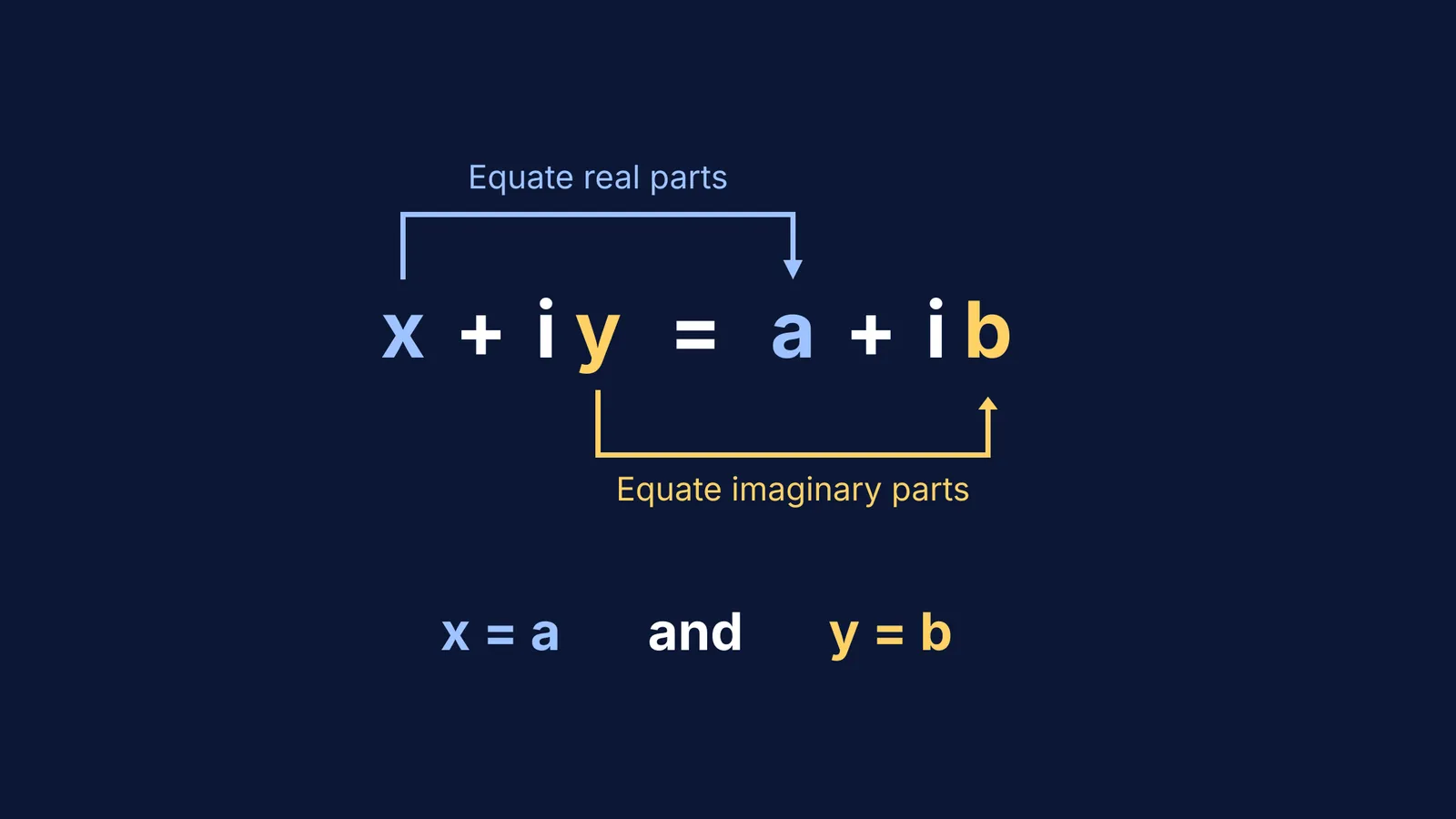
If you have an equation that simplifies to x + iy = a + ib, you can immediately conclude two things: x = a and y = b. This rule allows you to split the equation into two simpler, simultaneous equations. It converts a single, complicated statement in the complex plane into two straightforward algebra problems.
How do you find x and y from a complex equation?
Consider the equation (x + iy)(2 - 3i) = 4 + i.
The goal is to find the real numbers x and y. You cannot just guess the values, because x and y are mixed up with the real numbers (2 and 4) and the imaginary numbers (-3i and i). Your first step is to expand the brackets so you can clearly separate the real parts from the imaginary parts.
Step 1: Expand the expression. Multiply out the brackets to get: 2x - 3ix + 2iy - 3i²y = 4 + i.
Step 2: Apply the i² = -1 rule. This is where students often make mistakes. Replace i² with -1 to remove the squared terms: 2x - 3ix + 2iy - 3(-1)y = 4 + i 2x - 3ix + 2iy + 3y = 4 + i
Step 3: Group the real and imaginary terms. Gather all the terms without an i (the real part) and all the terms with an i (the imaginary part) together: (2x + 3y) + i(-3x + 2y) = 4 + i
Step 4: Equate the parts. Now that the equation is in the standard form, you can separate it into two equations.
Equating the real parts: 2x + 3y = 4
Equating the imaginary parts: -3x + 2y = 1
Step 5: Solve the simultaneous equations. Multiply the first equation by 3 and the second by 2: 6x + 9y = 12 -6x + 4y = 2
Add them together to eliminate x: 13y = 14, which means y = 14/13.
Substitute y back into the first equation: 2x + 3(14/13) = 4 2x + 42/13 = 52/13 2x = 10/13, which means x = 5/13.
The solution is x = 5/13 and y = 14/13.
What are the most common mistakes?
Algebraic slips, like dropping a negative sign or failing to group terms correctly, are common when expanding complex brackets. When you get stuck on an algebra problem, the Fermi Problem Library has worked problems with a step-by-step solver that explains the reasoning rather than printing an answer. It will catch the error and show you exactly where the algebra went wrong.
Whenever you face a single equation with complex components, grouping and equating the parts will break the problem down into manageable real numbers.
To see this method in action, try Solving equations in complex numbers by putting z = x + iy or calculating the Square root of a complex number: the method and JEE uses.


