On this page
A rectangle that sits on the x-axis with its top two corners on a downward parabola is a standard optimisation set-up in Class 12 calculus, and it has appeared in JEE Main. The answer has a pattern worth remembering: the best rectangle is always two-thirds as tall as the parabola's peak. Here is how to get there, and how to check it.
How do you set up the area function?
Use the six-step method in OpenStax Calculus Volume 1, section 4.7 on applied optimisation: name the variables and draw a figure, write the quantity to maximise, reduce it to one variable, fix the domain, then check critical points and endpoints.
Draw y = a − x² with a > 0. It meets the x-axis at x = −√a and x = √a.
The parabola is symmetric about the y-axis, so put the bottom corners at (−x, 0) and (x, 0) and the top corners at (−x, a − x²) and (x, a − x²).
Width = 2x and height = a − x², so A(x) = 2x(a − x²) = 2ax − 2x³.
Domain: 0 < x < √a. At either end the rectangle flattens to zero area, so the maximum must be inside.
A common slip is writing the width as x instead of 2x. Shippensburg University's interactive version of this problem makes the same point: x is the distance from the origin to the lower-right corner, not the length of the base.
Where is the maximum, and how do you know it is one?
Differentiate: A′(x) = 2a − 6x². Setting this to zero gives x² = a/3, so x = √(a/3).
Now check it. A″(x) = −12x, which is negative for every x > 0, so this critical point is a maximum. You can also read it from the sign of A′: positive before √(a/3), negative after. Our post on the first derivative test and sign changes covers that second route.
Substitute back:
half-width x = √(a/3), so the base is 2√(a/3)
height a − a/3 = 2a/3
maximum area 2√(a/3) × 2a/3 = 4a√a/(3√3)
If the second derivative test itself feels shaky, the Fermi Concept Library has a lesson for every concept in mathematics, each with its place in the map, so you can fill that gap before returning to the problem.
What did JEE Main ask about this?
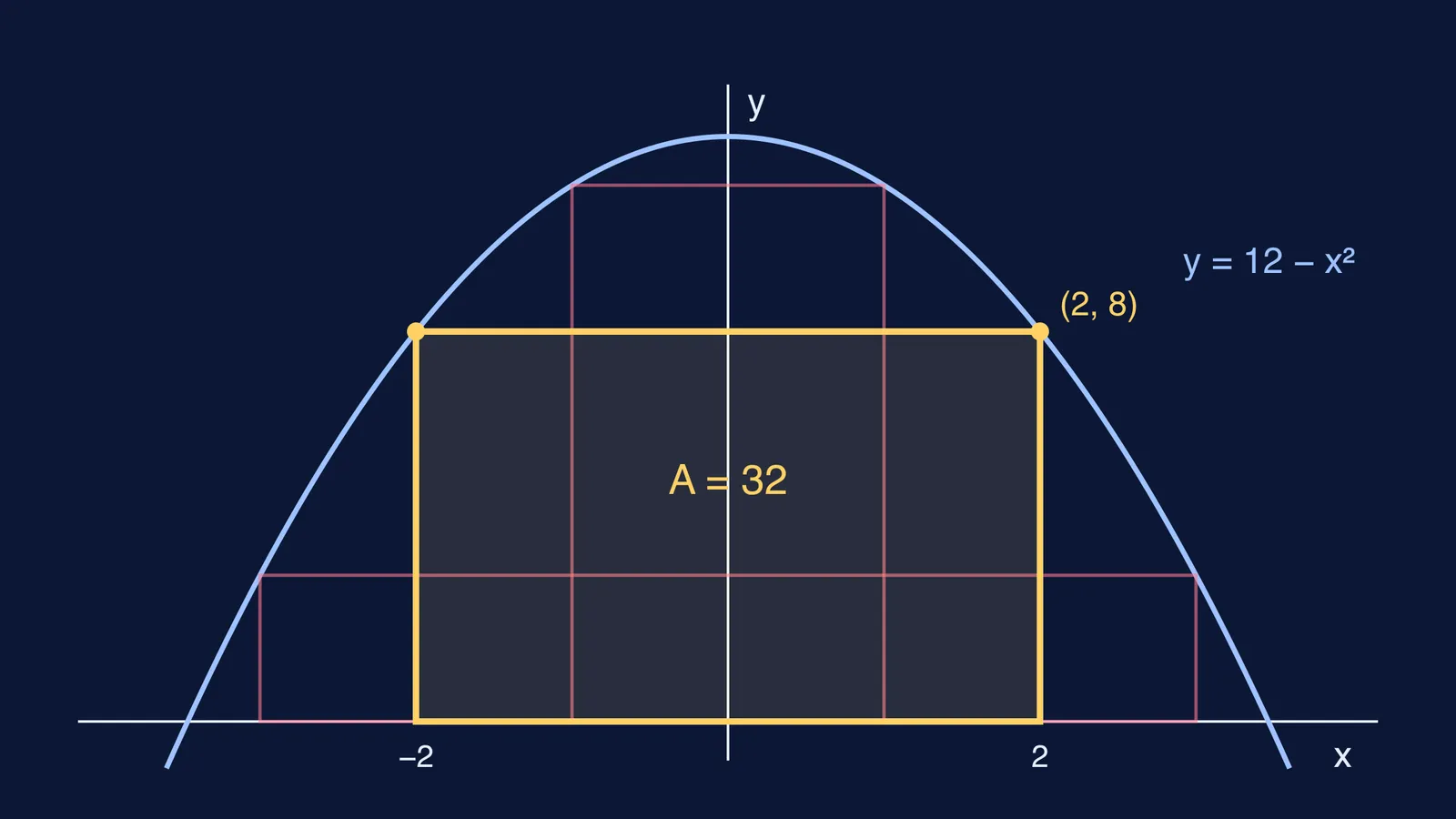
The JEE Main paper of 12 January 2019 (Shift 1) asked for the largest rectangle with its base on the x-axis and two vertices on y = 12 − x², lying inside the parabola; the answer is 32 square units (question and solution on Cracku).
Work it through with a = 12:
A(x) = 2x(12 − x²) = 24x − 2x³
A′(x) = 24 − 6x² = 0 gives x = 2
A″(2) = −24, which is negative, so it is a maximum
height = 12 − 4 = 8, which is two-thirds of 12
area = 4 × 8 = 32
Now try y = 9 − x² yourself before reading on. You should get x = √3, height 6 and area 12√3.
How much of the region under the parabola does the rectangle fill?
The area between y = a − x² and the x-axis is the integral of (a − x²) from −√a to √a, which is 4a√a/3. Divide the rectangle's area by this and a cancels: the ratio is 1/√3, a little under 0.58. So even the best rectangle leaves more than a third of the parabolic region uncovered, whatever the value of a.
The same question inside an ellipse gives a different answer; compare it with the largest rectangle inscribed in an ellipse.
What are the traps in this problem?
Width x instead of 2x: the critical x stays the same, but the area comes out half the real value.
Ignoring the domain: x = −√(a/3) also solves x² = a/3, but a half-width cannot be negative.
Stopping at x: the question asks for the area, not the corner. Write the final number with its units.
A shifted parabola, y = a − (x − h)²: centre the rectangle on x = h. The height is still 2a/3.
A stretched parabola, y = a − kx²: the half-width becomes √(a/(3k)), but the height is still 2a/3.
Windows, open boxes and cans follow the same six steps; our post on applications of maxima and minima collects them. If you keep getting the right derivative but the wrong final answer, the Fermi Problem Library has worked problems with a step-by-step solver that explains the reasoning rather than printing an answer, so you can find the step where your set-up went wrong.
Pick one parabola tonight, set up A(x) from a sketch, and check your height against 2a/3.