

On this page
This is a standard Class 12 Application of Derivatives problem. You can solve it with messy square roots, or in three lines by picking the right variable.
How do you find the largest rectangle inscribed in an ellipse?
Take the ellipse x²/a² + y²/b² = 1. A rectangle with all four corners on the ellipse is centred at the origin with sides parallel to the axes, so you only need to place one corner, in the first quadrant.
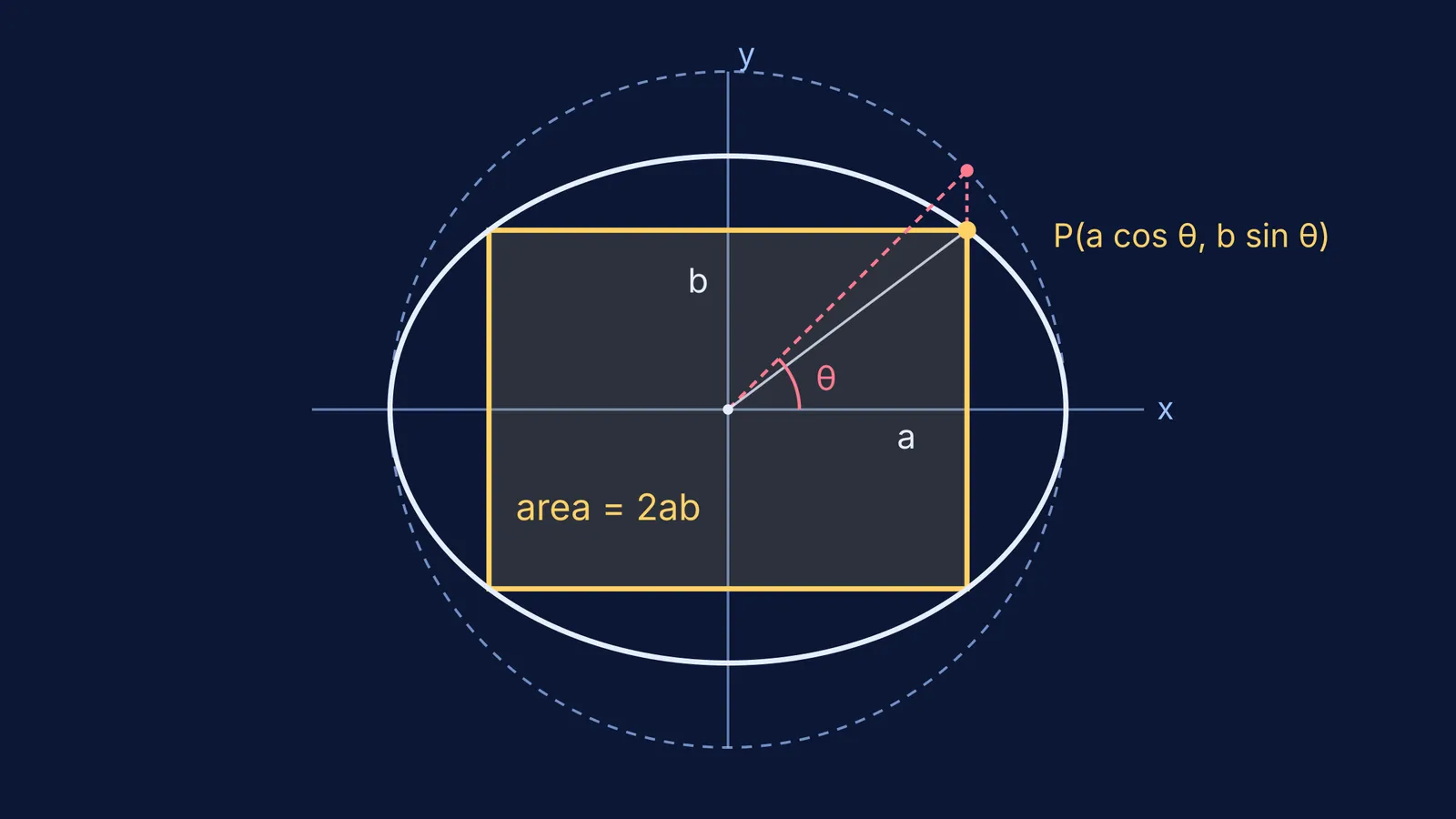
Every point on the ellipse can be written as (a cos θ, b sin θ); Wolfram MathWorld gives this as the ellipse's standard parametric form. One variable, θ, now does the work of two, and the constraint is built in.
Corner P = (a cos θ, b sin θ), with 0 < θ < π/2.
Width = 2a cos θ, height = 2b sin θ.
Area A = (2a cos θ)(2b sin θ) = 4ab sin θ cos θ = 2ab sin 2θ.
Since sin 2θ can never exceed 1, the area can never exceed 2ab. It reaches 2ab when 2θ = 90°, so θ = 45°. With calculus, dA/dθ = 4ab cos 2θ, which is zero at θ = π/4, and d²A/dθ² = −8ab sin 2θ is negative there, so it is a maximum.
At θ = 45° the corner is at (a/√2, b/√2), so the rectangle measures a√2 by b√2. The ellipse's own area is πab (MathWorld), so the best rectangle fills 2/π of it, about 63.7%, whatever the shape of the ellipse.
Is θ the angle the corner makes with the x-axis?
No. θ is the eccentric angle: MathWorld defines it as the angle t in the parametrisation x = a cos t, y = b sin t. You measure it on the auxiliary circle of radius a, not on the ellipse.
At the optimum θ = 45°, but the line from the centre to the corner makes an angle of tan⁻¹(b/a) with the x-axis. That equals 45° only when a = b. In the diagram at the top of this post, the dashed 45° line meets the auxiliary circle, and the corner sits directly below that point.
What is the largest rectangle inscribed in a circle?
A circle is an ellipse with a = b = r, so the same working gives a maximum area of 2r², with sides r√2 by r√2. The largest rectangle in a circle is a square. NCERT's Class 12 textbook asks you to prove exactly this in Chapter 6, Exercise 6.3, Question 19: "Show that of all the rectangles inscribed in a given fixed circle, the square has the maximum area" (NCERT Chapter 6 PDF).
A worked example with numbers
Find the largest rectangle inside x²/16 + y²/9 = 1.
Here a = 4 and b = 3.
Maximum area = 2ab = 2 × 4 × 3 = 24 square units.
Corner = (4/√2, 3/√2) = (2√2, 3/√2), roughly (2.83, 2.12).
Sides = 4√2 by 3√2, roughly 5.66 by 4.24, and 5.66 × 4.24 ≈ 24.
The ellipse's area is 12π ≈ 37.7, and 24/37.7 ≈ 0.637, matching 2/π.
If the ellipse comes as 9x² + 16y² = 144, divide by 144 first to read off a and b. The formula 2ab holds even when the major axis is vertical; our post on ellipses with the major axis along the y-axis covers that case.
What about the largest triangle in a circle?
Use the same move: describe the shape with an angle. Put the circle x² + y² = r² at the origin, fix the apex at (0, r), and place the base corners at (±r cos t, −r sin t).
Base = 2r cos t, height = r + r sin t.
Area A = r² cos t (1 + sin t).
dA/dt = r²(cos²t − sin t − sin²t) = r²(1 − 2 sin t)(1 + sin t).
This is zero when sin t = 1/2, so t = 30°.
Then the base is r√3, the height is 3r/2 and the area is 3√3r²/4. Each side works out to r√3, so the triangle is equilateral. Our step-by-step post on the isosceles triangle of maximum area in a circle shows why starting with an isosceles triangle loses nothing. In the same NCERT chapter, Miscellaneous Exercise Question 5 asks for the largest isosceles triangle inscribed in an ellipse with its vertex at one end of the major axis (NCERT Chapter 6 PDF).
Where to practise next
The same habit of choosing the variable that carries the constraint solves the cylinder of maximum volume inscribed in a sphere. If you get stuck partway through one of these, the Fermi Problem Library has worked problems with a step-by-step solver that explains the reasoning rather than printing an answer. If the parametric form itself feels shaky, the Fermi Concept Library gives each concept in mathematics its own lesson.


