

On this page
Calculus is full of optimization problems, and finding the maximum volume of a solid inscribed in a sphere is a classic exam favourite. Just like finding the absolute maximum and minimum on a closed interval, the trick is always the same: write the volume formula, use geometry to remove a variable, and set the derivative to zero. Whether you are dealing with a cylinder or a cone, this method yields elegant, exact ratios that highlight the symmetry of these shapes.
How do you solve inscribed solid problems?
Whenever you face an inscribed solid problem in an exam, follow this checklist to reach the correct answer without getting lost in the algebra.
Draw the cross-section: Always sketch the 2D cross-section of the 3D shapes. For a cylinder in a sphere, draw a rectangle inside a circle. For a cone in a sphere, draw an isosceles triangle inside a circle.
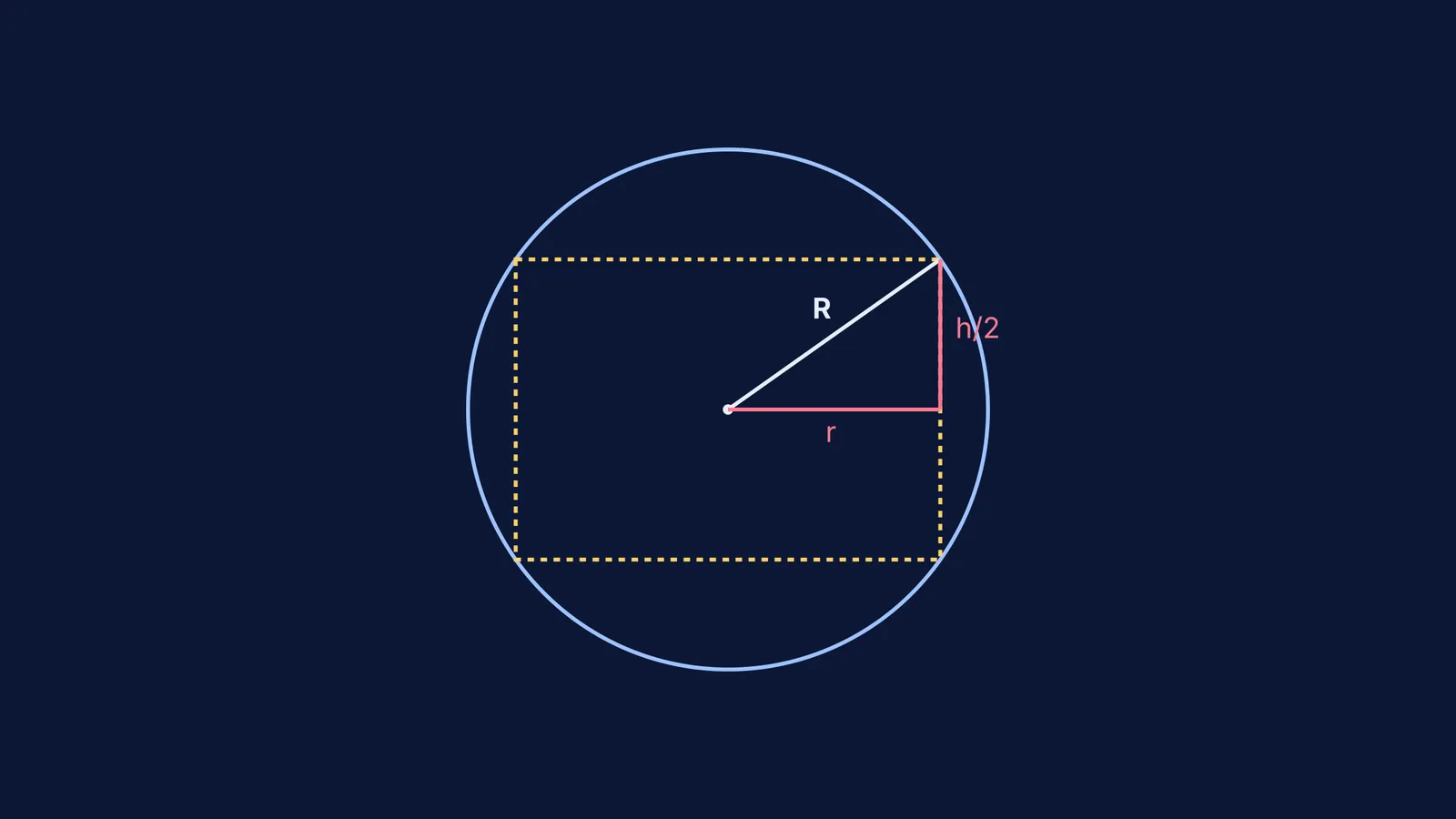
Find the right triangle: Look for a right-angled triangle that connects the centre of the outer shape to a critical point on the inner shape. This gives you the Pythagorean relationship you need as your constraint.
Substitute to get one variable: Write the volume formula, which usually has two variables (like r and h). Use your Pythagorean constraint to replace one variable (usually r²) so the volume only depends on h.
Differentiate and check: Take the derivative with respect to your chosen variable, set it to zero, and solve. Check the physical limits to ensure you found the maximum.
How do you set up the volume function?
If you inscribe a cylinder of radius r and height h inside a sphere of radius R, the corners of the cylinder touch the sphere. If you draw a right triangle connecting the sphere's centre, the edge of the cylinder's base, and the centre of the cylinder's base, the Pythagorean theorem relates them: R² = r² + (h/2)².
This means r² = R² - h²/4. The volume of a cylinder is V = πr²h. Many students make the mistake of trying to differentiate V with respect to r and h simultaneously, or they differentiate implicitly without substituting. While implicit differentiation works, expressing V entirely in terms of h keeps the algebra straightforward and minimizes the chance of losing a negative sign.
When you substitute r², you get a function in just one variable, h, which is exactly what you need to optimise the volume: V(h) = π(R² - h²/4)h = πR²h - πh³/4.
What is the maximum volume of a cylinder inscribed in a sphere?
To find the maximum, take the derivative of the volume with respect to h and set it to zero. Differentiating the function is as simple as applying the power rule, and you could also use second-order derivatives to prove it is a peak. dV/dh = πR² - (3πh²/4) = 0. Solving this for h tells us that 3h² = 4R², so the optimal height is h = 2R/√3.
When you substitute this height back into the equation for the radius, you find r = R√(2/3). The maximum volume is then 4πR³/(3√3), derived using standard optimization methods/04%3A_Applications_of_Differentiation/4.07%3A_Optimization_Problems). This is exactly 1/√3 of the sphere's total volume. If you often get stuck substituting variables or finding derivatives, the Fermi Problem Library has worked problems with a step-by-step solver that explains the reasoning.
What is the maximum volume of a cone inscribed in a sphere?
The steps for a right circular cone are nearly identical. For a cone of base radius r and height h in a sphere of radius R, the distance from the sphere's centre to the cone's base is h - R.
Applying the Pythagorean theorem again, R² = r² + (h - R)². When you expand the squared term, you get h² - 2hR + R². Because R² appears on both sides of the equation, they cancel out perfectly, leaving you with r² = 2hR - h². This simple expression is the secret to avoiding messy square roots when you calculate the cone's volume.
The volume of a cone is V = (1/3)πr²h. Substituting r² gives V(h) = (π/3)(2Rh² - h³).
When you set the derivative to zero, you get h(4R - 3h) = 0. Since the height must be positive, the optimal height is h = 4R/3. The maximum volume of the cone is 32πR³/81. This means the largest possible cone fills exactly 8/27 of the sphere.


