

On this page
A classic problem in differential calculus asks you to find the isosceles triangle of maximum area that can be inscribed in a circle of fixed radius R. While symmetry suggests an equilateral shape, proving it requires expressing area as a single-variable function and applying derivative tests.
According to geometric theorems in Wolfram MathWorld, an equilateral triangle of side a inscribed in a circumcircle of radius R achieves height h = (3/2) R and area (3√3/4) R². Furthermore, Wikipedia confirms that among all triangles inscribed in a circle, the regular equilateral triangle has the greatest area. Why restrict the search to isosceles triangles? For any fixed chord base, area equals (1/2) × base × height. Height is maximized when the opposite vertex lies on the perpendicular bisector of the base, making the two slant sides equal. Thus, the global maximum must occur within isosceles triangles, making maxima and minima applications directly applicable.
When setting up geometric problems, the Fermi Concept Library covers every concept in physics, chemistry, biology, mathematics and computing, each with its own lesson and its place in the map.
Why is the inscribed triangle of maximum area equilateral?
Before differentiating, visualizing why symmetry maximizes area provides an intuitive roadmap. If you fix two vertices B and C on a circle, chord BC has a constant length. The area of triangle ABC depends solely on the perpendicular distance from vertex A to chord BC. Moving A along the circumference increases this altitude until A reaches the midpoint of arc BC, directly above the center of chord BC. At this peak, triangle ABC is symmetric with AB = AC.
Repeating this logic for all three chords reveals that if any two sides were unequal, shifting the opposite vertex along the circle would immediately enlarge the area. Therefore, any stationary point of maximum area must satisfy bilateral symmetry across every vertex. The only triangle that is isosceles with respect to every side is an equilateral triangle.
How do you find maximum area using triangle height?
In CBSE Class 12 Mathematics, this problem is a standard optimization exercise. You can express the area entirely in terms of the height h, where 0 < h < 2R:
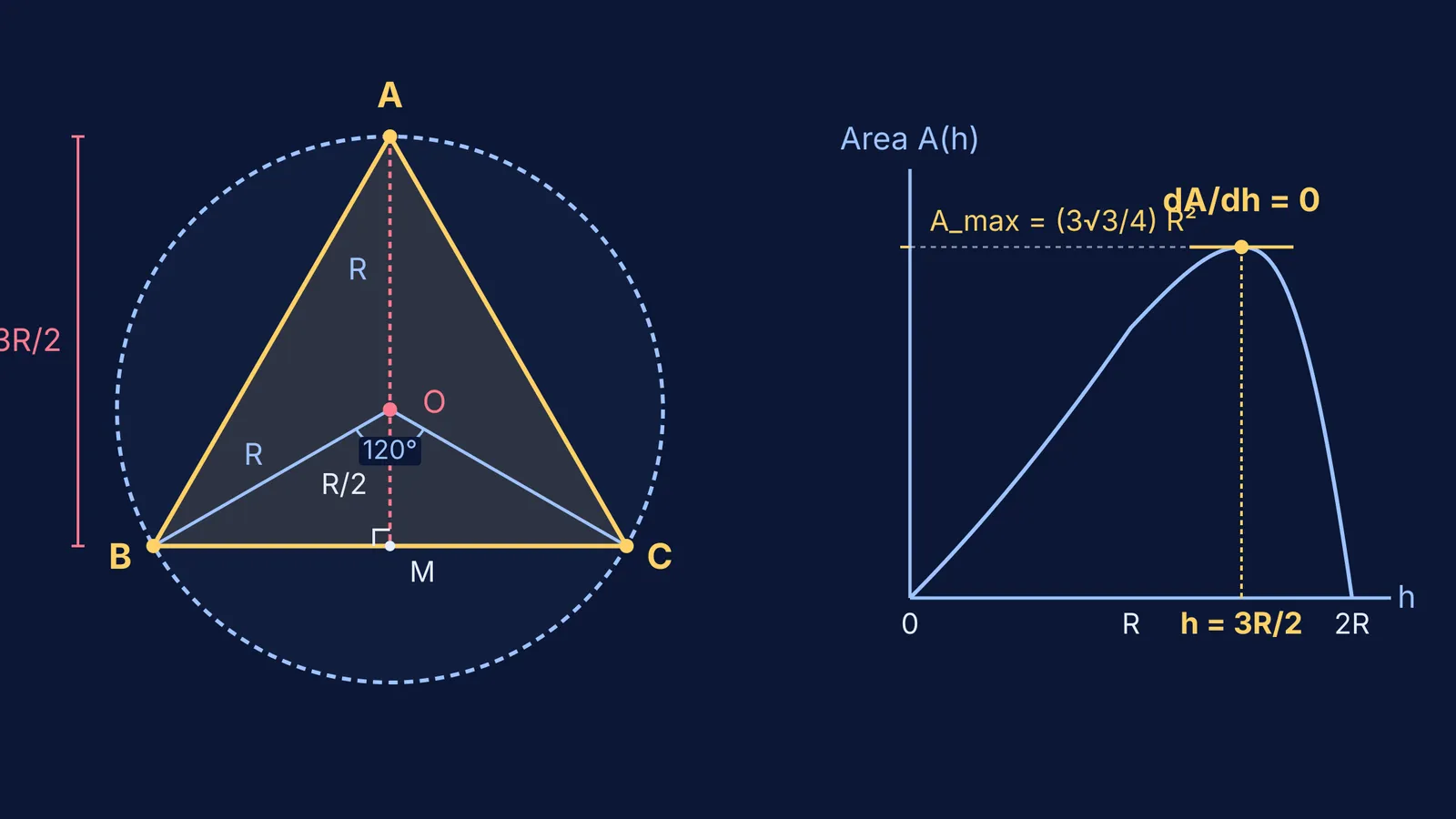
Relate base to height: Let circle radius be R and center be O. Let AM be the altitude of length h from apex A to base BC. The distance from center O to base BC is OM = |h − R|. In right triangle OMB with hypotenuse OB = R, the Pythagorean theorem gives BM² = R² − (h − R)² = 2hR − h², so base BC = 2√(2hR − h²).
Formulate area: Area A(h) = (1/2) × base × height = h√(2hR − h²).
Maximize the square: To avoid square roots, maximize Z = [A(h)]² = 2Rh³ − h⁴. Because A(h) > 0 on (0, 2R), Z and A share the same maximum point.
Set the first derivative to zero: Differentiating gives dZ/dh = 6Rh² − 4h³ = 2h²(3R − 2h). Setting dZ/dh = 0 for non-zero h yields h = 3R/2.
Verify the maximum: The second derivative d²Z/dh² = 12Rh − 12h² equals −9R² < 0 at h = 3R/2, confirming a maximum. At endpoints h = 0 and h = 2R, area is zero, confirming an absolute maximum as covered in absolute extrema on a closed interval.
At h = 3R/2, base BC = 2√(3R²/4) = √3 R. The slant sides satisfy AB² = h² + BM² = (3R/2)² + 3R²/4 = 3R², giving AB = AC = √3 R. Since all three sides equal √3 R, the triangle is equilateral, with maximum area (3√3/4) R².
How do you solve the optimization using a central angle?
Trigonometric parametrization offers an alternative path that highlights angular symmetry.
Let base BC subtend central angle 2θ at center O, where θ is the angle between the downward vertical and radius OB (0 < θ < π):
Dimensions: Height h = R + R cos θ = R(1 + cos θ), and half-base BM = R sin θ, so base BC = 2R sin θ.
Area function: A(θ) = (1/2)(2R sin θ)R(1 + cos θ) = R² sin θ (1 + cos θ) = R²(sin θ + (1/2) sin 2θ).
Differentiate: dA/dθ = R²(cos θ + cos 2θ) = R²(2 cos² θ + cos θ − 1) = R²(2 cos θ − 1)(cos θ + 1).
Critical points: Setting dA/dθ = 0 for 0 < θ < π gives 2 cos θ − 1 = 0, so cos θ = 1/2 and θ = π/3 (60°).
Second derivative test: d²A/dθ² = R²(−sin θ − 2 sin 2θ). At θ = π/3, d²A/dθ² = −(3√3/2) R² < 0, confirming a maximum using standard second-order derivative relations.
Because central angle 2θ = 120°, inscribed angle ∠A = (1/2)(120°) = 60°. Since AB = AC, base angles ∠B and ∠C are each (180° − 60°)/2 = 60°. All three angles equal 60°, proving the triangle is equilateral.
What mistakes do students make on this exam problem?
Students regularly drop marks on this question through three common oversights:
Stopping before proving the equilateral property: Finding h = 3R/2 or θ = π/3 identifies the critical point, but examiners require calculating side lengths or angles to demonstrate all three are equal.
Skipping the second derivative test: You must demonstrate d²Z/dh² < 0 or d²A/dθ² < 0 to prove the stationary value is a maximum rather than a minimum.
Overlooking centroid geometry: At h = 3R/2, center O divides altitude AM in a 2:1 ratio (AO = R, OM = R/2), which confirms that the circumcenter and centroid coincide.
To practice geometric optimization with step-by-step reasoning, the Fermi Problem Library provides worked problems with a step-by-step solver that explains the reasoning rather than printing an answer.


