

On this page
In an ellipse equation, the position of the larger denominator tells you which way the shape points. When the larger number sits under the x² term, the ellipse stretches horizontally. But when it sits under the y² term, the ellipse stands upright.
This vertical orientation is a classic trap in coordinate geometry. Students often learn one set of formulas—for the foci, the eccentricity, and the latus rectum—and apply them blindly, leading to errors in board exams and competitive tests.
Here is how to navigate the vertical ellipse and keep the formulas straight.
What is the equation of an ellipse with its major axis along the y-axis?
The standard equation of an ellipse centred at the origin is x²/a² + y²/b² = 1. The rule for its orientation is simple: the major axis lies along the coordinate axis that has the larger denominator.
If b > a, the larger denominator is under y², which means the major axis is along the y-axis.
There are two ways textbooks handle this, which is where the confusion begins:
The competitive exam convention: Many study materials keep the equation as x²/a² + y²/b² = 1 and state that b > a. In this notation, the semi-major axis is b and the semi-minor axis is a.
The NCERT convention: The Class 11 NCERT mathematics textbook prefers to always call the semi-major axis a. So, for a vertical ellipse, it swaps the letters to write x²/b² + y²/a² = 1, keeping a > b.
Both are mathematically correct. A reliable approach is to identify the semi-major axis (the square root of the larger denominator) and the semi-minor axis (the square root of the smaller one), rather than memorising letters.
How do the foci and vertices change?
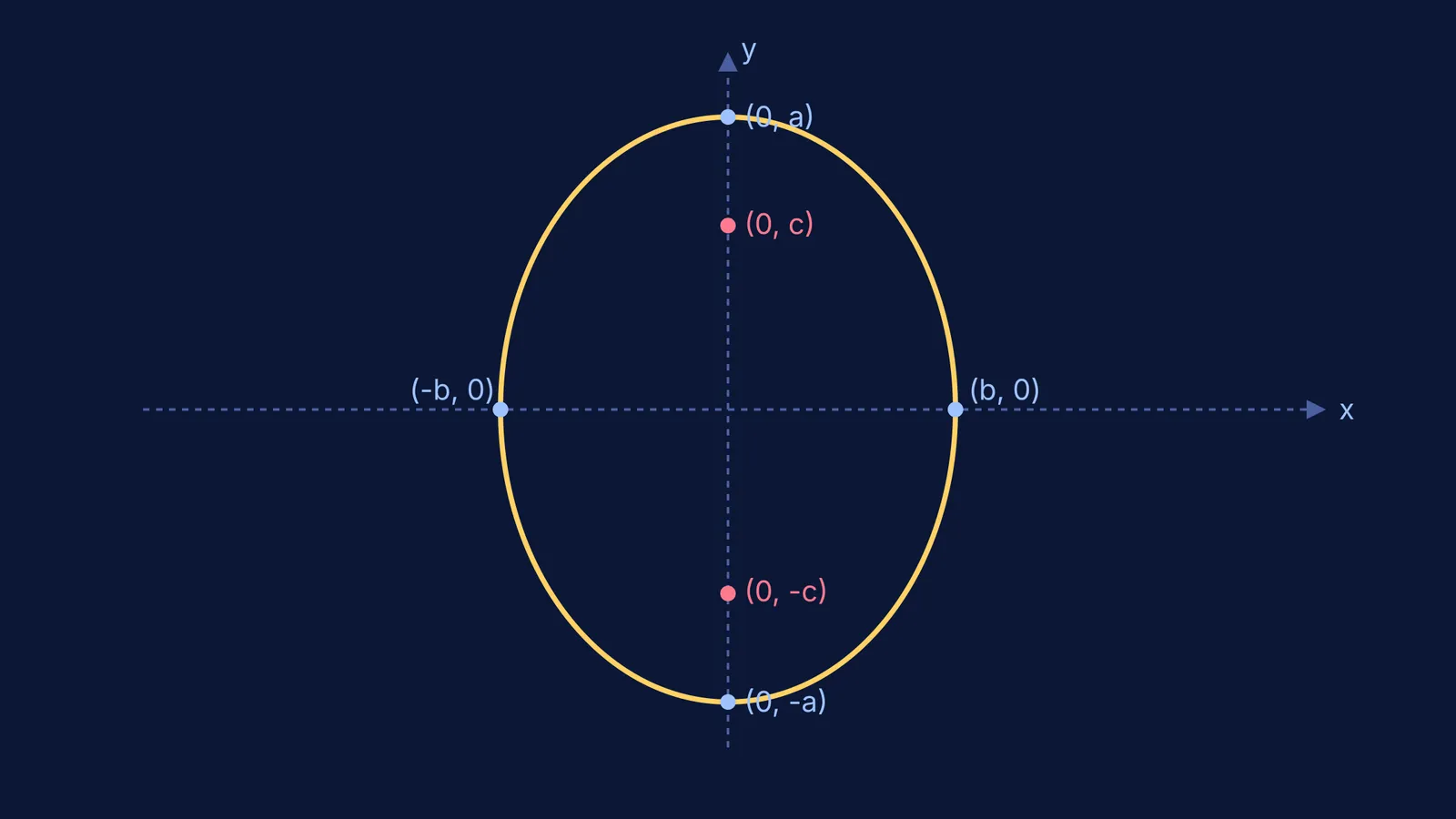
Because the ellipse is stretched vertically, its key points move from the x-axis to the y-axis.
Using the convention where the semi-major axis is b (from x²/a² + y²/b² = 1 with b > a):
Vertices: The ends of the major axis lie on the y-axis at (0, b) and (0, -b).
Foci: The foci are located at (0, c) and (0, -c). The focal distance c is calculated by subtracting the smaller denominator from the larger one: c = √(b² - a²).
Why do students mix up the formulas?
Common mistakes happen when calculating the eccentricity and the length of the latus rectum, because the standard formulas assume a horizontal ellipse.
The eccentricity trap: Eccentricity (e) measures how stretched the ellipse is, and it must be less than 1. The general formula is e = c / (semi-major axis). If you blindly use e = √(1 - b²/a²) when b > a, you will end up with the square root of a negative number. The correct formula always places the smaller square over the larger square: e = √(1 - minor² / major²).
The latus rectum trap: The latus rectum is the chord passing through a focus perpendicular to the major axis. The formula is often memorised as 2b²/a. However, the physical rule is 2 × (semi-minor axis)² / (semi-major axis). For a vertical ellipse (where b > a), the correct formula becomes 2a²/b. Applying the wrong one is a frequent error in JEE Main. For more on this geometry, see our guide on latus rectum lengths for an ellipse.
How to solve problems when the ellipse is vertical
When you are given an equation like x²/9 + y²/25 = 1, use this simple framework to avoid formula mix-ups:
Locate the larger denominator: Here, 25 is larger than 9, and it sits under y². The ellipse is vertical.
Define the axes in words, not just letters:
Semi-major axis = √25 = 5
Semi-minor axis = √9 = 3
Compute c first: c = √(25 - 9) = √16 = 4.
Place the points on the correct axis: Since it is vertical, the foci are on the y-axis at (0, ±4) and the vertices are at (0, ±5). (Compare this with focal distances on an ellipse).
If you struggle to remember which formula to use during practice, the Fermi Concept Library breaks down the geometry of conic sections so you can see why the formulas change. When solving numericals, the step-by-step solver in the Fermi Problem Library will point out if you have swapped the axes and explain the correct orientation before giving the final answer.


