On this page
On 20 February 1824, William Buckland put a broken jaw, a few vertebrae and some limb bones from a quarry near Oxford in front of the Geological Society of London. The paper he read that day, Notice on the Megalosaurus or great Fossil Lizard of Stonesfield, gave a scientific name to an animal we now call a dinosaur, years before the word “dinosaur” existed.
Who named the first dinosaur?
William Buckland, the University of Oxford's first professor of geology, named Megalosaurus in 1824, the first dinosaur formally named in the scientific literature (EarthDate, University of Texas at Austin). His notice was printed in the Transactions of the Geological Society of London, volume 1 of the second series, pages 390 to 396 (BioStor record of the paper).
The name had a short pre-history. The physician James Parkinson announced the name “Megalosaurus” in 1822, but it is Buckland's 1824 descriptions of the bones that count as the valid publication (Megalosaurus, Wikipedia). The bones were not new either: in 1676 a bone that looked like part of an oversized thigh bone was found in the Stonesfield slate quarry, and Robert Plot described it in his 1677 Natural History of Oxford-shire (EarthDate).
The word itself came seventeen years later, in 1841, when Richard Owen gave these animals the name Dinosauria, from the Greek for “terrible lizard” (EarthDate). We tell that story in how Richard Owen coined the word dinosaur, and the next dinosaur to be named has its own post: Gideon Mantell and the teeth that revealed Iguanodon.
What did Buckland actually have?
Very little, and he said so. “Nothing approaching to an entire skeleton has yet been found,” he wrote, and the bones “must have belonged to several individuals of various ages and sizes” (Buckland, 1824). They came from a bed of sandy slate no more than 6 feet thick at Stonesfield, about twelve miles north-west of Oxford, which quarrymen reached through more than 40 feet of rock (Buckland, 1824).
His inventory, from the same paper:
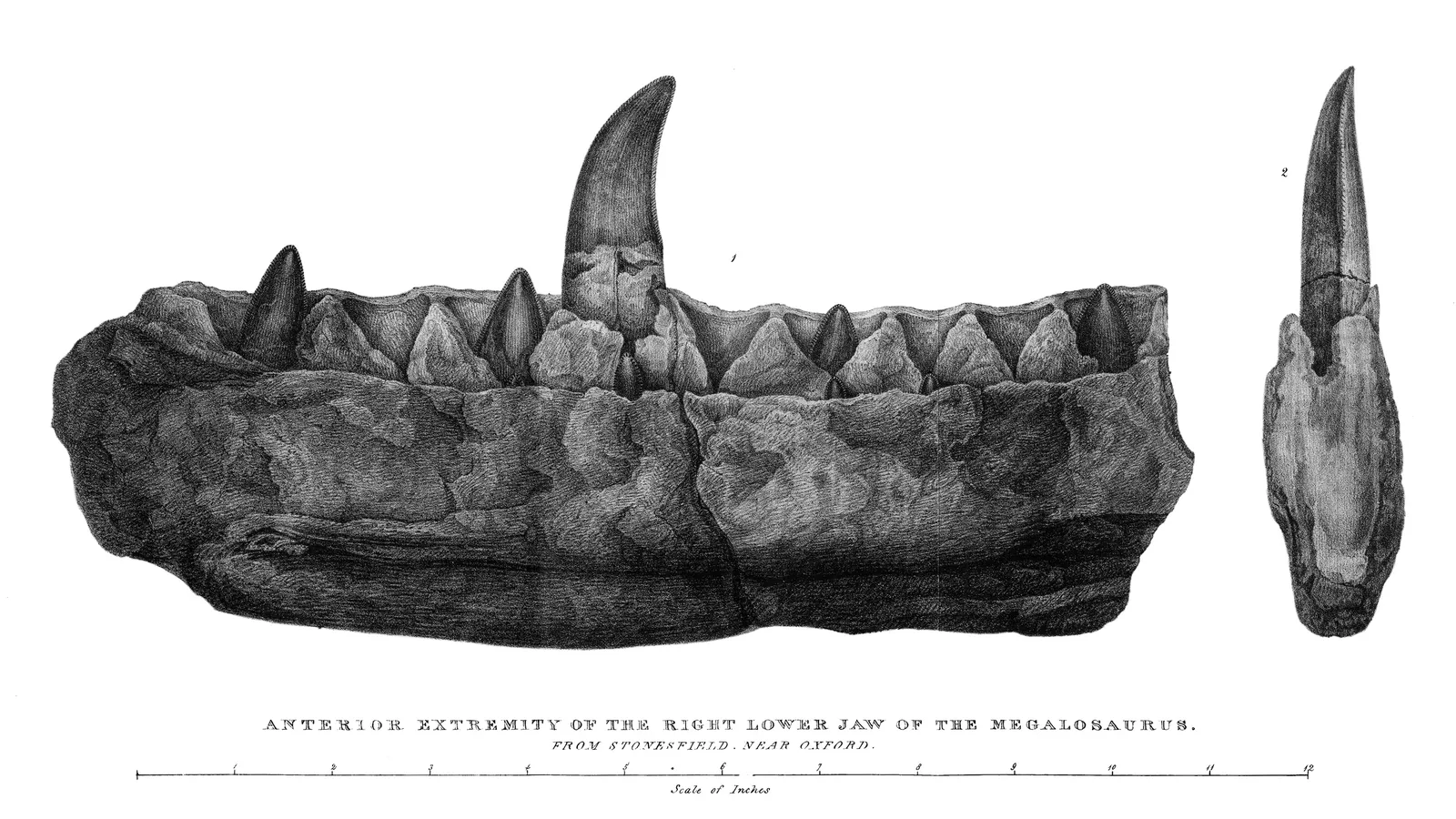
a fragment of the lower jaw, nearly a foot long, with teeth
a run of five fused vertebrae, including the two from the hip
ribs, an ilium (part of the hip) and a few pieces he identified only with hesitation
a thigh bone two feet nine inches long, about 84 cm
The jaw mattered most. He described teeth “flattened laterally, and recurved backwards, being serrated on the posterior edge”, with new teeth forming beside the old ones to replace them (Buckland, 1824). Flat, curved, serrated teeth are a meat-eater's teeth, and that part of his reading has lasted.
How big was Megalosaurus really?
Here the fragments misled him. From the 84 cm thigh bone, Cuvier had assigned the animal a length of more than 40 feet and the bulk of an elephant seven feet high, by comparing it with lizards; Buckland repeated this, and for the owner of a larger thigh bone in Gideon Mantell's collection, an animal he judged “twice as great”, he reckoned 60 to 70 feet “after making some deduction” (Buckland, 1824). Today Megalosaurus is understood as a Jurassic theropod, a meat-eater that walked on its hind legs, about 6 metres (20 feet) long (EarthDate).
A worked example shows where the gap comes from:
Convert units: 40 feet is about 12.2 metres.
The lizard model: 12.2 m ÷ 0.84 m ≈ 14.5, so Cuvier's estimate implies a body about 14 to 15 thigh-bone lengths long.
The modern estimate: 6 m ÷ 0.84 m ≈ 7, about 7 thigh-bone lengths.
Same bone, answers a factor of two apart. The division was fine; the lizard-shaped body was not.
Buckland saw the risk. He warned that “we cannot safely attribute exactly the same proportions to recent and extinct species” (Buckland, 1824), but still scaled from living reptiles, the only comparison he had.
What can students learn from Buckland's method?
Order-of-magnitude and data-interpretation questions ask you to estimate from partial data. Buckland's paper is a good template, mistakes included:
List what you actually have, as his inventory of bones did.
Name the model your answer depends on: write “assuming a lizard-shaped body” beside the number.
Rerun the arithmetic with a different model and see how far the answer moves.
Flag your weakest step. He said he was unsure whether one bone was a pubis or part of a shoulder blade.
Ask for more data. He published partly in the hope that people holding other parts of the same reptile would send the Society more information (Buckland, 1824).
If estimation questions trip you up on the method rather than the arithmetic, the Fermi Problem Library has worked problems with a step-by-step solver that explains the reasoning rather than printing an answer. For the biology of fossils and evolution, the Fermi Concept Library gives each concept its own lesson and its place in the map.
Next time you meet a number built on a few fragments, ask the question Buckland's estimate needed: what was the thing assumed to look like?