On this page
How do you describe an animal you have never seen, from a few teeth? In the early 1820s a country doctor in Sussex had exactly that problem. Gideon Mantell's answer, published in 1825, gave the world Iguanodon, one of the first large fossil reptiles to be named. This post covers who he was, how he reasoned from teeth to animal, the proportion sum he used and why it overshot, and what you can learn from his method.
Who was Gideon Mantell?
The Dictionary of National Biography (1893) says he was born in 1790 in Lewes, Sussex, the son of a shoemaker, and was kept out of the local grammar school by his father's politics. He trained as a surgeon in Lewes and became a partner in the practice, while collecting fossils from the chalk and the Weald in every spare hour. His first book, The Fossils of the South Downs (1822), had plates drawn by his wife.
He was elected a Fellow of the Royal Society in 1825, received the Geological Society's Wollaston medal in 1835 and a Royal Medal in 1849. He sold his collection to the British Museum for £5,000. In later life a spinal injury left him in pain, and he died on 10 November 1852 after taking opium for it. The DNB credits him with showing that the Wealden strata were laid down in fresh water, and with discovering four of the five dinosaur genera known at his death.
What did he find in Tilgate Forest?
His paper, Notice on the Iguanodon, a newly discovered fossil reptile, was read to the Royal Society on 10 February 1825. In it he writes that the Tilgate sandstone already held teeth of crocodiles, Megalosaurus and Plesiosaurus. But "in the summer of 1822, others were discovered in the same strata, which although evidently referable to some herbivorous reptile, possessed characters so remarkable, that the most superficial observer would have been struck with their appearance".
The teeth had serrated edges and crowns worn down "by mastication", that is, by chewing. That wear is why he called their owner a herbivorous reptile from the start.
How did he identify the animal?
Mantell sent specimens to leading naturalists, and quotes the reply of Baron Cuvier in French. Cuvier thought the teeth belonged to a reptile and asked, in effect, whether this might be a new animal, a herbivorous reptile, adding that only a jaw with teeth in place would settle it.
The breakthrough came at the Museum of the Royal College of Surgeons. With the help of Mr Clift, Mantell compared the fossils with living lizards and found, in an iguana prepared by Mr Stutchbury, "teeth possessing the form and structure of the fossil specimens". He noticed one more shared detail: a hollow at the base of each fossil tooth, made by the pressure of a replacement tooth growing beneath it, just as in the iguana. He adopted the name Iguanodon, "iguana tooth", at the suggestion of the Reverend W. Conybeare.
Worked example: Mantell's proportion sum
Mantell wrote that "if the recent and fossil animal bore the same relative proportions, the tooth, fig. 1. must have belonged an individual upwards of sixty feet long". He also records that the iguana skeleton he used was three feet six inches long.
Set up the proportion. If animal length is proportional to tooth size, then fossil length / iguana length = fossil tooth / iguana tooth.
What his answer implies. 60 ft / 3.5 ft ≈ 17. So the fossil tooth must have been about 17 times the size of the iguana's.
Convert. 60 ft × 0.3048 = 18.3 m.
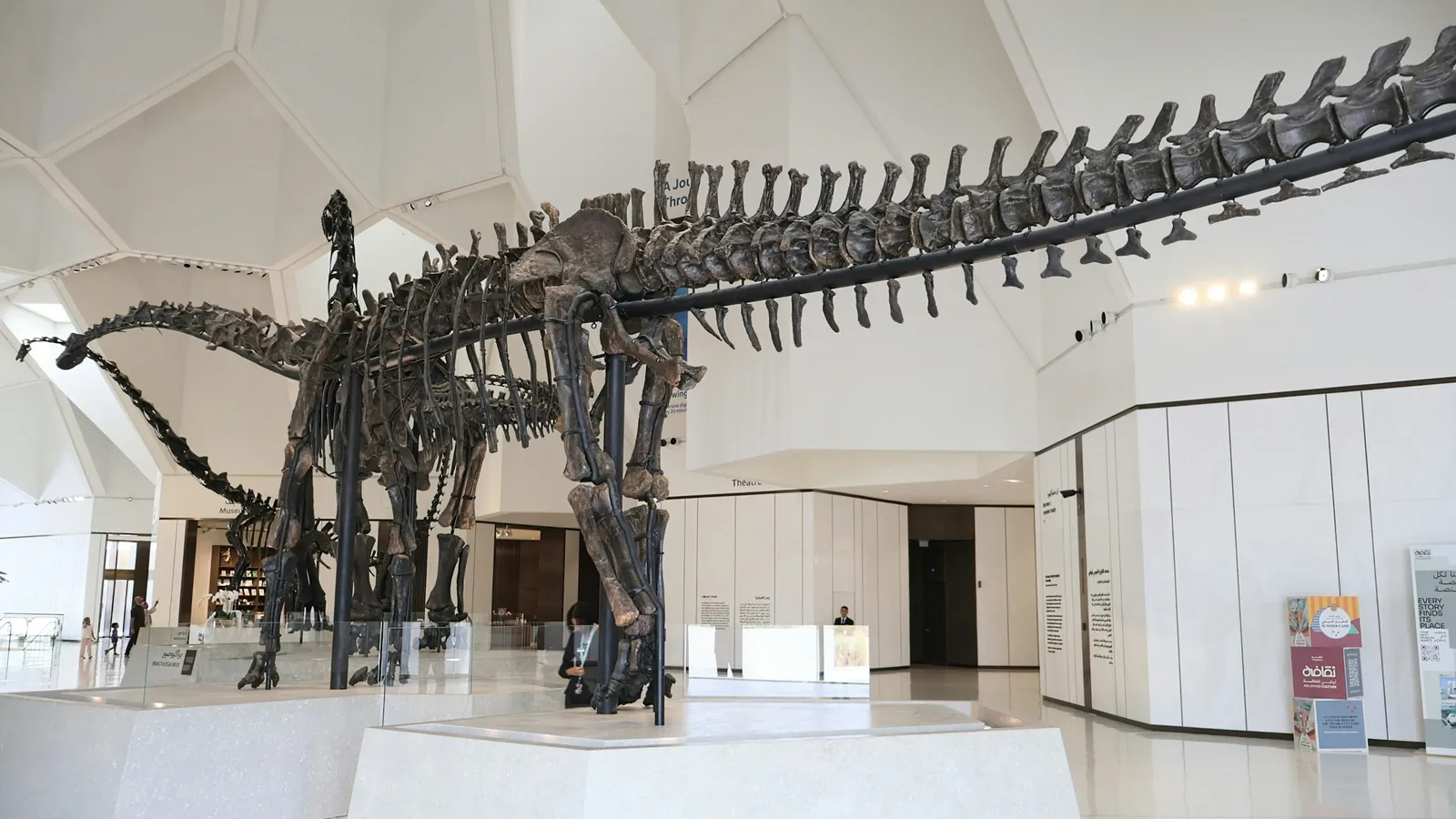
Compare. The Natural History Museum's Iguanodon page gives a length of about 10 m and a weight of about 4,000 kg. Mantell's estimate was nearly twice too long.
Why did it overshoot? The method assumes the giant had exactly an iguana's proportions, with teeth the same fraction of its body. Different animals are not scaled copies of each other. Our post on D'Arcy Thompson's mathematics of growth and form explains why size changes shape. Mantell flagged his assumption with the word "if", which is the honest way to do it.
What mistakes do students make here?
Treating a proportion as proof. A scaling estimate is only as good as the assumption that the shapes match.
Naming the wrong discoverer. Many people found fossils before Mantell. His contribution was the comparison and the name. Our post on Mary Anning covers another fossil hunter of the same years.
Forgetting what fossils are evidence for. For NEET, fossils are part of the evidence for evolution; see our guide to evolution for NEET.
If you want help setting up proportion problems like this one step at a time, the Fermi Problem Library has worked problems with a step-by-step solver that explains the reasoning.
What can a student take from how he worked?
Compare with something living. He solved the puzzle in a museum of modern skeletons, not in the field.
Look at small details. The hollow left by a replacement tooth was the clue that clinched the iguana match.
Ask experts, and quote them fairly. He printed Cuvier's caution along with his encouragement.
State your assumptions. "If the recent and fossil animal bore the same relative proportions" tells the reader exactly where his estimate could fail.
Next step: an iguana tooth is 3 mm long and a fossil tooth 40 mm. Using Mantell's method and a 1.07 m iguana, estimate the fossil animal's length, then say why you should not trust it.