On this page
Scale a mouse up to the size of an elephant, keeping every proportion the same, and its thin legs would struggle to hold it up. Shrink an elephant to mouse size and its legs would look absurdly thick. The reason is a piece of Class 9 mensuration, and the person who made biologists take it seriously was D'Arcy Wentworth Thompson. This post covers who he was, the main ideas of his 1917 book, three worked examples, and what students can learn from his way of thinking.
Who was D'Arcy Thompson?
The MacTutor biography at the University of St Andrews gives his birth as 2 May 1860 in Edinburgh and his death on 21 June 1948 in St Andrews. His mother died after his birth; his father was a classics teacher and later Professor of Greek at Galway, and his grandfather, Joseph Gamgee, a veterinary surgeon, gave him a love of science. He began medicine at Edinburgh, switched to zoology at Trinity College, Cambridge, and graduated in 1883.
In 1884 he became Professor of Biology at Dundee, and in 1917 he took the Chair of Natural History at St Andrews. MacTutor notes he held a chair for 64 years. He was also a serious classicist who translated Aristotle's Historia Animalium (1910). He was elected a Fellow of the Royal Society in 1916, knighted in 1937 and awarded the Society's Darwin Medal in 1946.
What was On Growth and Form about?
The book appeared in 1917 from Cambridge University Press, and the full first edition is free on Project Gutenberg. MacTutor sums up its approach: it "treated morphological problems by mathematics", at a time when zoology was mostly about comparative anatomy and evolutionary descent.
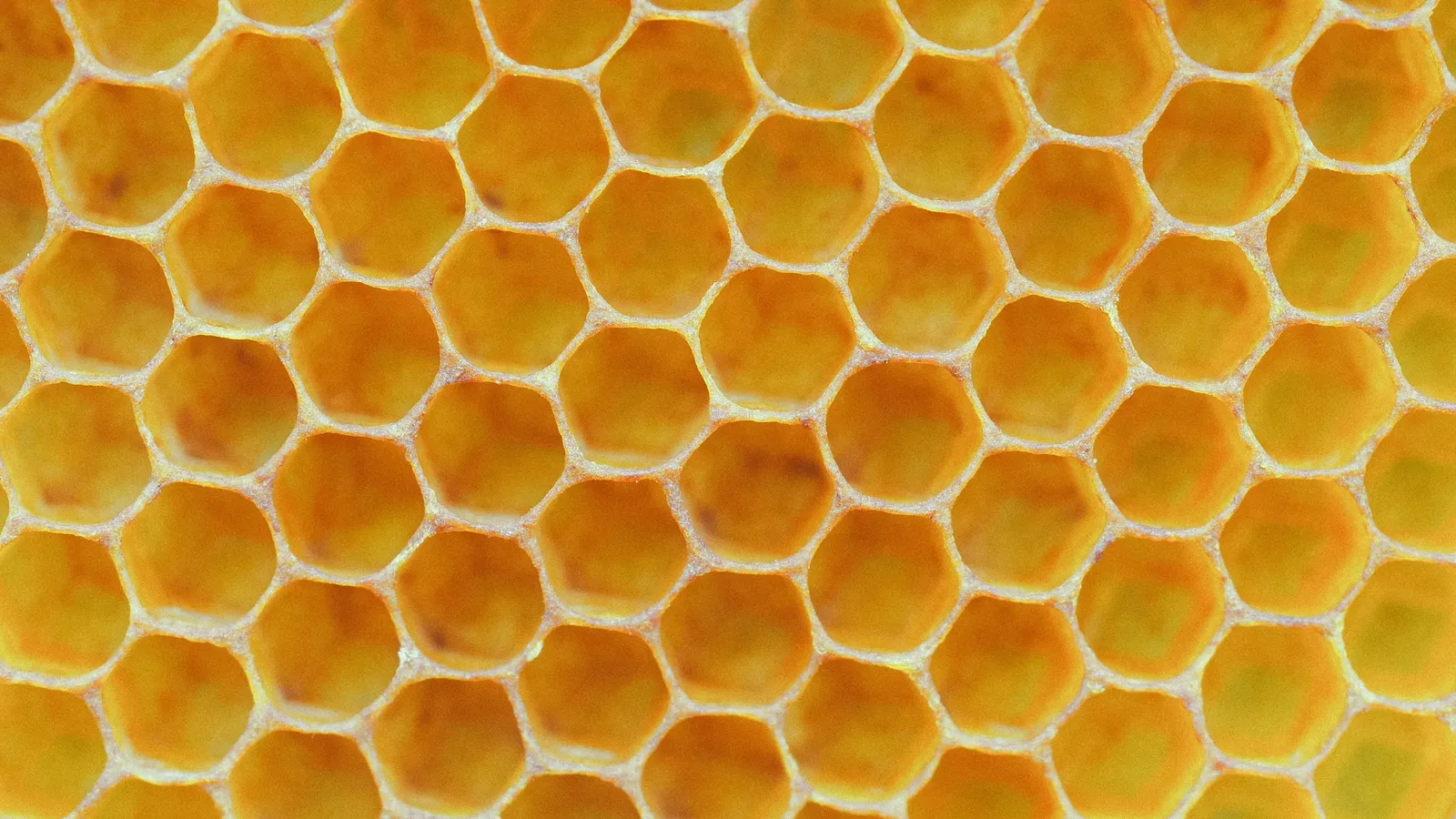
Thompson's complaint, in his first chapter, was that when a zoologist "finds a simple geometrical construction, for instance in the honey-comb, he would fain refer it to psychical instinct or design rather than to the operation of physical forces". His book looks at the honeycomb's hexagons, the spiral of the nautilus shell, the shapes of cells and drops, and the skeleton as an engineering frame.
Why does size change shape?
Chapter II, "On Magnitude", starts from school mathematics. In similar solids, "the surface increases as the square, and the volume as the cube, of the linear dimensions." For a sphere, S = 4πr² and V = (4/3)πr³, so V/S = r/3.
Some forces act on surfaces, such as the strength of a bone or muscle, which depends on its cross-section. Others, such as gravity, act on the whole volume. Thompson credits Galileo with the principle: you cannot build a house, or an animal, beyond a certain size with the same proportions and the same materials. The elephant, he writes, is "already shewing signs of a tendency to disproportionate thickness" in its limb bones. A whale escapes the limit because water supports its weight.
Worked examples: squares and cubes in biology
1. Thompson's fish. He writes that a fish "in doubling its length, multiplies its weight by no less than eight times; and it all but doubles its weight in growing from four inches long to five." Check: weight goes as L³, so (5/4)³ = 125/64 = 1.95. "All but doubles" is exactly right.
2. Galileo's bone. Scale an animal up by a factor of 2 with the same shape. Its weight rises by 2³ = 8. The cross-section of its leg bones rises by 2² = 4. So the stress on the bone, force per area, rises by 8/4 = 2. To keep the stress the same, the bone's area must rise by 8, so its diameter must rise by √8 ≈ 2.83, not 2. That is why big animals have relatively thick legs.
3. Cell size. For a spherical cell, S/V = 3/r. A cell of radius 10 μm has S/V = 0.3 per μm; at radius 20 μm it is 0.15 per μm. The bigger cell has half as much membrane per unit of contents to move food and waste through. Our posts on cell membrane transport and on breathing and exchange of gases show how cells and lungs deal with this. Thompson made the same point: nature increases the breathing surface of a lung "by a complex system of branching tubes and minute air-cells".
Common mistakes: applying the rule to shapes that are not similar (a growing child changes proportions), and forgetting that density must stay the same for weight to scale as volume. Thompson himself noted that the length-weight rule holds only if the animal has "in no way altered its form, nor its specific gravity".
What were his transformation grids?
In Chapter XVII, "On the Theory of Transformations, or the Comparison of Related Forms", Thompson drew one species on a square grid, then bent the grid. He took the outline of a porcupine-fish, Diodon, and deformed its grid lines into circles and curves; the same outline became the very different-looking sunfish, Orthagoriscus mola. He argued that one smooth transformation could account for all the external differences between the two.
If you prefer to build these ideas up one concept at a time, the Fermi Concept Library covers every concept in physics, chemistry, biology, mathematics and computing.
What can a student take from his way of working?
Use the maths you already know. Squares and cubes from Class 9 explain bones, cells and fish.
Ask what forces shaped something. He looked at a honeycomb and asked about physics before instinct.
Read widely. His classics, from Aristotle to Galileo, gave him ideas other zoologists missed.
Write well. MacTutor quotes him saying his gift for writing English was "the one thing I am a bit proud and vain of".
Next step: a cube-shaped cell has side 2 μm; find its S/V, then double the side and see how much it falls.