On this page
If you are revising plant tissues for a Class 9 test, your CBSE boards or NEET-UG biology, this question keeps coming back. The word “complex” here does not mean difficult. It means mixed: more than one kind of cell in a single tissue, all doing one job together.
What makes a plant tissue simple or complex?
Permanent tissues are sorted by how many kinds of cell they contain. In the 2023-24 edition of NCERT’s Class 9 Science chapter on tissues, tissues that are “all made of one type of cells, which look like each other” are called simple permanent tissues.
The same chapter defines the other group in one line: complex tissues are made of more than one type of cells, and all these cells coordinate to perform a common function.
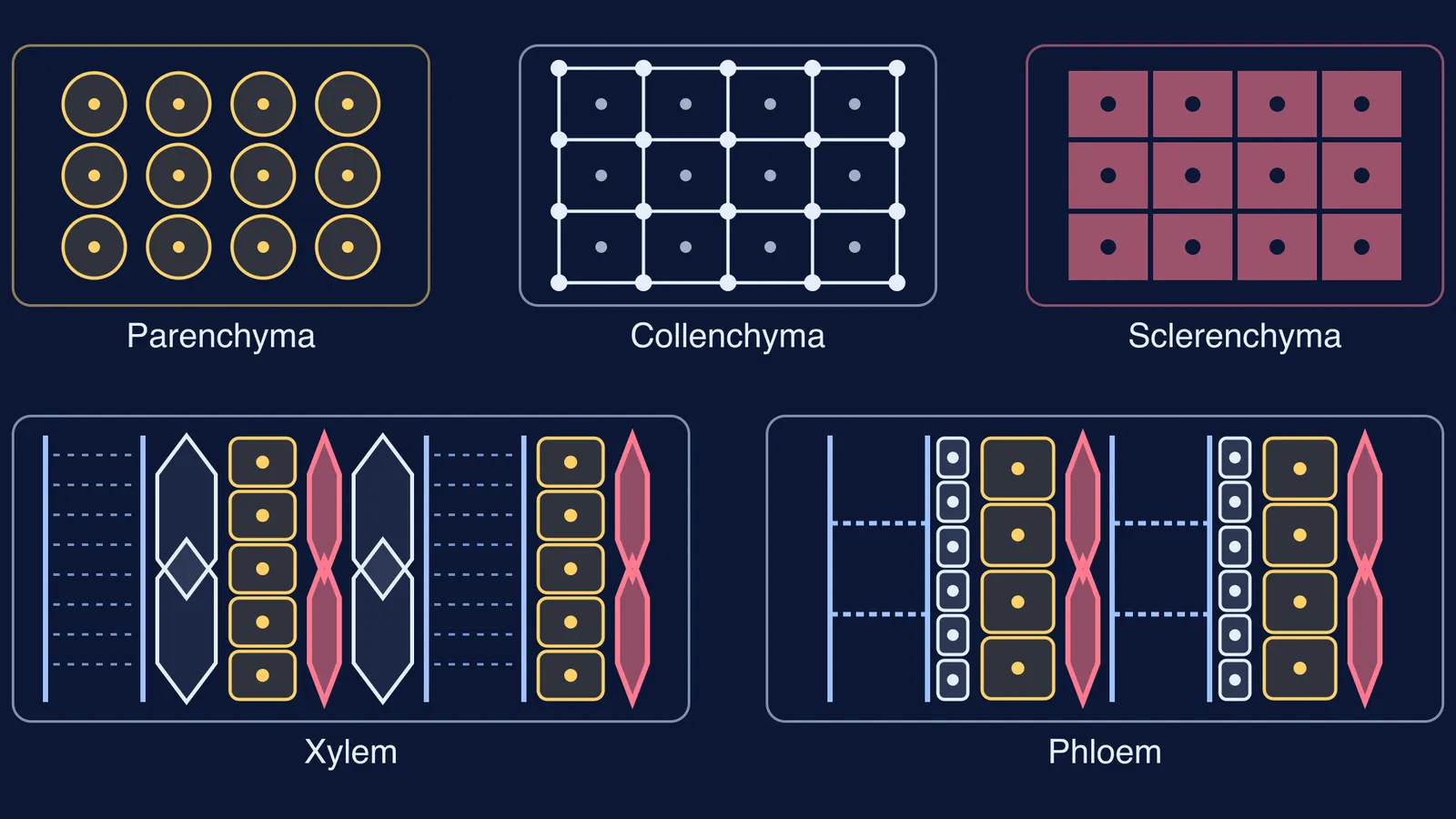
NCERT’s current Class 11 Biology chapter, Anatomy of Flowering Plants, keeps the same split. The ground tissue “consists of simple tissues such as parenchyma, collenchyma and sclerenchyma”, while “the vascular system consists of complex tissues, the phloem and the xylem”.
Why are xylem and phloem called complex permanent tissues?
Because each one is a team of different cells. According to the NCERT Class 9 chapter, xylem consists of tracheids, vessels, xylem parenchyma and xylem fibres:
Tracheids and vessels have thick walls, are tubular, and many are dead when mature. They transport water and minerals vertically through the plant.
Xylem parenchyma stores food.
Xylem fibres are mainly supportive.
The same chapter lists five types of cells in phloem: sieve cells, sieve tubes, companion cells, phloem fibres and phloem parenchyma. Sieve tubes are tubular cells with perforated walls. Phloem carries food from the leaves to other parts of the plant, and except for the phloem fibres, all its cells are living.
The OpenStax Biology 2e chapter on stems adds a detail worth remembering: sieve-tube cells are still alive at maturity, even though their nucleus and other cell components have disintegrated. It also describes what phloem carries as organic substances such as sugars and amino acids.
Notice the division of labour. In both tissues, some cells conduct, some store and some support. That teamwork is what “complex” refers to.
How are parenchyma, collenchyma and sclerenchyma different?
Each simple tissue is one kind of cell with one main job. From the NCERT Class 9 chapter:
Parenchyma: living cells with thin walls, loosely packed with spaces between them. It generally stores food. When it contains chlorophyll it is called chlorenchyma; in aquatic plants, parenchyma with large air cavities is called aerenchyma.
Collenchyma: living, elongated cells, irregularly thickened at the corners. It gives flexibility, so tendrils and the stems of climbers bend without breaking.
Sclerenchyma: dead cells, long and narrow, with walls thickened by lignin. It makes parts of the plant hard and stiff, like the husk of a coconut.
How do you answer this in an exam?
Use a three-step frame. It works for a 2-mark or a 3-mark question:
Define: a complex tissue is made of more than one type of cell, working together for a common function.
Name the cells of each tissue.
State the common function of each.
Here is a model answer built from that frame:
“Xylem and phloem are called complex tissues because each is made of more than one type of cell, and these cells work together to perform a common function. Xylem consists of tracheids, vessels, xylem parenchyma and xylem fibres, and conducts water and minerals. Phloem consists of sieve cells, sieve tubes, companion cells, phloem parenchyma and phloem fibres, and conducts food from the leaves to other parts of the plant.”
Before you move on, check your answer against this list:
Did you write “more than one type of cell”, not “complicated”?
Did you name the cells of both tissues, without swapping them? Companion cells belong to phloem; tracheids and vessels belong to xylem.
Did you give each tissue’s function?
If the question says “compare”, did you set them against one simple tissue, such as parenchyma, which has only one cell type?
If the tissue types still blur together, the Fermi Concept Library has every concept in biology, each with its own lesson and its place in the map, so you can see how plant tissues connect to the topics around them. And if you are not sure which chapter to revise first, Fermi’s AI tutor can work out what you already know and build a plan for the session.
Try the model answer from memory tomorrow, then check it against the cell lists above.