

On this page
In April 1842, British comparative anatomist Richard Owen formally introduced the taxon Dinosauria in the proceedings of the British Association for the Advancement of Science. Owen had presented a survey of fossil reptiles at Plymouth in July 1841, but research documented by Demetriou, Benton, and Duffin, building on archival discoveries by historian Hugh Torrens in 1992, confirmed the name did not appear in his spoken address. Owen coined Dinosauria during manuscript revisions between late 1841 and early 1842, publishing it on page 103 of his "Report on British Fossil Reptiles, Part II".
In a footnote defining the term, Owen combined two ancient Greek roots: *deinos*, which he defined as "fearfully great", and *sauros*, meaning "a lizard". While popular culture quickly translated the moniker as "terrible lizard", Owen's original phrasing captured awe and monumental scale. He was not describing terrifying monsters; he was defining an extinct sub-order whose sheer size, massive bone structure, and anatomical sophistication exceeded any living reptile on Earth.
Which fossil animals led Richard Owen to Dinosauria?
When Owen proposed Dinosauria, he based the group on three distinct genera unearthed from the Mesozoic strata of southern England. The first was *Megalosaurus*, a gigantic carnivorous theropod discovered in the Stonesfield Slate of Oxfordshire and scientifically described in 1824 by William Buckland. Buckland had recognised its reptilian affinities from a blade-like tooth embedded in a fossil jaw, but he reconstructed the animal as an immense, sprawling quadruped around 12 metres long.
The second and third genera were herbivorous reptiles discovered by physician Gideon Mantell in Sussex. Mantell described *Iguanodon* in his 1825 paper in Philosophical Transactions after examining fluted teeth mirroring modern iguanas. In 1833, Mantell described *Hylaeosaurus*, an armoured reptile studded with dermal spines (Mantell, 1833). As detailed in our review of Gideon Mantell and the teeth that revealed Iguanodon, early naturalists struggled to visualise how these scattered remains fit together. Owen realised that all three animals shared a unified skeletal plan.
How did bone anatomy prove dinosaurs were not ordinary lizards?
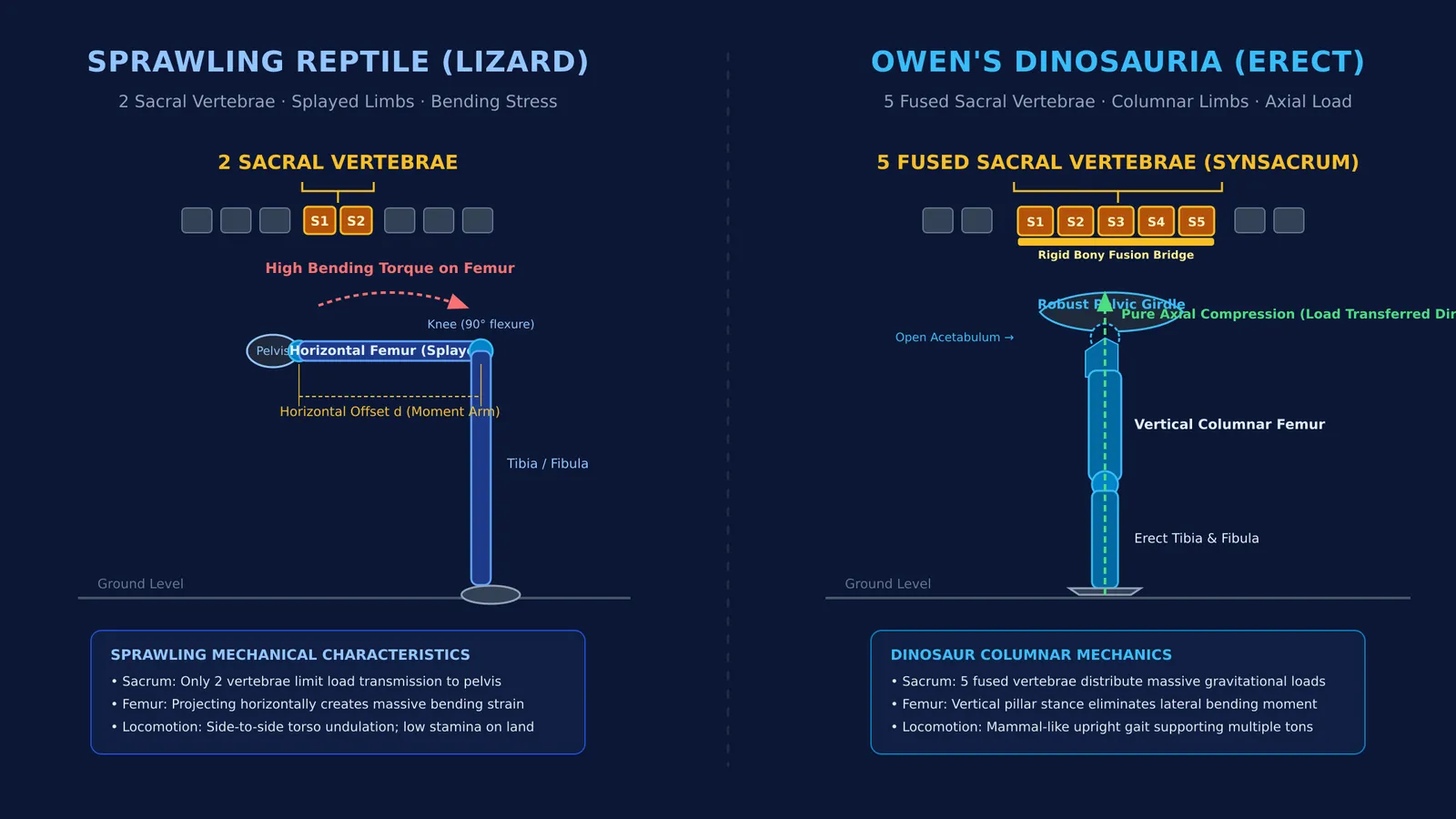
Before Owen's synthesis, naturalists assumed that extinct reptiles shared the sprawling posture of modern monitor lizards and crocodiles. In living reptiles, the limbs project outward horizontally from the sides of the torso, and the sacrum contains only 2 sacral vertebrae connecting the backbone to the pelvic girdle, as highlighted in comparative evaluations of Owen's taxonomy. This geometry limits stamina and requires reptiles to crawl with an undulating, side-to-side gait.
Owen discovered that both *Megalosaurus* and *Iguanodon* possessed 5 fused sacral vertebrae. This extended sacrum created an exceptionally rigid, shock-absorbing anchor for the pelvis, capable of supporting thousands of kilograms on land. Just as Georges Cuvier proved that fossil bones reveal species extinction, Owen's osteological analysis demonstrated that dinosaurs stood on vertical, pillar-like legs tucked directly beneath their bodies, resembling elephants and rhinoceroses rather than sprawling lizards.
This anatomy carried ideological weight in Victorian science. Radical thinkers cited Lamarckian transmutation to claim that life ascends continuously from crude, primitive forms to complex modern ones. Owen overturned that view: the fossil record showed that ancient reptiles possessed advanced, mammal-like skeletal mechanics, while living lizards were comparatively diminished. To Owen, dinosaurs demonstrated that vertebrate design began at magnificent heights rather than ascending through unguided change.
How can students diagnose vertebrate fossils from skeletal anatomy?
When examining vertebrate fossils, reconstructing an organism from isolated bones requires a systematic method based on established osteological criteria. Comparing axial and appendicular skeletal anatomy shows whether an animal was built for sprawling crawl, swimming, or upright terrestrial locomotion:
Check sacral vertebral fusion: Sprawling reptiles have 2 sacral vertebrae; dinosaurs possess 5 or more fused sacral vertebrae to anchor the pelvis.
Inspect the hip socket: Sprawling lizards have a solid cup directing the femur sideways. Dinosaurs developed an open, perforate acetabulum locking the femoral head into a vertical stance.
Trace limb articulation: Dinosaurs bear columnar femurs with an inward-turned femoral head fitting directly beneath the pelvic girdle rather than jutting outwards.
Evaluate tooth implantation: Unlike lizards whose teeth fuse along the jaw ridge, archosaurs and dinosaurs anchor teeth within deep sockets.
Why does comparative anatomy matter for active learning?
Mastering biology requires looking past superficial labels to understand mechanical relationships. When preparing for competitive examinations or advanced courses, students often memorize names without exploring the skeletal mechanics behind body plans. Connecting bone architecture to physical forces makes comparative morphology intuitive and memorable.
Working through morphological problems helps students develop first-principles reasoning. The Fermi Concept Library covers every concept in physics, chemistry, biology, mathematics and computing, placing structural adaptations into an interconnected map of life. When you need to practise applying physiological and biomechanical principles to exam scenarios, the Fermi Problem Library provides worked problems with a step-by-step solver that explains the reasoning rather than printing an answer.


