On this page
If you love animals and are studying biology, you have probably wondered whether wildlife work is a real job or a hobby with a long commute. It is a real job. But the road runs through a small number of competitive master's programmes, years of fieldwork and, for many, a PhD.
What do you study to become a wildlife biologist in India?
You do not need a degree called "wildlife" to start. A BSc in zoology, botany, life sciences, environmental science, forestry or agriculture is a common base, and the specialised training comes at master's level.
Two programmes are widely known. The Wildlife Institute of India's MSc in Wildlife Science is a two-year residential course in Dehradun, at an autonomous institution of the Ministry of Environment, Forest and Climate Change, and affiliated to AcSIR. Its 2025-27 advertisement accepted a bachelor's degree in life sciences, environmental science, veterinary science, agriculture, forestry and several other fields, including engineering and computer science.
The MSc in Wildlife Biology and Conservation at NCBS, Bengaluru is open to Indian graduates in any discipline with 50% aggregate marks in core subjects, including students in their final year.
Some people reach conservation work through government service instead, for example through the Indian Forest Service exam conducted by UPSC. Check the current notice there for eligibility, because exam rules change each year.
How hard is it to get into a wildlife master's?
The seats are few. The WII 2025-27 advertisement offered 20 seats in total: 15 for Indian nationals and 5 for foreign nationals. Applicants needed 50% aggregate marks (45% for SC/ST candidates), and that year's upper age limit was 25, with relaxations for OBC and SC/ST candidates.
Selection at WII starts with a 2-hour online test of 100 marks covering aptitude, language, basic maths and quantitative skills, biology, ecology and conservation issues. Shortlisted candidates then sit a personality and aptitude test in Dehradun, and the final merit list weighs the written test and the interview 50:50.
Money matters too. The same advertisement put the course fee at about ₹6,50,000 for Indian students, with full scholarships for eight Indian students on merit and a ₹3,000 monthly stipend, both subject to the institute's funds. At NCBS, the programme covers course fees for all selected students, takes up to fifteen Indian students per batch, and selects through a 3-hour test in four sections, the last an essay on an ecology or conservation topic.
If school maths has gone rusty, the Fermi Concept Library has a lesson for each concept in mathematics and biology, so you can rebuild probability, graphs or basic ecology one idea at a time.
What are field jobs in conservation actually like?
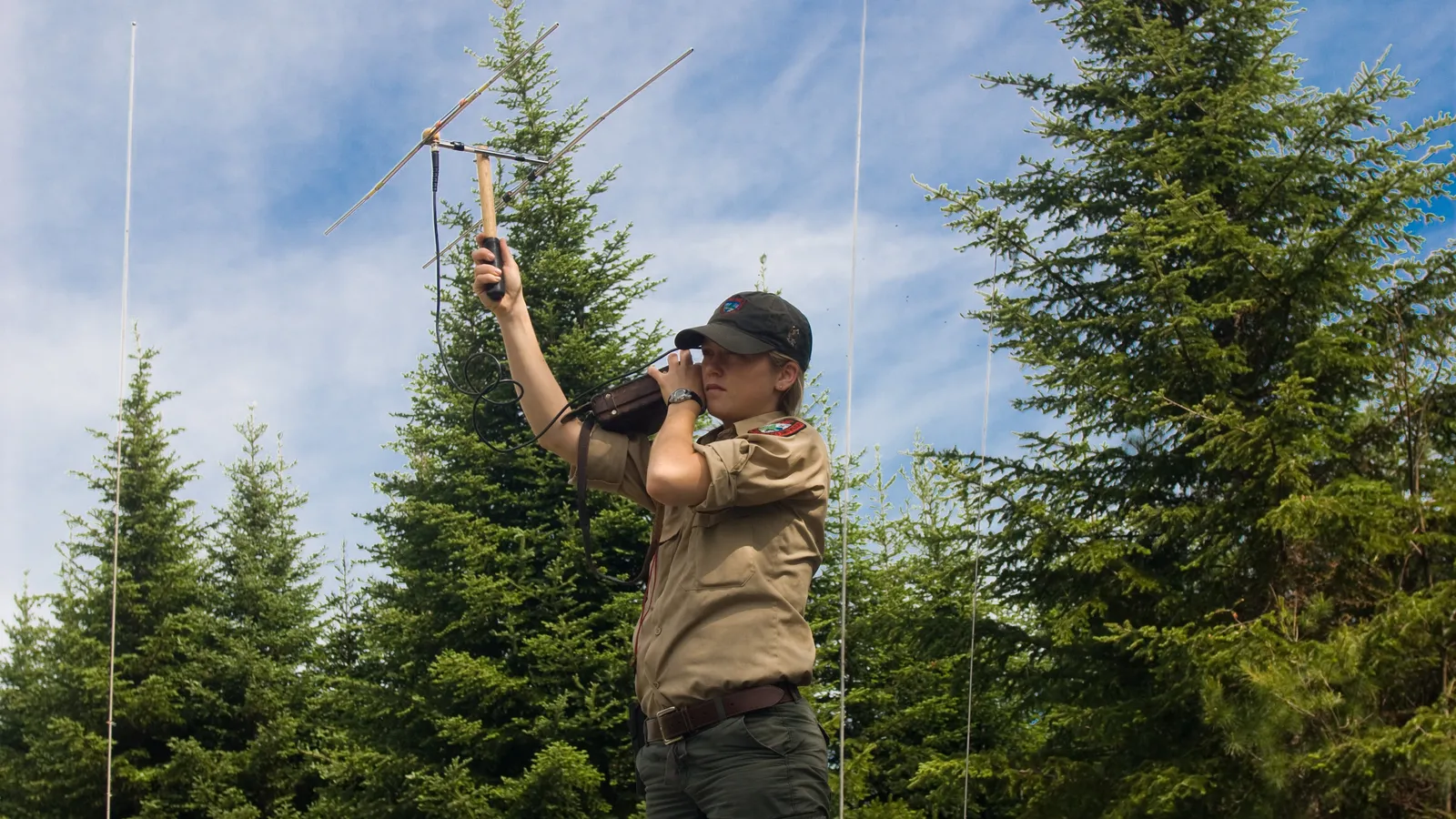
The US Bureau of Labor Statistics describes American jobs, but its picture is a useful guide. Zoologists and wildlife biologists typically need a bachelor's degree to enter the occupation, at least a master's for higher-level positions, and a PhD for independent research positions. Fieldwork may mean travelling to remote locations for long periods, and it can be physically demanding, with work outdoors in all types of weather.
In practice, early jobs are often project-based: field assistant or research assistant on a funded study, setting camera traps, walking transects, recording data and entering it every evening. Such posts often last only as long as the project's grant. That is common in this field, not a sign that you have failed.
The work is also less solitary than people expect. Conservation projects often deal with forest departments, farmers and villagers whose lives overlap with wildlife, and talking with people, writing reports and cleaning data can take up much of the week.
A plan from first-year BSc to your first field job
First year: choose core subjects that match the eligibility lists in the WII advertisement and on the NCBS page, and protect your aggregate, since both set a 50% floor for general candidates.
Second year: volunteer for a bird count, a college survey or a short internship with a conservation NGO.
Second year, holidays: learn basic statistics and a spreadsheet properly. Practise turning field counts into a table and a graph.
Final year: apply to both programmes in the same cycle. Read each year's advertisement, because dates, fees and age limits change. Practise writing a short essay on a conservation issue you care about.
After the master's: expect some time in project jobs before deciding on a PhD. Keep a notebook of every method you have used in the field; it becomes your CV.
If you are not sure where your gaps are before an entrance test, Fermi's AI tutor works out what you already know and builds a plan for the session, so each study hour goes where it is needed.
Start with the latest WII admissions page and the NCBS programme page, and mark next year's dates now.