On this page
Rub a mint leaf between your fingers and the smell reaches you at once. Leave the same leaf on the plant and you barely notice it. That difference is the whole story: the smell is sealed inside tiny containers on the leaf surface, and crushing the leaf breaks them open.
Where does the smell of mint and tulsi come from?
The leaves of mint and tulsi carry microscopic oil glands called glandular trichomes, a kind of leaf hair that makes chemicals instead of just covering the surface.
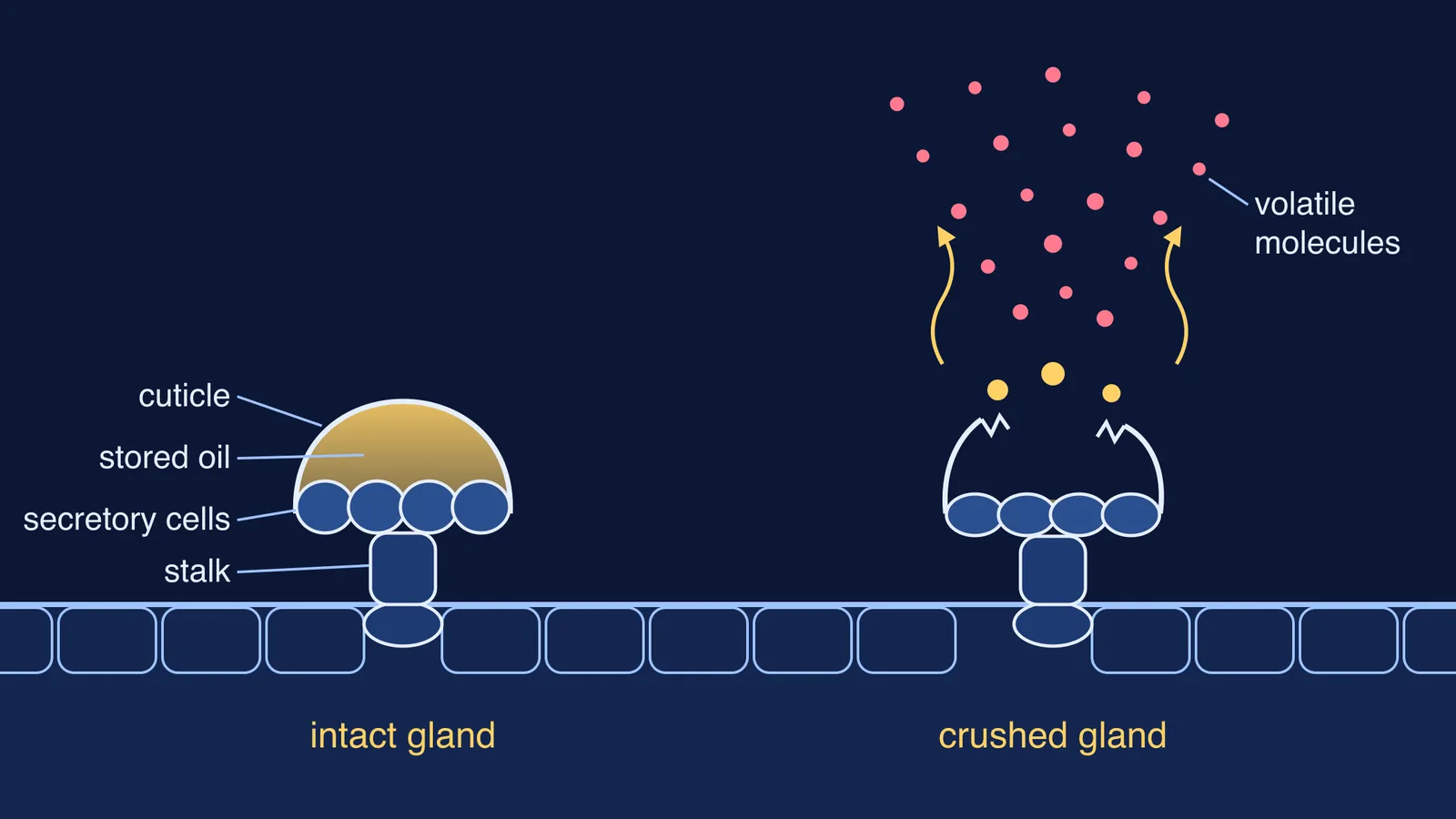
In peppermint, each peltate (shield-shaped) gland has a basal cell, a stalk cell and eight secretory cells arranged in a disc, according to a study of peppermint oil glands in Plant Physiology. The same study describes how the gland stores its oil: the thick cuticle on top separates from the secretory cells to form a subcuticular pocket, and the oil collects there. Think of it as a sealed storage tank sitting on a short stalk.
Tulsi (holy basil, Ocimum tenuiflorum) works the same way. In a BMC Genomics study of holy and sweet basil, the authors note that most of the plant's aromatic chemicals are sequestered in glandular trichomes on the surface of the leaves and stems. In sweet basil, a close relative, the peltate glands were found to be "the major, and possibly the only, site" where its fragrant compounds are made and stored (Plant Physiology, 2001).
What chemicals make tulsi and mint smell?
The oils are mixtures of volatile compounds: small molecules that evaporate easily at room temperature, which is how they travel through the air to your nose.
Mint: menthol is "the principal and characteristic constituent of the essential oil of peppermint", made inside the oil glands through eight enzyme steps, with a ring-shaped molecule called limonene formed early in the sequence (Naturwissenschaften, 2005).
Tulsi: eugenol made up 83.56% of the essential oil of the Indian tulsi variety CIM-Ayu (BMC Genomics, 2014).
Not every tulsi smells the same. In the essential oil of tulsi grown in Australia, eugenol was only 13.77%, behind camphor (31.52%) and eucalyptol (18.85%) (Frontiers in Microbiology, 2016). So two tulsi plants, from different seeds or places, can smell noticeably different.
If words like monoterpene or phenylpropene are new to you, the Fermi Concept Library has every concept in chemistry and biology, each with its own lesson.
Why do leaves smell stronger when you crush them?
An intact gland keeps its oil sealed under the cuticle, so much less of it reaches the air. Crushing tears that cuticle and releases the whole store at once, spread thinly over your fingers and the torn leaf, where it evaporates quickly.
Insects trigger the same thing. A review of glandular trichomes in the International Journal of Molecular Sciences describes how glandular trichomes break open when insects walk over or damage them, and how attackers can be trapped by sticky or toxic exudates.
Why do plants make strong-smelling oils at all?
Mostly for defence. The same review calls glandular trichomes "important chemical barriers for plant parasites" and names mint and basil as plants grown for their trichome-made essential oils. In one example from that review, a compound released from the glandular trichomes of a wild potato was shown to repel aphids.
For tulsi's main compound, the sweet basil study notes that eugenol has a marked effect against insects that feed on plants and also inhibits the growth of many food-borne bacteria.
This is plant chemistry, not a health claim. If you are thinking of using tulsi or mint oil for an illness, ask a doctor first.
Try it: a 10-minute leaf test at home
Pick two mint or tulsi leaves of similar size. Smell the first without bending or rubbing it, and rate the smell from 0 to 5.
Rub the second leaf between your fingers, smell it, and rate it again.
Wait 10 minutes and smell the rubbed leaf once more. If the smell has faded, that is volatility: the molecules have left for the air.
Zoom your phone camera in on the underside of a leaf in good light and note anything you see on the surface.
If you can, repeat with tulsi from a different home or nursery and compare the smell.
Write one line explaining your results with four words: gland, cuticle, volatile, defence.
How molecules move and spread is often easier to watch than to read about. The Fermi Simulation Lab has interactive simulations for the ideas that are easier to see than to read.