On this page
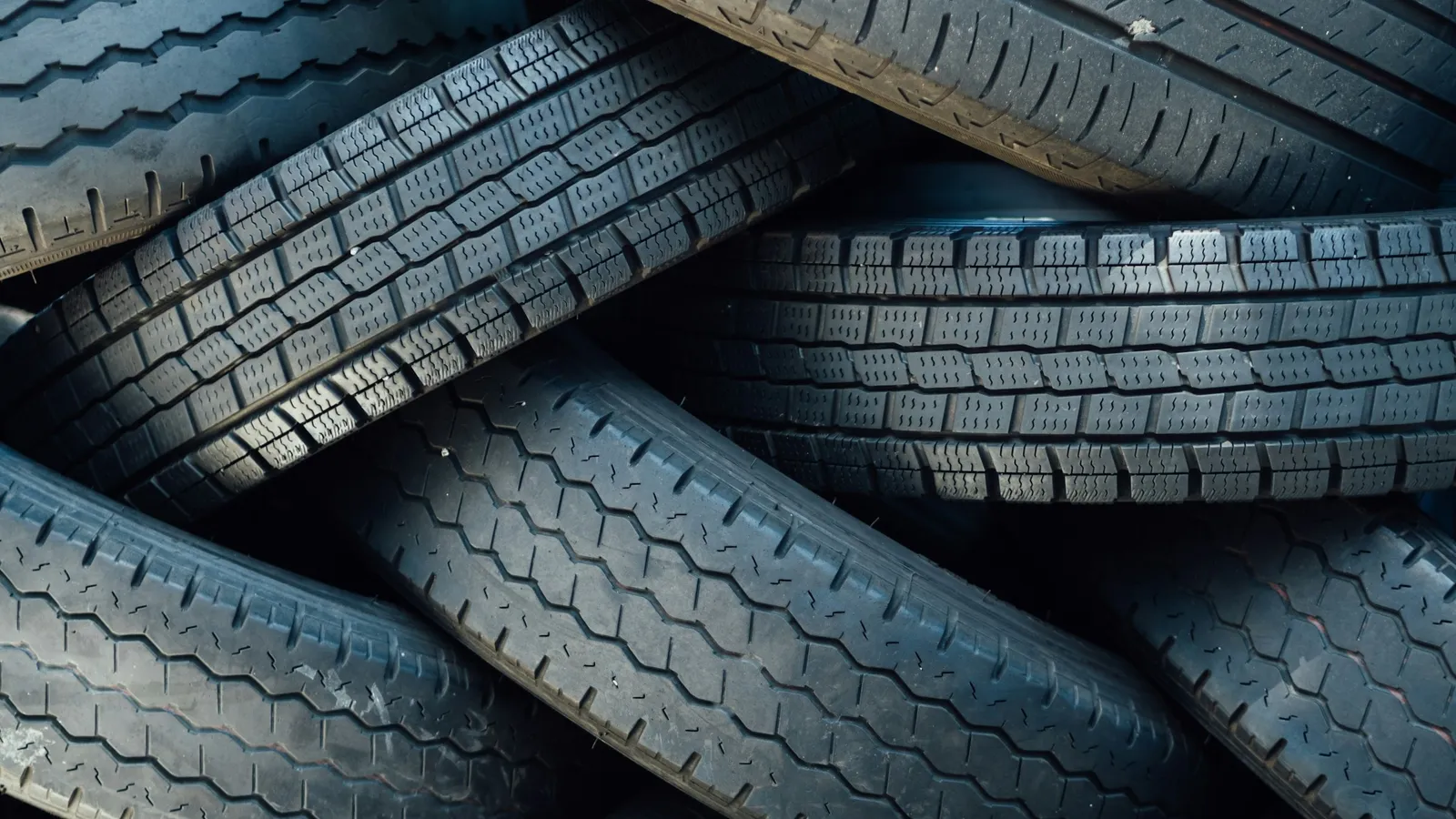
Look at the traffic on any Indian road: autos, scooters, buses, trucks. Every tyre is black. That is not a style choice. Rubber is not black to begin with; as Apollo Tyres explains, its natural colour is milky white, and the pneumatic tyres of the 1890s were mostly white too. The black comes from one ingredient added for strength, and the colour is a side effect.
What is carbon black, and why is it in tyres?
Carbon black is a powder of nanometre-scale carbon particles that stick together in clusters called aggregates. In a 2021 review in the journal Polymers, Christopher Robertson and Ned Hardman list mean aggregate diameters of 63 to 179 nm for common rubber grades of carbon black.
Tyres are where most of it ends up. The same Polymers review gives the global production of carbon black as 15 million metric tons a year, with 93% going into rubber: 73% into automobile tyres and 20% into other rubber products.
How does carbon black make rubber stronger?
Rubber is made of long, tangled polymer chains. Vulcanisation ties those chains together with sulphur crosslinks (the story of how that was found is in our post on Charles Goodyear and vulcanisation). Crosslinks alone are not enough. The Polymers review puts it plainly: "Without fillers, crosslinked rubbers are generally weak materials."
Reinforcing fillers such as carbon black enhance the tensile strength, tear resistance and abrasion resistance of rubber, and make it stiffer, according to the same review. Part of the picture is how rubber chains interact with the particle surface. Chemists measure this as "bound rubber": the portion of the elastomer that interacts with the filler so strongly that a solvent cannot extract it from the uncured mix.
Here is a detail many explainers skip. The review notes that carbon black reinforcement has been studied for nearly 100 years, yet the origin of the stiffening is still debated, including whether the chains are only physically adsorbed on the carbon or also chemically bonded to it.
Tyres use synthetic rubber as well as natural rubber; read how Sergei Lebedev made synthetic rubber from butadiene.
Why are tyres black and not white or coloured?
A tyre sits in the sun for years, and ultraviolet light can degrade rubber over time. Apollo Tyres says carbon black shields tyres against UV radiation, decreasing the chance of premature degradation. Cabot, a carbon black maker, states that carbon black particles can absorb UV radiation in polymers, and that how well they work depends on particle size, aggregate structure, loading and how evenly they are dispersed.
Research points the same way on particle size. A 2018 study in Polymer Degradation and Stability tested a polyurethane-urea elastomer stabilised with a range of carbon blacks under UV light and found that carbon black gave moderate protection, with the smallest particles the most effective.
Apollo Tyres adds two practical points: it says the black colour helps a tyre dissipate heat, and that the carbon black mix increases resistance to abrasion, so the tread lasts longer. Strength and sun protection from one cheap additive is why black stuck.
How do you explain this in a chemistry answer?
If a test or viva asks why tyres are black, a four-line structure covers it and shows you understand materials, not just the fact:
Natural rubber is milky white; the colour comes from an additive.
The additive is carbon black, a nanoscale filler mixed into vulcanised rubber.
Rubber chains interact strongly with its surface (bound rubber), and the filler raises tensile strength, tear resistance and abrasion resistance.
Carbon black also absorbs UV light, which slows sunlight damage to the rubber.
Then try a quick predict-and-check at home. Before you look, predict the colour of each rubber object below, then check:
a bicycle or scooter tyre (outdoors, rubs on the road)
a pencil eraser (indoors, no road wear)
kitchen or lab gloves (indoors, short life)
The pattern to look for: rubber that faces years of sunlight and road wear is usually black, while rubber that does not is often coloured.
For ideas that are easier to see than to read, the Fermi Simulation Lab has interactive simulations. If words like elastomer or crosslink are new, the Fermi Concept Library covers every concept in chemistry, physics, biology, mathematics and computing.
Next time you check tyre pressure, read our post on how tubeless tyres hold air, even with a nail in them.