On this page
In 1910 the chemist Sergei Lebedev became the first person to polymerise butadiene, a small gas molecule, into a rubbery solid (Polybutadiene, Wikipedia). Twenty-two years later, a new Soviet factory was turning out his rubber in 500-kilogram batches, and today about 70% of polybutadiene goes into tyres, according to the same source. His work is also a clean, real-world example of the addition polymers in Class 12 chemistry.
Who was Sergei Lebedev?
Sergei Vasilyevich Lebedev was born on 13 July 1874 in Lublin and died in Leningrad on 2 May 1934 (Sergey Lebedev, Wikipedia)). He researched the polymerisation of butadiene from 1910 to 1913. The same source records that he received the Order of Lenin in 1931 and became a full member of the Soviet Academy of Sciences in 1932.
How did Lebedev make rubber from butadiene?
His process had two steps, and both are worth knowing.
Alcohol to butadiene. Between 1926 and 1928 he developed a single-stage method for making butadiene from ethanol (Sergey Lebedev, Wikipedia)). The overall reaction runs at 400 to 450 °C over metal oxide catalysts: 2 CH₃CH₂OH → CH₂=CH–CH=CH₂ + 2 H₂O + H₂ (1,3-Butadiene, Wikipedia).
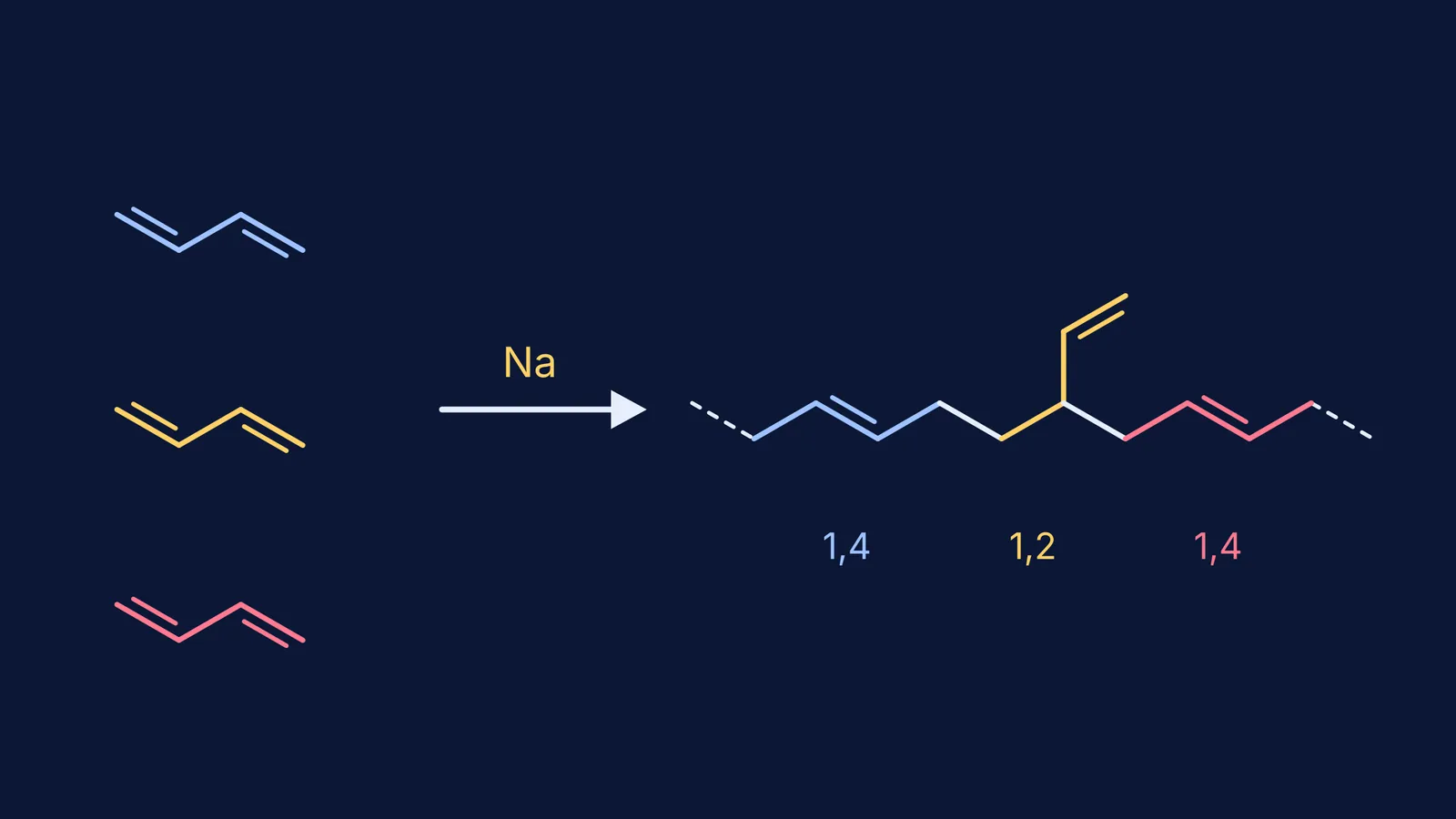
Butadiene to rubber. In 1928 he worked out an industrial method that polymerised butadiene using metallic sodium as the catalyst (University of Bristol, Molecule of the Month: butadiene).
The ethanol came from grain or potatoes, which, as the Bristol page notes, led to jokes about Russian tyres being made from potatoes.
When did the USSR start making synthetic rubber at scale?
The historian R. A. Lewis traces the story in the journal Slavic Review (Lewis, 1979, doi:10.2307/2497226). At the end of 1927, a two-kilogram package of a honey-coloured material its makers called "Diolefin", Lebedev's entry in a state competition, was deposited with the chemical industry's scientific and technical council in Moscow. Just over four and a half years later, on a summer day in 1932, 500 kilograms of the same material came out of an autoclave in a new factory in Yaroslavl.
That factory, SK-1, had a design capacity of 10,000 metric tons and, Lewis writes, was the first large-scale synthetic rubber plant built anywhere in the world (Lewis, 1979). The first three Soviet plants opened in 1932 and 1933, and by 1940 the industry was producing more than 50,000 tons a year (Sergey Lebedev, Wikipedia)). Lebedev lived to see the first plants run; he died in 1934.
What is Buna rubber, and where is it in Class 12 chemistry?
The name Buna comes from Lebedev's recipe: Bu for butadiene and Na for sodium (natrium in Latin) (Polybutadiene, Wikipedia). Scientists at Bayer in Germany, who reproduced his sodium process, coined it, and it stuck to later rubbers too.
Polybutadiene is a homopolymer: one monomer, butadiene, repeated.
Buna-S is a copolymer of butadiene and styrene (Styrene-butadiene, Wikipedia).
Buna-N is a copolymer of butadiene and acrylonitrile, also called nitrile rubber (Nitrile rubber, Wikipedia).
In CBSE's 2026-27 Class 12 chemistry curriculum, Polymers ("Polymerisation, Homopolymers and copolymer with few examples") is listed among topics that will be assessed only formatively, not in the summative assessments (CBSE Chemistry curriculum 2026-27). Entrance exam syllabi are set separately and change, so check the current official syllabus for your exam before you decide how much time polymers get.
How do you draw the polybutadiene repeat unit?
This is where butadiene gets tricky, because the double bond moves. Work through it once with a pencil.
Write the monomer and number it: C1H₂=C2H–C3H=C4H₂.
1,4-addition: C1 and C4 each form a new bond to the next unit. Both old double bonds open, and one new double bond forms between C2 and C3. The repeat unit is –CH₂–CH=CH–CH₂–.
1,2-addition: only the C1=C2 double bond opens. C3=C4 stays intact and hangs off the chain as a vinyl side group: –CH₂–CH(CH=CH₂)–. The Bristol page describes both routes (University of Bristol).
Check the atoms. Each repeat unit is still C₄H₆, the same as the monomer. Nothing is lost, which is what makes this addition polymerisation, not condensation.
Extend to a copolymer. For Buna-S, draw a butadiene unit next to a styrene unit, –CH₂–CH(C₆H₅)–, and you have the idea.
If the idea of a double bond "moving" still feels slippery, look up addition polymerisation in the Fermi Concept Library, which gives every chemistry concept its own lesson and its place in the map. If you are unsure where polymers fit in your revision, Fermi's AI tutor can work out what you already know and build a plan for the session.
Next time you see the word Buna in a textbook, read it as a recipe: butadiene, sodium, and a chemist who spent two decades getting from a flask to a factory.