On this page
Class 12 crystal field theory starts with the octahedron: two sets of orbitals, one gap called Δo. Square planar complexes split the d orbitals into four levels instead. It gets easier once you see the square as an octahedron that has lost its two z-axis ligands.
What happens to the d orbitals when the z ligands leave?
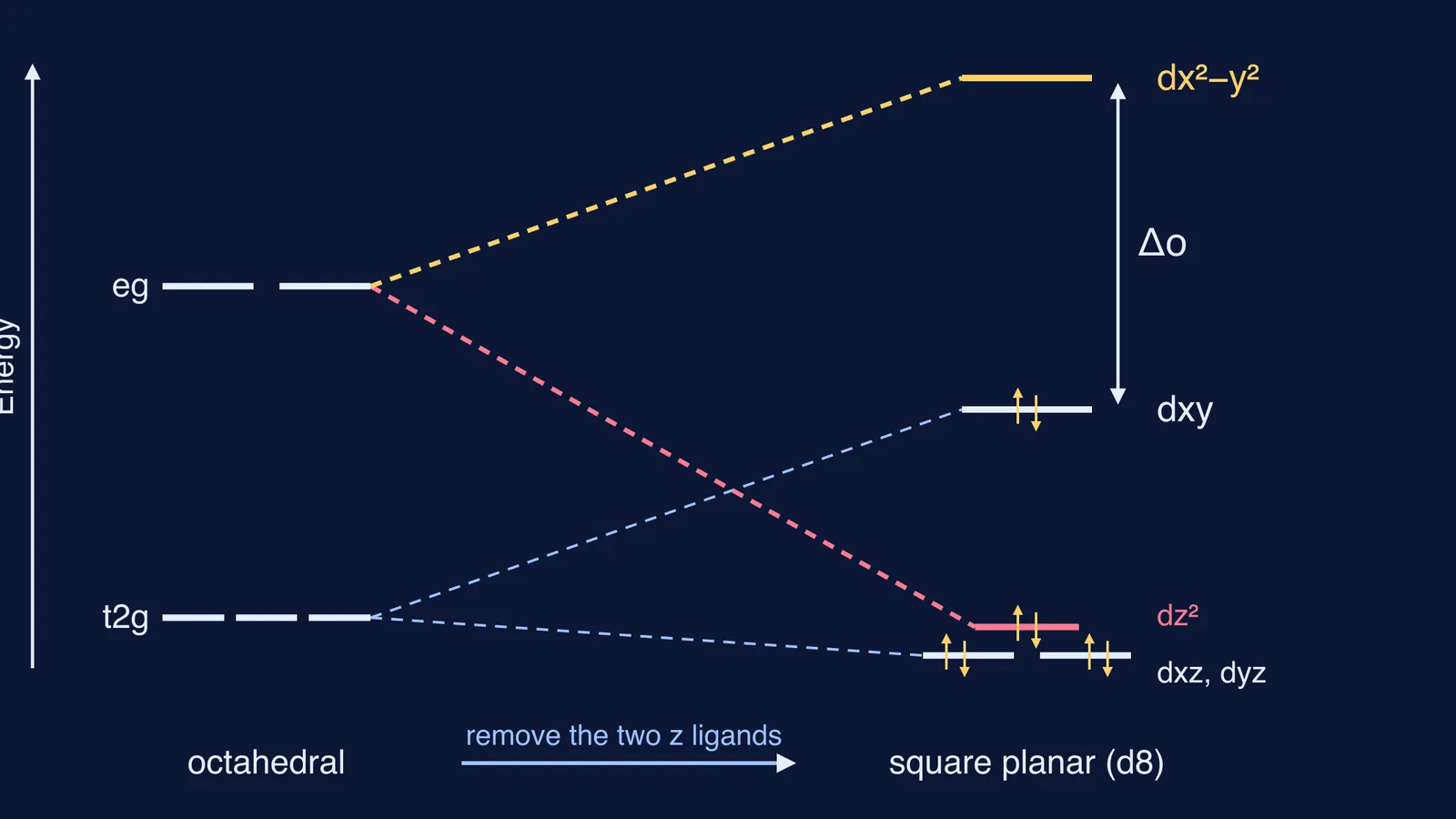
Pull the two z-axis ligands of an octahedral complex away. The Penn State chemistry text on LibreTexts/05%3A_Coordination_Chemistry_and_Crystal_Field_Theory/5.07%3A_Non-octahedral_Complexes) describes this tetragonal distortion: the orbitals with a z component (dxz, dyz, dz²) go down in energy, while the two that lie in the xy plane (dxy, dx²−y²) go up.
dz² falls a long way. Its big lobes pointed at the two ligands that left, so its energy drops much faster than that of dxz and dyz. It is not fully non-bonding, because the ring round its middle still meets the four in-plane ligands, as the LibreTexts inorganic chemistry text on square planar complexes/10%3A_Coordination_Chemistry_II_-_Bonding/10.03%3A_Ligand_Field_Theory/10.3.05%3A_Square-Planar_Complexes) explains.
dx²−y² rises. Its lobes point straight at the four ligands that remain, and those ligands now interact more strongly with it, as the University of Arkansas at Little Rock course text describes.
What is the order of d orbitals in a square planar complex?
From top to bottom: dx²−y², then dxy, then dz² and the dxz, dyz pair close together at the bottom. That makes four energy levels, with only dxz and dyz still degenerate (LibreTexts/10%3A_Coordination_Chemistry_II_-_Bonding/10.03%3A_Ligand_Field_Theory/10.3.05%3A_Square-Planar_Complexes)).
In the simple point-charge model, the energies are +12.28 Dq for dx²−y², +2.28 Dq for dxy, −4.28 Dq for dz² and −5.14 Dq each for dxz and dyz, where 10 Dq = Δo (crystal field notes by Prof. Narendra Pratap Singh, Udai Pratap College, Varanasi). Treatments that include bonding can put dz² below dxz and dyz (LibreTexts/10%3A_Coordination_Chemistry_II_-_Bonding/10.03%3A_Ligand_Field_Theory/10.3.05%3A_Square-Planar_Complexes)), so learn the top two firmly and treat the bottom three as a close group.
The key fact: the gap between dxy and dx²−y² stays equal to Δo, whatever the distortion (LibreTexts/05%3A_Coordination_Chemistry_and_Crystal_Field_Theory/5.07%3A_Non-octahedral_Complexes)).
Why do d8 ions with strong ligands prefer square planar geometry?
Count the electrons. The Penn State text says that at d8 the lowest four orbitals are filled and the highest is empty, which gives a large crystal field stabilisation energy, or CFSE (LibreTexts/05%3A_Coordination_Chemistry_and_Crystal_Field_Theory/5.07%3A_Non-octahedral_Complexes)).
Pairing costs energy, though. The eighth electron has a choice: pair up in dxy, or jump the Δo gap into dx²−y². It pairs only when the gap is bigger than the pairing energy, and the gap is big only with strong field ligands or heavier metals. That is why the same text says square planar geometry often shows up in 3d8 complexes with strong field ligands and in 4d8 and 5d8 complexes with any ligands.
The ligand makes a real difference: for palladium complexes, two of the gaps between the upper levels are about 50% greater with cyanide than with chloride (LibreTexts/10%3A_Coordination_Chemistry_II_-_Bonding/10.03%3A_Ligand_Field_Theory/10.3.05%3A_Square-Planar_Complexes)).
Worked example: why is [Ni(CN)₄]²⁻ square planar?
Ni²⁺ is 3d8, and CN⁻ is a strong field ligand. Use the point-charge energies from the Udai Pratap College notes.
Low spin (all paired, dx²−y² empty): 4 × (−5.14) + 2 × (−4.28) + 2 × (+2.28) = −24.56 Dq.
High spin (one electron each in dxy and dx²−y²): 4 × (−5.14) + 2 × (−4.28) + 1 × (+2.28) + 1 × (+12.28) = −14.56 Dq.
Low spin is 10 Dq lower, which is exactly Δo, but it needs one extra electron pair. So it wins when Δo is larger than the pairing energy.
Cyanide makes Δo large, so all eight electrons pair. No unpaired electrons means [Ni(CN)₄]²⁻ is diamagnetic, which is what the UALR course text reports.
Now swap the ligand. With weak field ligands Ni²⁺ is not square planar: [NiCl₄]²⁻ is tetrahedral (UALR course text), and [Ni(H₂O)₆]²⁺ is octahedral and paramagnetic with two unpaired electrons (LibreTexts/05%3A_Coordination_Chemistry_and_Crystal_Field_Theory/5.07%3A_Non-octahedral_Complexes)). For the full octahedral and tetrahedral arithmetic, see our guide to calculating CFSE for octahedral and tetrahedral complexes, and for the magnetic side, how high-spin and low-spin complexes differ.
Heavier metals rely less on the ligand: the Penn State text lists cisplatin, cis-Pt(NH₃)₂Cl₂, plus [Pd(H₂O)₄]²⁺ and [AuCl₄]⁻ as square planar d8 examples. Our post comparing nickel complexes by hybridisation tells the same story in valence bond (dsp²) language.
How do you answer square planar questions in an exam?
Run this four-step check:
Find the d count of the metal ion. Square planar is a d8 signal.
Check the row. For 4d8 and 5d8 ions (Pd²⁺, Pt²⁺, Au³⁺), usually expect square planar with any ligand.
For 3d8 (Ni²⁺), check the ligand. Strong field, such as CN⁻: square planar. Weak field, such as Cl⁻ or H₂O: tetrahedral or octahedral.
Predict the magnetism. Square planar d8 is diamagnetic, so a d8 complex with two unpaired electrons is not square planar.
When you draw the diagram, push dz² down, dx²−y² up, and mark the dxy to dx²−y² gap as Δo. If you keep getting a step wrong, the Fermi Problem Library has worked problems with a step-by-step solver that explains the reasoning rather than printing an answer. If the orbital shapes themselves are the gap, every chemistry concept in the Fermi Concept Library has its own lesson.