

On this page
Crystal field stabilisation energy (CFSE) questions are really a counting exercise. Once you know where each d electron goes and what each orbital set is worth, every answer takes about four lines.
To revise ligands first, read our posts on ligand denticity and the chelate effect and naming coordination compounds and crystal field basics.
What is crystal field stabilisation energy?
CFSE is the energy of the d electrons in the split crystal field minus their energy in an imaginary spherical field with no splitting, as set out in this LibreTexts chapter on CFSE. The splitting keeps the average energy fixed, so some orbitals go down and others go up.
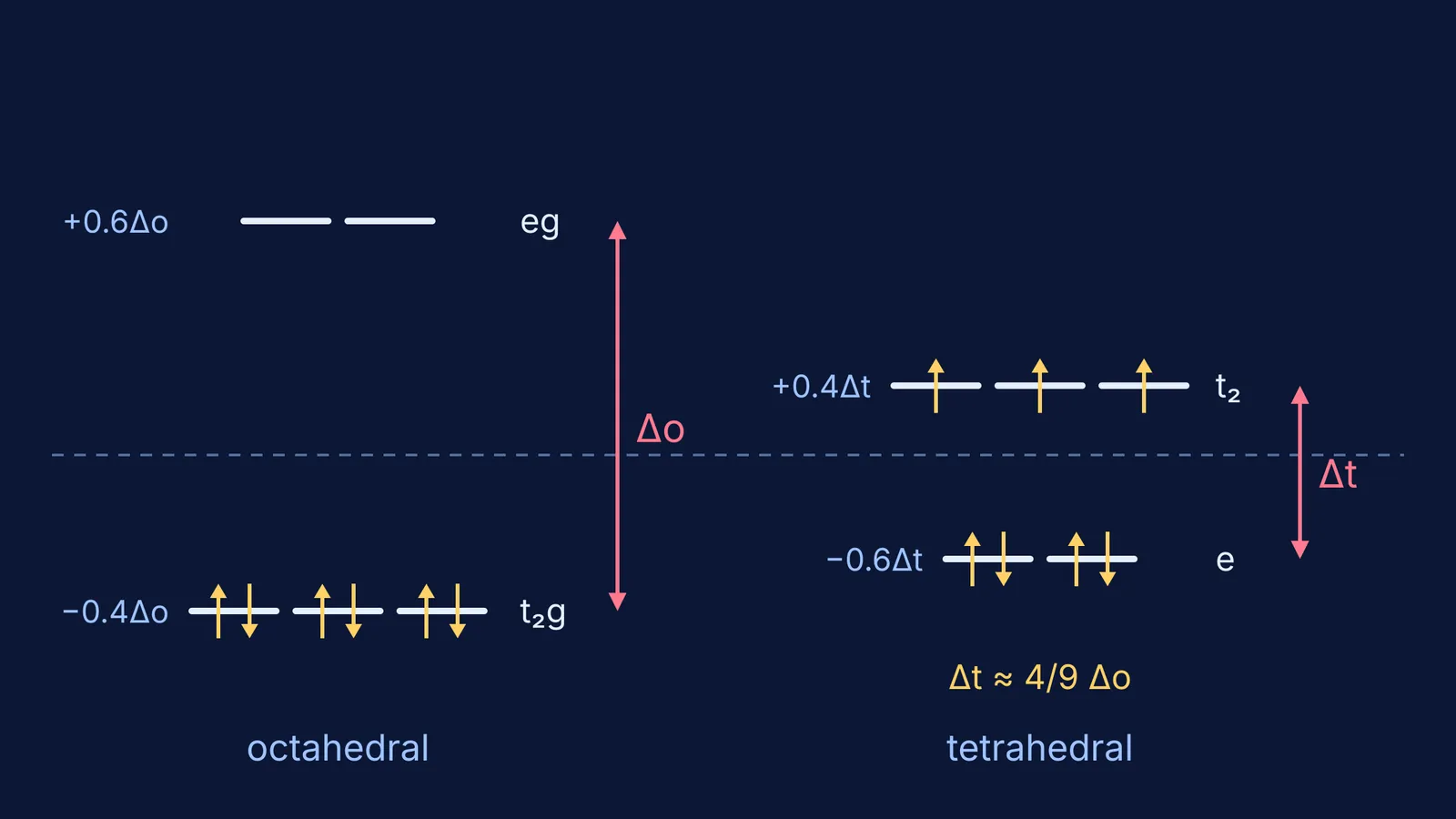
In an octahedral field, the three t₂g orbitals drop by 0.4Δo and the two e_g orbitals rise by 0.6Δo, according to LibreTexts on crystal field stabilisation energy. Check the balance: 3 × (−0.4) + 2 × (+0.6) = 0.
The working formula is CFSE = (−0.4 × electrons in t₂g + 0.6 × electrons in e_g) Δo, before any pairing correction.
How do you fill t₂g and e_g for weak and strong ligands?
For d¹, d² and d³ the electrons go singly into t₂g, and for d⁸, d⁹ and d¹⁰ there is only one possible arrangement (t₂g full, the rest in e_g). The choice only arises for d⁴, d⁵, d⁶ and d⁷, where electrons beyond the third can either pair up in t₂g or go up to e_g.
The Penn State Wikibook chapter on CFSE and pairing/05%3A_Coordination_Chemistry_and_Crystal_Field_Theory/5.06%3A_Crystal_Field_Stabilization_Energy_Pairing_and_Hund's_Rule) defines pairing energy P as the energy penalty for putting two electrons in the same orbital, and states that a complex is low spin if Δo > P and high spin if Δo < P.
Weak-field ligand (small Δo, Δo < P): fill all five orbitals singly before pairing. This is high spin.
Strong-field ligand (large Δo, Δo > P): fill t₂g completely (up to six electrons) before using e_g. This is low spin.
To decide which kind of ligand you have, use the spectrochemical series. One common form, in order of decreasing Δo, is CO ≈ CN⁻ > NO₂⁻ > en > NH₃ > SCN⁻ > H₂O > oxalate > OH⁻ > F⁻ > acetate > Cl⁻ > Br⁻ > I⁻, from this LibreTexts page on the spectrochemical series/CHEM_431_Readings/11%3A_Ligand_Field_Theory_(LFT)_and_Crystal_Field_Theory_(CFT)_of_Octahedral_Complexes/11.05%3A_The_Effect_of_Ligands_and_the_Spectrochemical_Series).
How do you add pairing energy to CFSE?
Add +P for each electron pair the low-spin arrangement creates beyond the high-spin one. The Penn State Wikibook/05%3A_Coordination_Chemistry_and_Crystal_Field_Theory/5.06%3A_Crystal_Field_Stabilization_Energy_Pairing_and_Hund's_Rule) gives low-spin d⁴ as −8/5 Δo + P: t₂g⁴ has one pair, high-spin t₂g³e_g¹ has none.
For a sense of scale, the same Wikibook notes that a typical P for 3d elements is about 15,000 cm⁻¹.
Worked example: one d⁶ ion, two ligands
Take a d⁶ ion, such as Fe²⁺, and apply the Wikibook rule/05%3A_Coordination_Chemistry_and_Crystal_Field_Theory/5.06%3A_Crystal_Field_Stabilization_Energy_Pairing_and_Hund's_Rule) that low spin wins when Δo > P.
Weak-field ligand, high spin: t₂g⁴e_g². CFSE = 4(−0.4) + 2(+0.6) = −1.6 + 1.2 = −0.4Δo. One pair, which the free ion also has, so no P term.
Strong-field ligand, low spin: t₂g⁶e_g⁰. CFSE = 6(−0.4) = −2.4Δo. Three pairs against one in high spin, so add 2P: CFSE = −2.4Δo + 2P.
Compare with made-up numbers: suppose Δo = 20,000 cm⁻¹ and P = 15,000 cm⁻¹. High spin gives −8,000 cm⁻¹. Low spin gives −48,000 + 30,000 = −18,000 cm⁻¹, so low spin wins, as it should when Δo > P.
How do you calculate CFSE for a tetrahedral complex?
Tetrahedral splitting is upside down: the two e orbitals drop by 0.6Δt and the three t₂ orbitals rise by 0.4Δt, as given on the LibreTexts CFSE page. There is no g in the labels because a tetrahedron has no centre of symmetry.
For the same metal and ligands, Δt is approximately 4/9 Δo, says LibreTexts on octahedral vs tetrahedral geometries/Crystal_Field_Theory/Octahedral_vs._Tetrahedral_Geometries), so tetrahedral complexes are often high spin; the ETSU LibreTexts chapter says always, because the splitting is appreciably smaller than P. In exam problems, treat them as high spin: fill e and t₂ singly, then pair.
Worked example, tetrahedral d⁷ (for instance Co²⁺): e⁴t₂³. CFSE = 4(−0.6) + 3(+0.4) = −2.4 + 1.2 = −1.2Δt. To express it in Δo units, multiply by 4/9: −1.2 × 4/9 ≈ −0.53Δo.
Octahedral CFSE from d¹ to d¹⁰: a list to check your answers
These follow from the −0.4Δo and +0.6Δo weights in the LibreTexts CFSE page, with P counted relative to high spin.
d¹: −0.4Δo; d²: −0.8Δo; d³: −1.2Δo
d⁴: high spin −0.6Δo; low spin −1.6Δo + P
d⁵: high spin 0; low spin −2.0Δo + 2P
d⁶: high spin −0.4Δo; low spin −2.4Δo + 2P
d⁷: high spin −0.8Δo; low spin −1.8Δo + P
d⁸: −1.2Δo; d⁹: −0.6Δo; d¹⁰: 0
Cover the list, work each one out, then check. For the same high-spin and low-spin choice seen through hybridisation, compare valence bond theory for complexes.
If you keep getting configurations wrong, practise in the Fermi Problem Library, where a step-by-step solver explains the reasoning rather than printing an answer.


