On this page
A JEE Main or CBSE board maths problem can leave you needing 97² or 104² partway through a longer calculation. You can grind it out with long multiplication, or use one identity from school algebra and finish it in your head. Here is the method for numbers near 100, why it works, how it stretches to numbers near 50 and 1000, and a short practice plan.
How do you square a number close to 100 mentally?
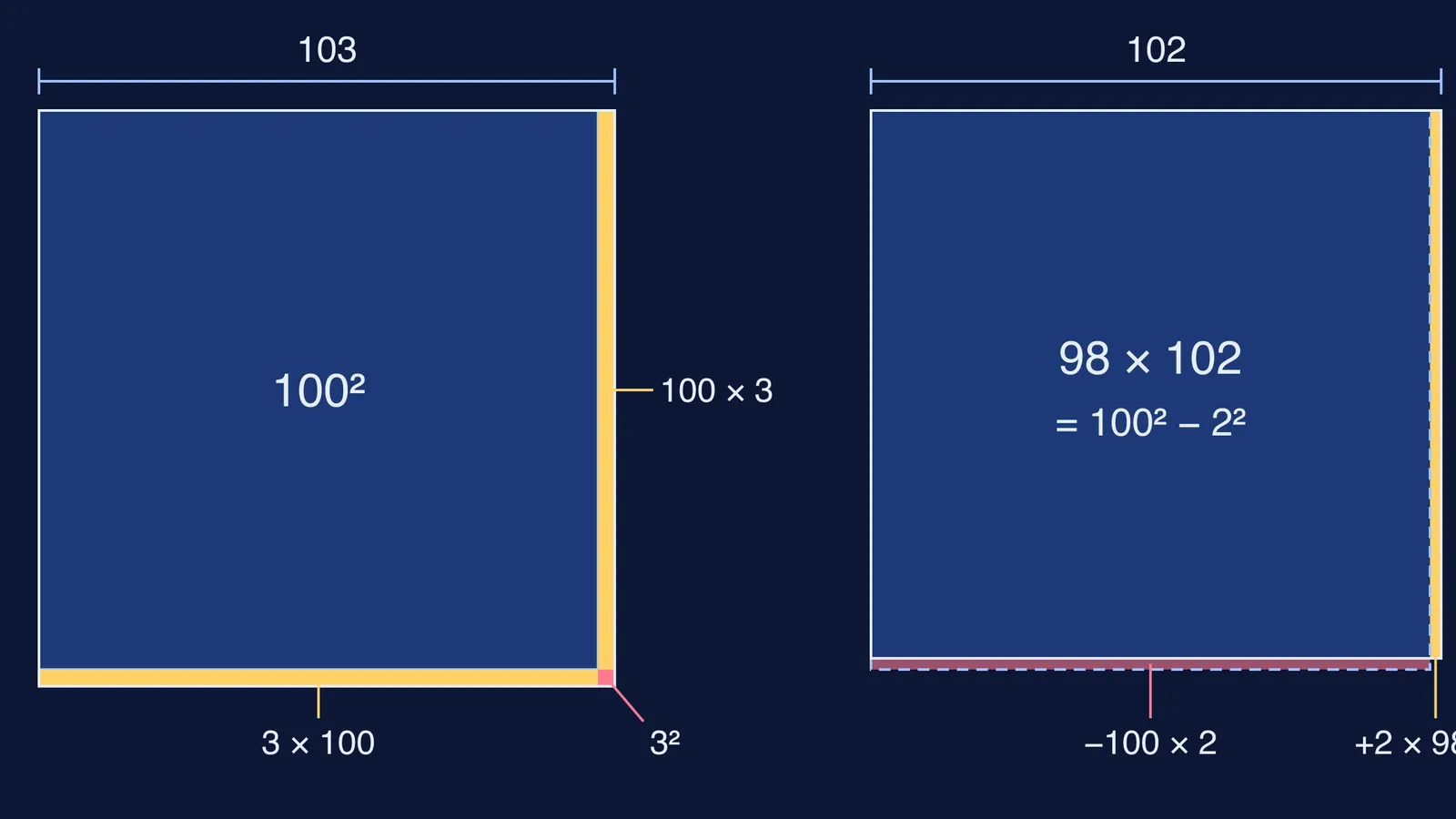
Start from (a + b)² = a² + 2ab + b². Put a = 100 and call the distance from 100 d, so (100 + d)² = 10000 + 200d + d². The first two terms make 100 × (100 + 2d), and 100 + 2d is just the number plus d again. So:
The square of a number near 100 is (the number + d) hundreds, plus d², where d is its distance from 100 (negative if it is below).
Find d. For 104, d = 4. For 97, d = −3.
Add d to the number. 104 + 4 = 108. 97 − 3 = 94.
Square d and write it as exactly two digits. 4² = 16. 3² = 09.
Join the two parts. 104² = 10816. 97² = 9409.
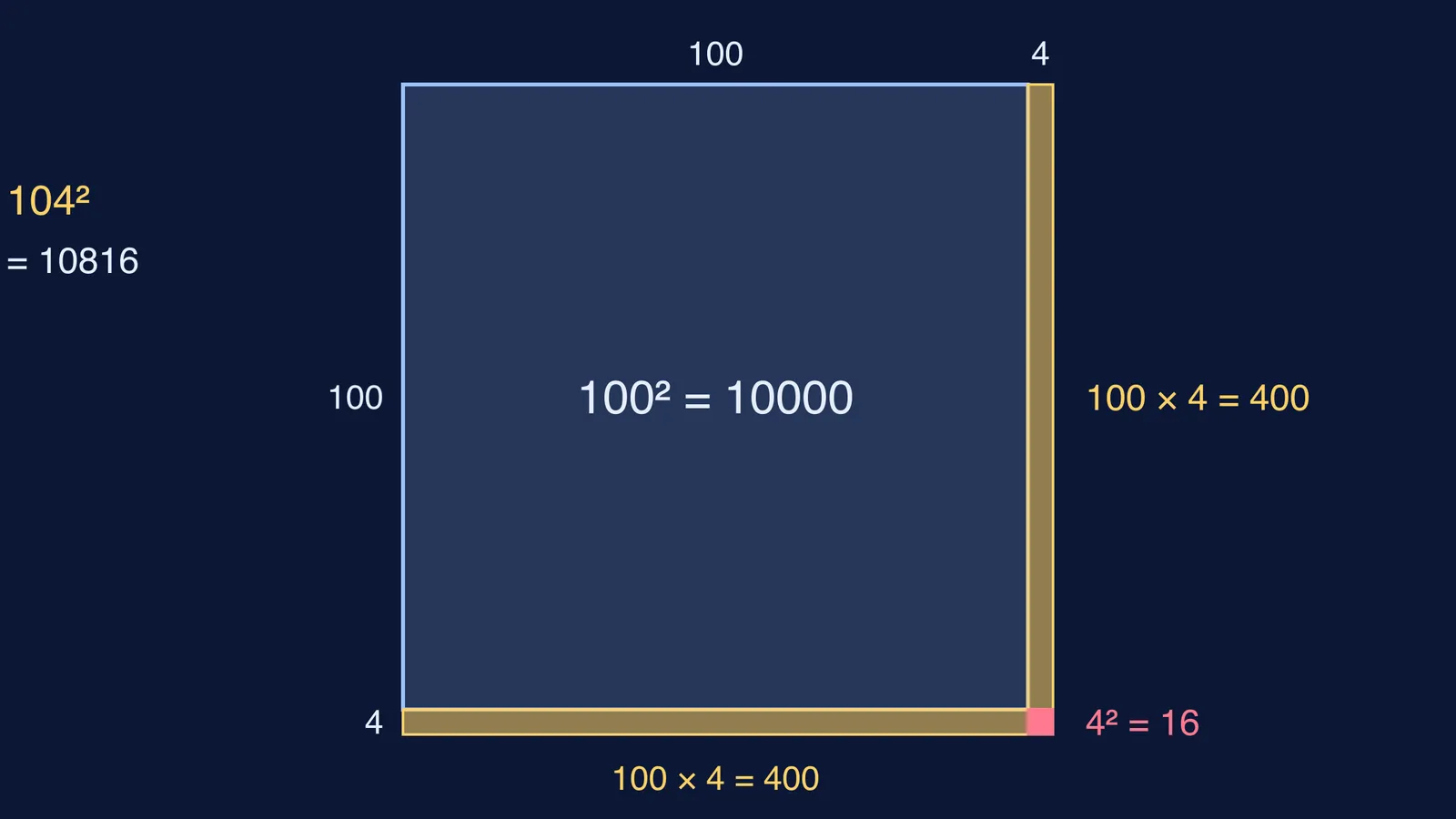
Check with the full expansion: 104² = 10000 + 800 + 16 = 10816, and 97² = 10000 − 600 + 9 = 9409. The diagram above shows 104² as a 100 by 100 square, two 100 by 4 strips and a 4 by 4 corner.
What if the number is further away, like 88 or 112?
Then d² has three digits, so its extra digit carries into the hundreds.
112²: d = 12. 112 + 12 = 124. 12² = 144. So 12400 + 144 = 12544.
88²: d = −12. 88 − 12 = 76. 12² = 144. So 7600 + 144 = 7744.
Once d passes about 15, d² becomes a sum of its own, and a nearer base is quicker: for 83², use 80 rather than 100. The idea also scales up to 1000, with d² written as three digits: 996² is 992 thousands plus 016, which is 992016.
How do you square numbers near 50?
Use 50 as the base. (50 + d)² = 2500 + 100d + d², and 2500 + 100d = 100 × (25 + d). So the rule changes slightly:
The square of a number near 50 is (25 + d) hundreds, plus d² as two digits.
53²: d = 3. 25 + 3 = 28. 3² = 09. Answer 2809.
47²: d = −3. 25 − 3 = 22. Answer 2209.
58²: d = 8. 25 + 8 = 33. 8² = 64. Answer 3364.
44²: d = −6. 25 − 6 = 19. 6² = 36. Answer 1936.
The 25 is there because 50² = 2500, which is 25 hundreds. Numbers that end in 5, such as 65 or 85, have their own shortcut, covered in our guide to squaring numbers ending in 5.
Why learn two methods instead of one?
Try 53² with base 100 instead of base 50. Now d = −47, so the hundreds part is 53 − 47 = 6, and you still need 47², which is 2209. Then 600 + 2209 = 2809. Same answer, far more work. Seeing the two routes side by side teaches you to pick the nearest base, which is the real skill.
There is research behind comparing methods like this. In a study by Bethany Rittle-Johnson and Jon Star, 70 seventh-grade students learned to solve equations either by comparing two solution methods on the same page or by studying the methods one at a time. The comparison group gained more in solving equations and in flexibility, such as using shortcuts and producing more than one solution, while both groups made similar gains in conceptual understanding. The study appeared in the Journal of Educational Psychology in 2007.
The same base idea works for products of two different numbers too, as in our walk-through of multiplying 97 by 96 with the base method.
A 10-minute practice plan
Minutes 1 to 2: Write (100 + d)² = 10000 + 200d + d² from memory and derive the rule once.
Minutes 3 to 5: Square 91 to 109 out loud, skipping 100. Say d, the hundreds part and d² each time.
Minutes 6 to 7: Do 41 to 59 with base 50.
Minutes 8 to 9: Three carry cases: 112², 88² and 115².
Minute 10: Check any answer you doubted with the full expansion and note which step slipped.
For varied questions, the Fermi Problem Library has worked problems with a step-by-step solver that explains the reasoning rather than printing an answer, so you can see where a squaring shortcut fits inside a longer problem. For more speed methods, read our roundup of mental arithmetic shortcuts for JEE.