

On this page
Mental math shortcuts often look like party tricks, but they are actually applied algebra in disguise. When you learn to square numbers ending in 5 or multiply by 11 instantly, you are not just memorising a clever rule; you are using algebraic identities to skip the tedious, error-prone work of long multiplication.
Replacing a complex string of calculations with a single, reliable algebraic pattern drastically reduces the burden on your working memory. A classic 1956 study by cognitive psychologist George A. Miller found that human short-term memory can typically hold only about seven items of information at once. If you try to hold every carry-over digit and intermediate product in your head during a traditional multiplication, you quickly run out of mental space. Using a structural shortcut frees up that cognitive capacity, allowing you to work faster and with more confidence during stressful exams.
What is the square of a number ending in 5 trick?
If you need to square a two-digit or three-digit number that ends in 5, such as 35, 65, or 115, you can find the exact answer in your head in two simple steps:
Take the part of the number that comes before the 5, and multiply it by the next integer up.
Write "25" at the end of that result.
For example, to find 35²:
The part before the 5 is 3.
Multiply 3 by the next number up, which is 4: 3 × 4 = 12.
Attach 25 to the end: 1225.
To find 85²:
The part before the 5 is 8.
Multiply 8 by the next integer up: 8 × 9 = 72.
Attach 25 to the end: 7225.
This shortcut scales up efficiently. It even works for three-digit numbers, provided you know your times tables. For 105²:
The part before the 5 is 10.
Multiply 10 × 11 = 110.
Attach 25 to the end: 11025.
Why does the trick work?
The trick is not a random coincidence; it works universally because of the standard Algebraic identities in Class 8: expand, check and calculate faster that you use to expand (a + b)².
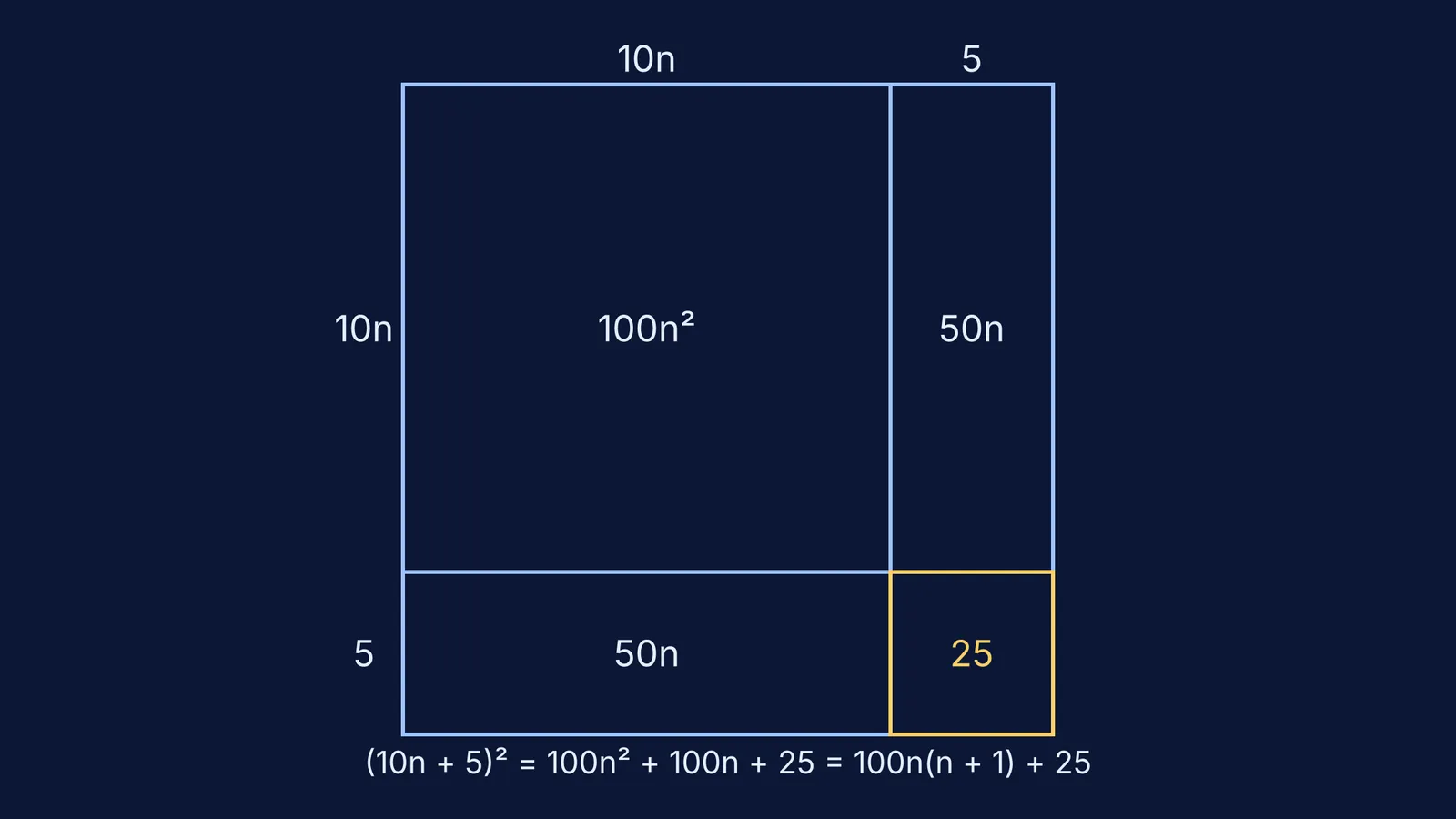
Any number ending in 5 can be written algebraically as 10n + 5, where n represents the part of the number before the 5. For 35, n is 3 (so 10 × 3 + 5 = 35). For 105, n is 10.
When you square the binomial (10n + 5), you apply the standard identity (a + b)² = a² + 2ab + b²: (10n + 5)² = (10n)² + 2(10n)(5) + 5² = 100n² + 100n + 25
Now, look at the first two terms. We can factor out 100n from both of them: = 100n(n + 1) + 25
This final algebraic expression, 100n(n + 1) + 25, is the exact recipe for the mental math trick. The n(n + 1) portion tells you to multiply the first digit by the next integer up. Multiplying that result by 100 shifts the number two places to the left, which leaves two empty zeros at the end. That perfectly creates room to simply add the 25. If visualising the expansion of variables and area models feels overly abstract, the Fermi Concept Library gives every concept in mathematics its own lesson and its place in the map.
How does the multiply-by-11 digit trick work?
A remarkably similar algebraic pattern powers the famous trick for multiplying any two-digit number by 11.
To multiply 35 by 11:
Split the two digits apart: 3 and 5.
Add them together: 3 + 5 = 8.
Place the sum in the middle of the original digits: 385.
If the sum of the two digits is greater than 9, you simply carry the 1 over to the first digit. For example, to find 87 × 11:
Split 8 and 7.
Add them together: 8 + 7 = 15.
Place the 5 in the middle, and carry the 1 to the 8: (8 + 1) 5 7 = 957.
Once again, the algebra explains exactly why this arrangement happens. Any two-digit number can be written algebraically as 10a + b (where a is the tens digit and b is the units digit). Multiplying this number by 11 is the same as multiplying by (10 + 1): (10a + b) × (10 + 1) = 100a + 10a + 10b + b
Grouping the terms by their place value gives: = 100a + 10(a + b) + b
This expanded formula shows that the original tens digit (a) moves to the hundreds place, the original units digit (b) stays safely in the units place, and the sum of the two digits (a + b) becomes the new tens digit. This is precisely the same structural logic used to find the Sum of all numbers formed from given digits: the column trick, where understanding place value dictates the final result.
A framework for mastering math shortcuts
When you encounter a new mental math trick on social media or in a classroom, do not just memorise the steps blindly. Instead, use this three-step framework to turn the shortcut into a powerful active learning exercise:
Test it with small numbers: Always verify that the trick works with numbers you can calculate normally (such as 15² or 12 × 11). This builds initial confidence.
Translate it to algebra: Write the numbers as variables (using forms like 10n + 5 or 10a + b) and expand the expression to prove fundamentally why it works.
Find the mathematical limits: Ask yourself when the trick breaks down. Does the multiply-by-11 trick work for three-digit numbers? (Yes, if you write it as 100a + 10b + c, the algebra expands to 1000a + 100(a+b) + 10(b+c) + c).


