

On this page
The Vedic "base method", or *Nikhilam* sutra, is a popular mental trick for multiplying numbers that sit just below a power of 10. While often taught as a set of magical rules, it is entirely based on elementary algebra. Once you see the algebraic expansion behind it, you will never need to blindly memorise the steps again.
What is the Vedic base method?
Vedic Mathematics is a system of 16 arithmetic sutras (aphorisms) formulated by Bharati Krishna Tirtha in the mid-20th century. The most famous of these for multiplication is *Nikhilam Navatashcaramam Dashatah*, which translates roughly to "all from nine and the last from ten".
This specific sutra powers the "base method" — a shortcut for multiplying two numbers that are close to a base like 10, 100, or 1000. It turns tedious multi-digit multiplication into a couple of single-digit subtractions and one simple product.
How to multiply 97 times 96 step by step?
If you need to multiply 97 × 96, both numbers are close to 100. This makes 100 our "base".
Find the deficits: Work out how far each number is below the base.
97 is 3 below 100 (a deficit of −3). 96 is 4 below 100 (a deficit of −4).
Cross-subtract: Take one of your original numbers and subtract the *other* number's deficit.
97 − 4 = 93. (Notice that doing it the other way, 96 − 3 = 93, gives the exact same result). This number, 93, forms the first half of your answer. Because the base is 100, this really stands for 9300.
Multiply the deficits: Multiply the two deficits together.
(−3) × (−4) = 12. This forms the second half of your answer.
Combine: Put the two parts together.
9300 + 12 = 9312.
In four quick steps, 97 × 96 is 9312.
The algebra that justifies the shortcut
Calculation shortcuts work because of patterns in our number system. The base method is simply a fast way of doing the algebraic expansion of a binomial.
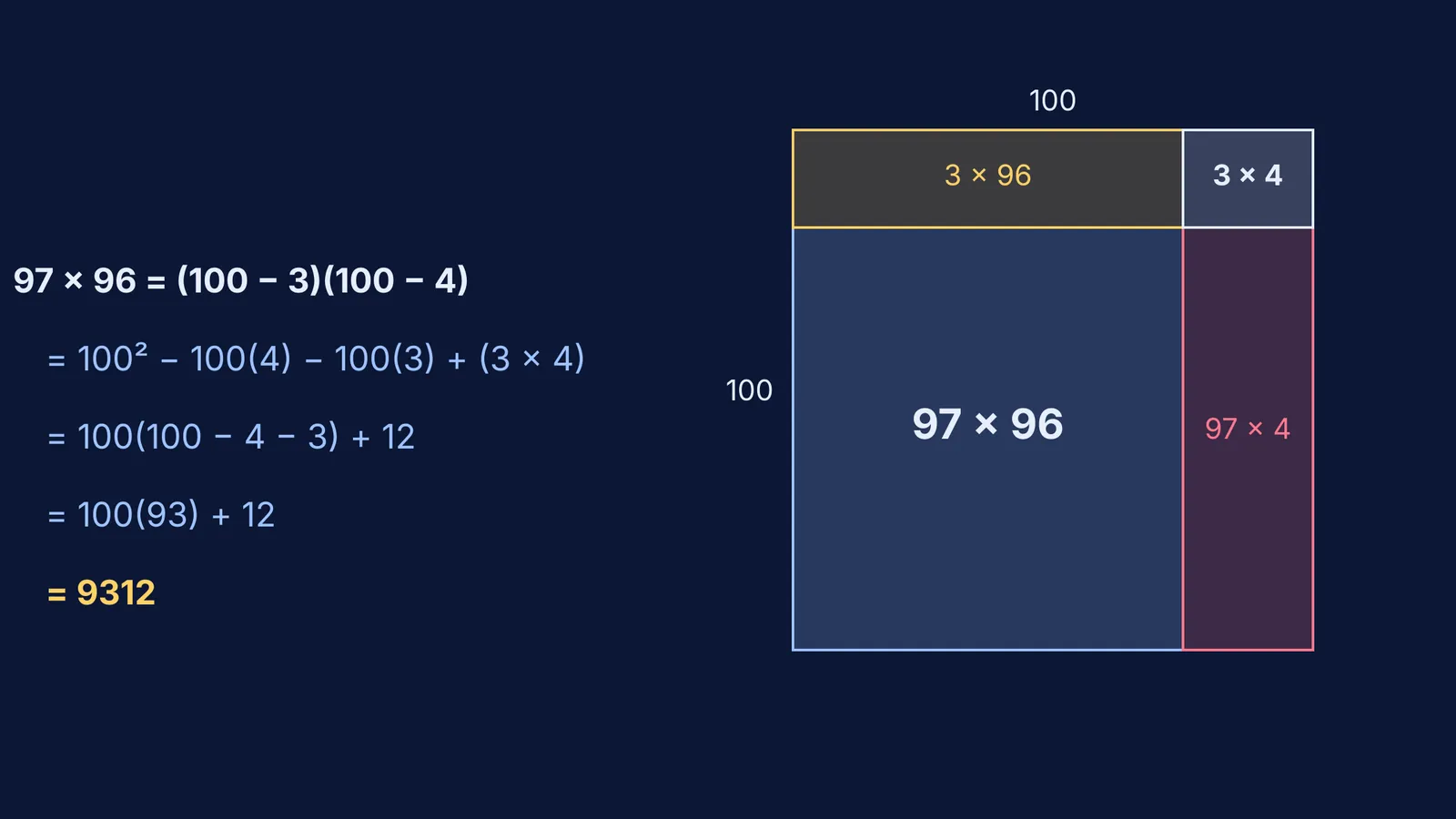
Let the base be B (which is 100 in our example). Let the first number be B − a and the second number be B − b. When we multiply them, we expand the brackets: (B − a)(B − b) = B² − aB − bB + ab
If we factor out the common B from the first three terms, we get: = B(B − a − b) + ab
Look closely at the expression inside the brackets: (B − a − b). Since our first number is (B − a), subtracting b is the exact same as taking the first number and subtracting the second number's deficit. This explains the "cross-subtraction" step!
Multiplying that result by B simply shifts it left by two place values (turning 93 into 9300). Finally, adding + ab means we add the product of the two deficits to the end, explaining the final step of the trick.
When you are learning new calculation shortcuts, understanding the underlying algebra is more useful than memorising rules. If you are stuck on algebraic expansions, the Fermi Concept Library contains every concept in physics, chemistry, biology, mathematics and computing, each with its own lesson and its place in the map, to help you build a solid foundation.
Does it work for numbers above 100?
Yes, the algebra holds perfectly if the numbers are slightly greater than the base. Let's look at 104 × 106.
Instead of deficits, we now have *surpluses*: +4 and +6.
Cross-add: Take one number and add the other's surplus: 104 + 6 = 110. This becomes 11,000.
Multiply surpluses: 4 × 6 = 24.
Combine: 11000 + 24 = 11024.
The algebraic proof is identical, except we use plus signs: (B + a)(B + b) = B(B + a + b) + ab
What if one number is above and one is below?
The method still applies, but you must be careful with negative signs. Consider 102 × 97. The deviations are +2 and −3.
Cross-add/subtract: 102 − 3 = 99. (Or 97 + 2 = 99). This stands for 9900.
Multiply deviations: 2 × (−3) = −6.
Combine: Because the product is negative, you cannot just append the digits. You must perform the arithmetic: 9900 − 6 = 9894.
The algebra verifies this once again: (B + a)(B − b) = B(B + a − b) − ab
For general numbers that are not near 10, 100, or 1000, explore standard expansion techniques like binomial sums, or look into the column trick for sums to build your mental math speed across the board. If you see repeated multiplication in an algebra problem, recovering series sums often yields a much faster algebraic route.


