

On this page
In JEE Main and JEE Advanced, every number you need comes from your own head and a sheet of rough paper. That makes arithmetic a quiet source of lost marks: the physics is right, the method is right, and 53² comes out as 2609. The fix is a short set of shortcuts, practised until they are automatic.
Are calculators allowed in JEE Main and JEE Advanced?
No. The JEE (Advanced) 2026 general guidelines for candidates list calculators, log tables and any printed, blank or hand-written paper among the items candidates may not carry into the centre. The same guidelines say a scribble pad is kept at each desk at the start of each paper for rough work and no additional scribble pad will be provided, so plan to keep your working compact.
For JEE Main 2026, NTA issued a clarification that the use of calculators in any form is prohibited and that a mention of a virtual calculator in its information bulletin was a typographical error, as reported by ETV Bharat in November 2025. Rules can change each year, so check the current bulletin on the official NTA and JEE Advanced sites before your exam.
Which calculation shortcuts actually matter for JEE?
You do not need a book of tricks. Four tools handle a lot of the numbers in JEE physics, chemistry and maths.
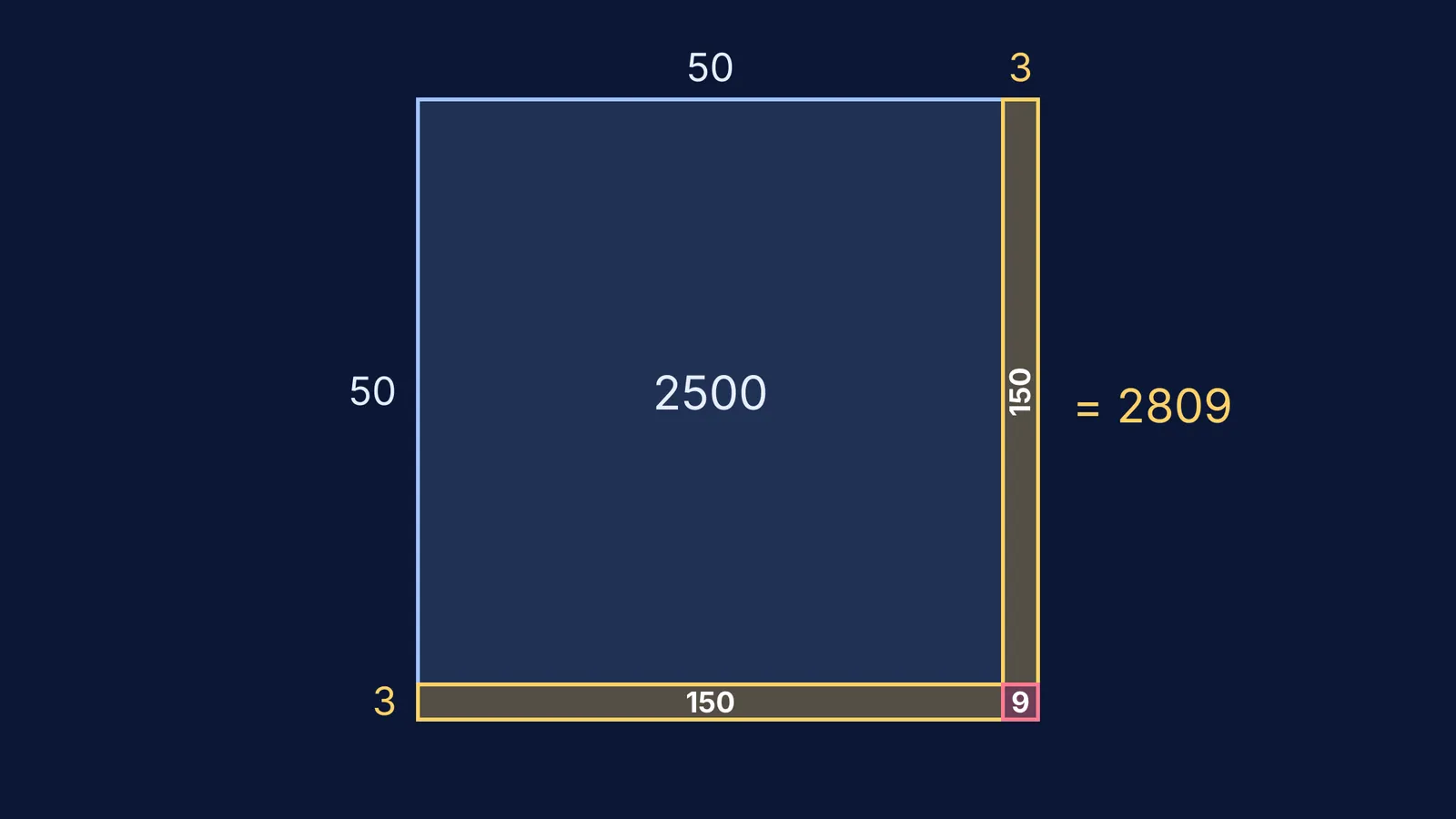
1. Squaring near a round number. Use (a + b)² = a² + 2ab + b², with a as the nearest round number.
53² = 50² + 2 × 50 × 3 + 3² = 2500 + 300 + 9 = 2809
97² = (100 − 3)² = 10000 − 600 + 9 = 9409
Numbers ending in 5 have their own pattern; our post on the algebra behind squaring numbers ending in 5 shows why it works.
2. Multiplying near a round number. When two numbers sit either side of a round number, use (a − b)(a + b) = a² − b². Otherwise, round one factor and subtract the correction.
48 × 52 = 50² − 2² = 2500 − 4 = 2496
98 × 37 = 100 × 37 − 2 × 37 = 3700 − 74 = 3626
3. Fractions and roots as decimals. Know these cold, because they turn up inside answers and options:
1/6 = 0.1667 and 1/12 = 0.0833
1/7 = 0.142857, so 3/7 = 0.428571
1/8 = 0.125 and 3/8 = 0.375
1/9 = 0.111 and 1/11 = 0.0909
√2 = 1.414 and √3 = 1.732
4. Square-root estimates. Pick the nearest perfect square a, then √x ≈ √a + (x − a)/(2√a).
√50 ≈ 7 + 1/14 ≈ 7.071 (the true value is 7.0711)
A body dropped from 5 m with g = 9.8 m/s²: v = √(2 × 9.8 × 5) = √98 ≈ 10 − 2/20 = 9.9 m/s
Our guide on estimating square roots without a calculator covers more cases, and logs without a calculator for pH and half-life handles the chemistry side.
Why does quick recall of number facts help?
A 2013 brain-imaging study in The Journal of Neuroscience by Gavin Price, Michèle Mazzocco and Daniel Ansari looked at high school seniors solving single-digit arithmetic. Students who showed more activation in brain regions linked to arithmetic fact retrieval had higher PSAT maths scores, while greater activation in a region linked to processing quantities went with lower scores. It is a correlation, not proof that drills raise marks, but it fits a simple idea: instant recall leaves more attention for the problem.
The shortcuts only pay off if the method around them is right. When a numerical goes wrong and you cannot see where, the Fermi Problem Library has worked problems with a step-by-step solver that explains the reasoning rather than printing an answer, so you can tell an arithmetic slip from a wrong method.
How should you practise mental maths for JEE?
Try ten minutes a day for two weeks. Here is a plan.
Days 1 to 3: square ten numbers a day between 31 and 99 using (a ± b)², saying the middle term out loud.
Days 4 to 6: multiply pairs near 50 and 100 (47 × 53, 96 × 104, 98 × 67).
Days 7 to 9: write the fraction list from memory each morning, then check it.
Days 10 to 12: estimate ten square roots, then check them by squaring your answer.
Days 13 and 14: redo the arithmetic in five numericals from an old mock without a calculator, and time it.
After each mock, list every mark lost to arithmetic separately from marks lost to concepts. If a slip keeps coming from a shaky formula rather than the numbers, revisit the idea in the Fermi Concept Library, which gives each concept in physics, chemistry and mathematics its own lesson.
Start with today's ten squares: 31² to 40², no calculator, then check.


