

On this page
Many pH, pKa and kinetics questions in Class 11 and 12 chemistry need logs, and in exams that do not allow calculators you work them out by hand on a rough sheet. The good news: you only need three numbers, two rules and a habit of checking.
Which log values should you memorise?
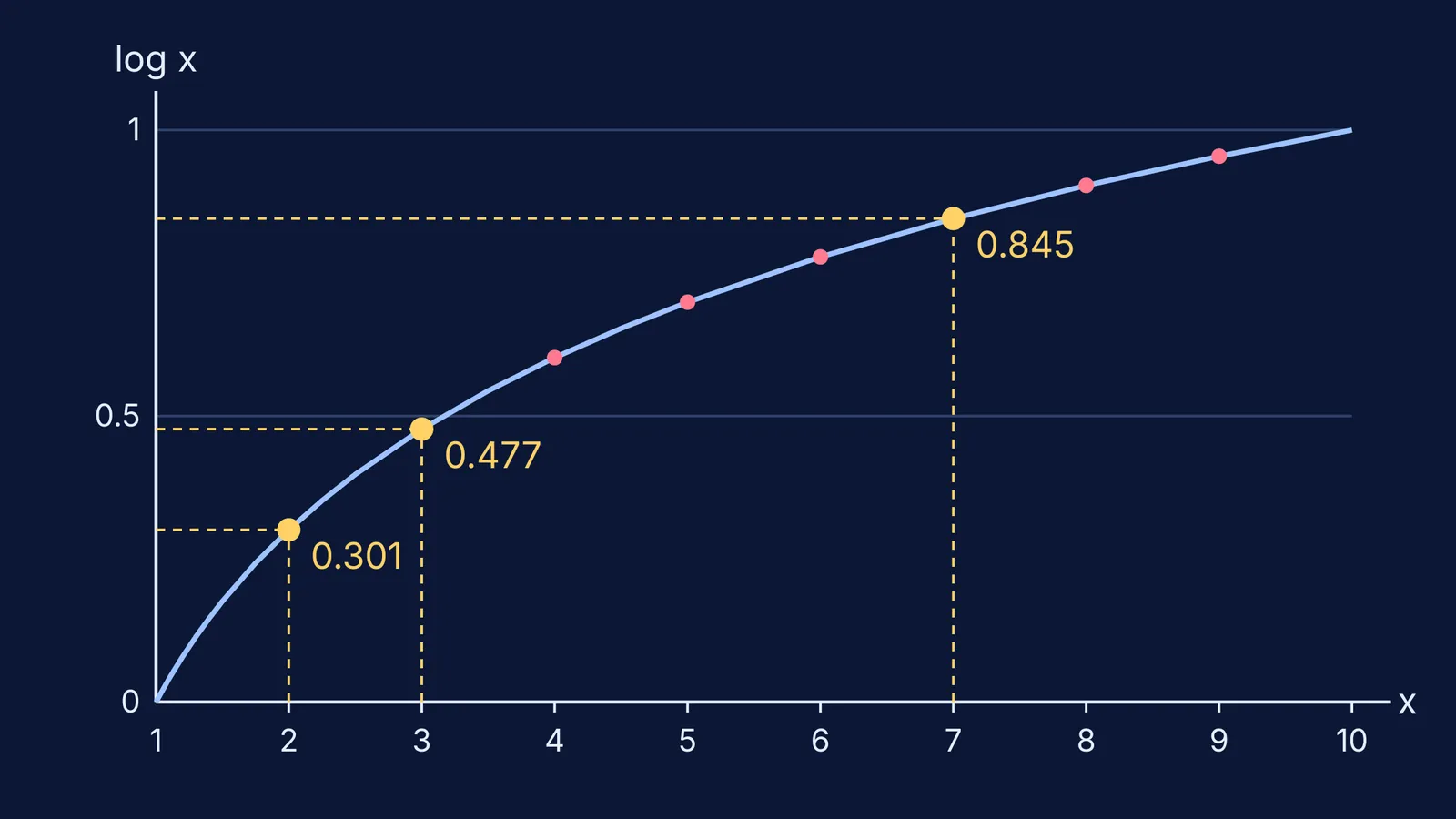
Learn three to three decimal places. The base-10 log of 2 is 0.30103 (OEIS A007524). The base-10 log of 3 is 0.47712 (OEIS A114490). The base-10 log of 7 is 0.84510 (OEIS A153620).
Everything from 1 to 10 follows from log(ab) = log a + log b and log 10 = 1:
log 4 = 2 × 0.301 = 0.602
log 5 = 1 − 0.301 = 0.699, which matches the listed value of 0.69897 (OEIS A153268)
log 6 = 0.301 + 0.477 = 0.778
log 8 = 3 × 0.301 = 0.903
log 9 = 2 × 0.477 = 0.954
For decimals, factorise instead of guessing. log 1.5 = log 3 − log 2 = 0.176. log 1.2 = log 12 − 1 = 0.477 + 0.602 − 1 = 0.079. log 2.5 = 1 − log 4 = 0.398.
How do you calculate pH and pKa without a calculator?
pH is defined as pH = −log[H⁺], and the "p" in front of any quantity means "take the negative log" (Chemistry LibreTexts, The pH Scale/Acids_and_Bases/Acids_and_Bases_in_Aqueous_Solutions/The_pH_Scale)). So write the concentration as a × 10⁻ⁿ, with a between 1 and 10. Then the answer is simply n − log a.
[H⁺] = 3 × 10⁻⁴ M gives pH = 4 − 0.477 = 3.52.
Ka = 6 × 10⁻⁵ gives pKa = 5 − 0.778 = 4.22.
[OH⁻] = 2 × 10⁻³ M gives pOH = 3 − 0.301 = 2.70, so pH = 14 − 2.70 = 11.30 at 25 °C.
For buffers, the Henderson–Hasselbalch equation is pH ≈ pKa + log([A⁻]/[HA]), and it works best when that ratio lies between 0.1 and 10 (Chemistry LibreTexts, Henderson–Hasselbalch approximation/Acids_and_Bases/Buffers/Henderson-Hasselbalch_Approximation)). The same page gives a pKa of about 4.74 for acetic acid. So with twice as much acetate as acid, pH = 4.74 + 0.301 = 5.04. With half as much, pH = 4.74 − 0.301 = 4.44. For harder buffer and salt-hydrolysis cases, see our worked guide to ionic equilibrium, pH and buffers.
How do you take an antilog by hand?
To go from pH back to concentration, split −pH into a negative whole number and a positive decimal, then match the decimal to a log you know.
pH 4.7: 10⁻⁴·⁷ = 10⁰·³ × 10⁻⁵, and 0.3 ≈ log 2, so [H⁺] ≈ 2 × 10⁻⁵ M.
pH 3.15: 10⁰·⁸⁵ × 10⁻⁴, and 0.85 ≈ log 7, so [H⁺] ≈ 7 × 10⁻⁴ M.
pH 5.6: 10⁰·⁴ × 10⁻⁶, and 0.4 ≈ log 2.5, so [H⁺] ≈ 2.5 × 10⁻⁶ M.
How do logs speed up half-life questions?
For a first-order reaction, t½ = ln 2/k ≈ 0.693/k, and the half-life does not depend on the starting concentration (Chemistry LibreTexts, First-Order Reactions/Kinetics/02%3A_Reaction_Rates/2.03%3A_First-Order_Reactions)). The 0.693 is ln 2 (OEIS A002162). The 2.303 in t = (2.303/k) log([A]₀/[A]) is ln 10 = 2.3026 (OEIS A002392).
Worked example: k = 0.0231 min⁻¹. Then t½ = 0.693/0.0231 = 30 min, and 2.303/k ≈ 100 min. How long until the reaction is 30% complete? Then [A]₀/[A] = 10/7, and log(10/7) = 1 − 0.845 = 0.155. So t ≈ 100 × 0.155 ≈ 15.5 min.
Here is a shortcut worth knowing. A reaction is 90% complete when log([A]₀/[A]) = 1, so t = 2.303/k. That is 2.303/0.693 ≈ 3.3 half-lives. Our guide to rate laws, order and half-life covers the other orders.
How can you check your answer in seconds?
Bracket it. If [H⁺] = a × 10⁻ⁿ, the pH must lie between n − 1 and n. An answer of 3.52 for 3 × 10⁻⁴ M passes.
Buffer direction. More base than acid means pH above pKa. In the 0.1 to 10 range, pH can never be more than 1 unit away.
Half-life ladder. After n half-lives of a first-order reaction, (1/2)ⁿ is left (Chemistry LibreTexts, First-Order Reactions/Kinetics/02%3A_Reaction_Rates/2.03%3A_First-Order_Reactions)). If only 30% is done, your time must be less than one half-life.
Reverse it. Take the antilog of your pH and check you get your concentration back.
If you keep getting the method wrong rather than the arithmetic, the Fermi Problem Library has worked problems with a step-by-step solver that explains the reasoning rather than printing an answer. If the gap is the idea itself, such as what pKa measures, the Fermi Concept Library gives each concept its own lesson. For where log tables came from, read about Henry Briggs and how base-10 logarithms were first computed.


