

On this page
When a mechanic finds a nail in a tubeless tyre, it can seem odd that the tyre is still holding air. The tyre, the rim and the air pressure do that job together, and two ideas from school physics explain how: pressure and elasticity.
How does a tubeless tyre hold air without a tube?
A tube holds the air in its own rubber skin. Without one, the tyre and rim must be airtight in two places.
First, the rubber has to be airtight. The BF Goodrich tubeless design used butyl rubber, which was more resistant to air leakage than the natural rubber used in earlier designs, according to Wikipedia's article on the tubeless tire.
Second, the tyre's edge, called the bead, must seal against the metal rim. The same article puts it simply: ribs moulded into the bead "are forced by air pressure into a flange on the metal rim".
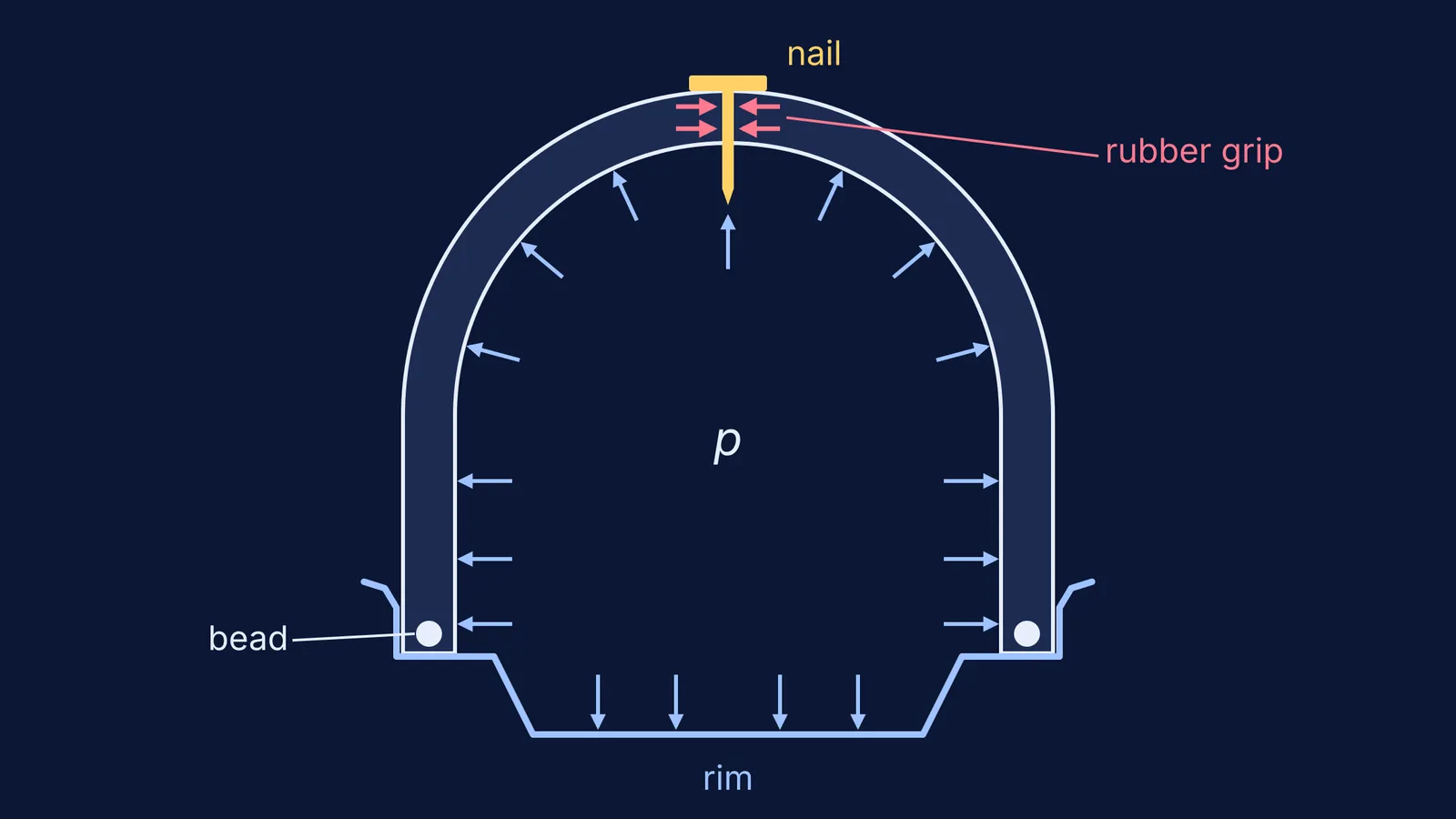
This is how pressure in a fluid works. A gas at rest pushes on every surface it touches, at right angles to that surface, with the same pressure whichever way the surface faces. Inside a tyre, the air pushes outward on the tread, outward on the sidewalls, down on the rim, and sideways on the beads, pressing them against the lip of the rim.
The Killen Tire was patented in the UK in 1930, Frank Herzegh of BF Goodrich was granted a US patent in 1952, and by 1955 tubeless tyres were standard equipment on new cars, says the same Wikipedia article. Tubes go back to the pneumatic bicycle tyre John Boyd Dunlop invented.
Why doesn't a nail let all the air out at once?
With a small puncture in a tubeless tyre, air escapes only through the hole, so the tyre deflates gently, and many punctures seal themselves, Wikipedia notes.
Elasticity explains why the gap stays small. When a nail forces its way in, it pushes the thick tread rubber aside. Like a squashed spring, the rubber pushes back and squeezes the nail from every side. The nail becomes a plug, and the gaps around it are tiny.
A tube is different: it is a thin skin kept stretched by the air inside, so tension pulls the edges of a hole apart instead of squeezing them shut.
How hard is the air pushing on the nail?
Use force = pressure × area.
Pressure: Vredestein India's tyre pressure chart gives 32 psi for the front tyres of a small hatchback (check your own car's door sticker). One psi is about 6.895 kPa, so that is about 221 kPa above atmospheric pressure.
Area: suppose the nail is 3 mm thick. Its cross-section is π × (1.5 mm)², about 7.1 mm², or 7.1 × 10⁻⁶ m².
Force: F = pA = 221,000 Pa × 7.1 × 10⁻⁶ m², about 1.6 N.
That is roughly the weight of a 160 g object, so the rubber's grip on the shank only has to hold back a small push. Width matters, though: area grows with the square of the diameter, so a 6 mm hole has four times the area and the air pushes on it with about 6 N. The same 221 kPa presses on every square centimetre of the bead with about 22 N, all the way round the rim.
Even a sealed tyre is not perfect. Michelin India's tyre FAQ says tyres lose about 2 psi over a month or so, and advises checking pressure every two weeks and before long drives. Temperature changes the reading too: here is why tyre pressure rises after a long drive, and whether filling tyres with nitrogen helps.
What should you do if you find a nail in a tubeless tyre?
Check the pressure with a gauge first. If it is holding, drive gently to a puncture repair shop.
Leave the nail in until then. As the physics above shows, it is acting as the plug; pull it out and the hole is open.
Know which punctures can be fixed. Michelin India says most punctures up to 6 mm, with an angle of injury under 15 degrees and confined to the tread, can be repaired by trained personnel, and sidewall punctures should not be repaired.
Ask how it will be repaired. The US Tire Manufacturers Association says a plug alone is not an acceptable repair: a plug must fill the puncture and a patch must seal the inner liner, and the tyre must be taken off the rim and inspected.
If pressure pushing at right angles to every surface is still hard to picture, the Fermi Simulation Lab has interactive simulations for ideas that are easier to see than to read. Pressure and elasticity each have their own lesson in the Fermi Concept Library.
Next time you pass a puncture shop, ask to watch a tubeless repair and look for the bead and the rim's lip.


