

On this page
When you pull into a petrol pump after a long drive on the highway and decide to check your tyre pressure, you might be surprised to see the reading is several PSI higher than it was in the morning. This is not a faulty gauge or a sudden increase in the amount of air inside the tyre. It is a direct demonstration of high school thermodynamics in the real world.
For students preparing for competitive exams, this everyday phenomenon is a perfect practical example of the ideal gas laws. It bridges the gap between abstract textbook formulas and the tangible mechanics of a car on the road. Let us break down the physical mechanism that causes a hot tyre to read a higher pressure.
Why does tyre pressure increase after a long drive?
As your car moves, the segment of the tyre touching the road—the contact patch—flattens under the heavy weight of the vehicle. As the wheel rotates and that segment leaves the road surface, the rubber springs back to its original curved shape.
Rubber is a viscoelastic material, meaning it absorbs energy when deformed and does not return all of it when it relaxes. This internal friction within the rubber molecules is known as hysteresis (Wikipedia), and the lost mechanical energy is converted directly into thermal energy, or heat.
At highway speeds, a standard passenger tyre flexes hundreds of times every minute. The rubber heats up rapidly and transfers this thermal energy to the air trapped inside. Because the volume of the tyre remains largely constant, the added heat has nowhere to go but into the kinetic energy of the air molecules.
The physics: Gay-Lussac's law in action
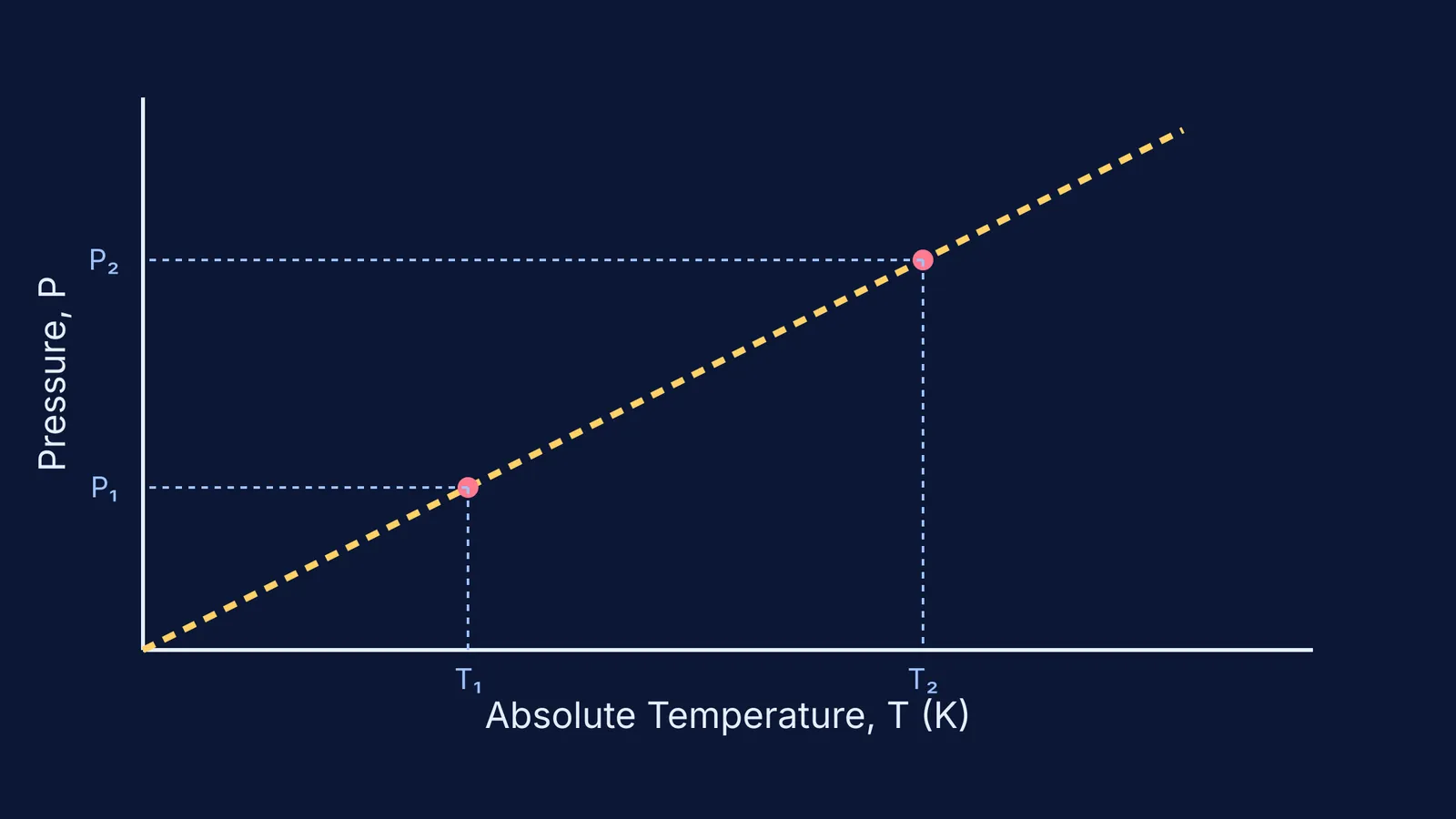
The relationship between the temperature and pressure of a confined gas is described by Gay-Lussac's law. For a fixed amount of gas at a constant volume, the pressure is directly proportional to its absolute temperature in Kelvins (Wikipedia).
Mathematically, this is written as P₁/T₁ = P₂/T₂, which is derived directly from the ideal gas equation PV = nRT when volume (V) and the number of moles (n) are held fixed. As the air molecules inside the heated tyre gain kinetic energy, they strike the inner walls of the tyre more frequently and with greater force, registering as an increase in pressure on your pressure gauge.
If you want to build a solid intuition for how pressure and temperature move together before tackling the mathematics, the Fermi Simulation Lab provides interactive simulations for the ideas that are easier to see than to read. Once the foundational concept clicks, you can confidently move on to exam problems involving isobaric and isochoric processes or converting PV, PT and VT graphs of ideal gas processes.
How much does the pressure actually change?
The amount of pressure increase is highly predictable. A widely accepted rule of thumb in the automotive industry is that tyre pressure changes by about 1 PSI for every 10 °F (roughly 5.5 °C) change in temperature, according to Discount Tire. On a long summer drive, the combination of hot tarmac and hysteresis can easily raise the air temperature inside the tyre by 15 °C or more.
Worked example: calculating the pressure rise
A common mistake in physics problems is using gauge pressure instead of absolute pressure. Suppose you check your tyre pressure on a cool morning at 20 °C (293 K) and the gauge reads 32.0 PSI. Atmospheric pressure is about 14.7 PSI, so the absolute starting pressure (P₁) is 46.7 PSI.
After a long highway drive, the intense flexing heats the air inside the tyre to 45 °C (318 K). We can use Gay-Lussac's law to find the new absolute pressure (P₂):
P₁/T₁ = P₂/T₂
46.7 / 293 = P₂ / 318
P₂ = (46.7 × 318) / 293 = 50.7 PSI absolute.
To find what the gauge will actually read at the petrol pump, subtract the 14.7 PSI atmospheric pressure: 50.7 − 14.7 = 36.0 PSI gauge pressure.
The tyre pressure has increased by 4.0 PSI simply due to the heat generated during the drive.
What should you do about it?
Because pressure fluctuates so predictably with temperature, vehicle manufacturers always calibrate their recommended PSI for "cold" tyres. A tyre is considered cold if the car has been parked in the shade for at least three hours, or driven for less than a mile at low speeds.
If you must measure your tyres during a road trip and find them 3 to 5 PSI higher than the recommended cold limit on your door jamb, do not bleed the air out. Letting air out of a hot tyre will leave it dangerously underinflated once it cools down overnight. Leave the hot pressure alone, and check it again the next morning to ensure it is at the correct cold specification.


