

On this page
At fuel stations and tyre dealerships across India and worldwide, motorists are routinely offered nitrogen inflation as a premium upgrade. The pitch sounds persuasive: nitrogen molecules permeate rubber slower than oxygen. Yet ambient air is not devoid of nitrogen. By volume, dry air already consists of roughly 78% nitrogen, 21% oxygen, and 1% argon, as documented in the NHTSA tyre gas study and our guide on the average molar mass of a gas mixture.
Why does nitrogen leak more slowly than oxygen?
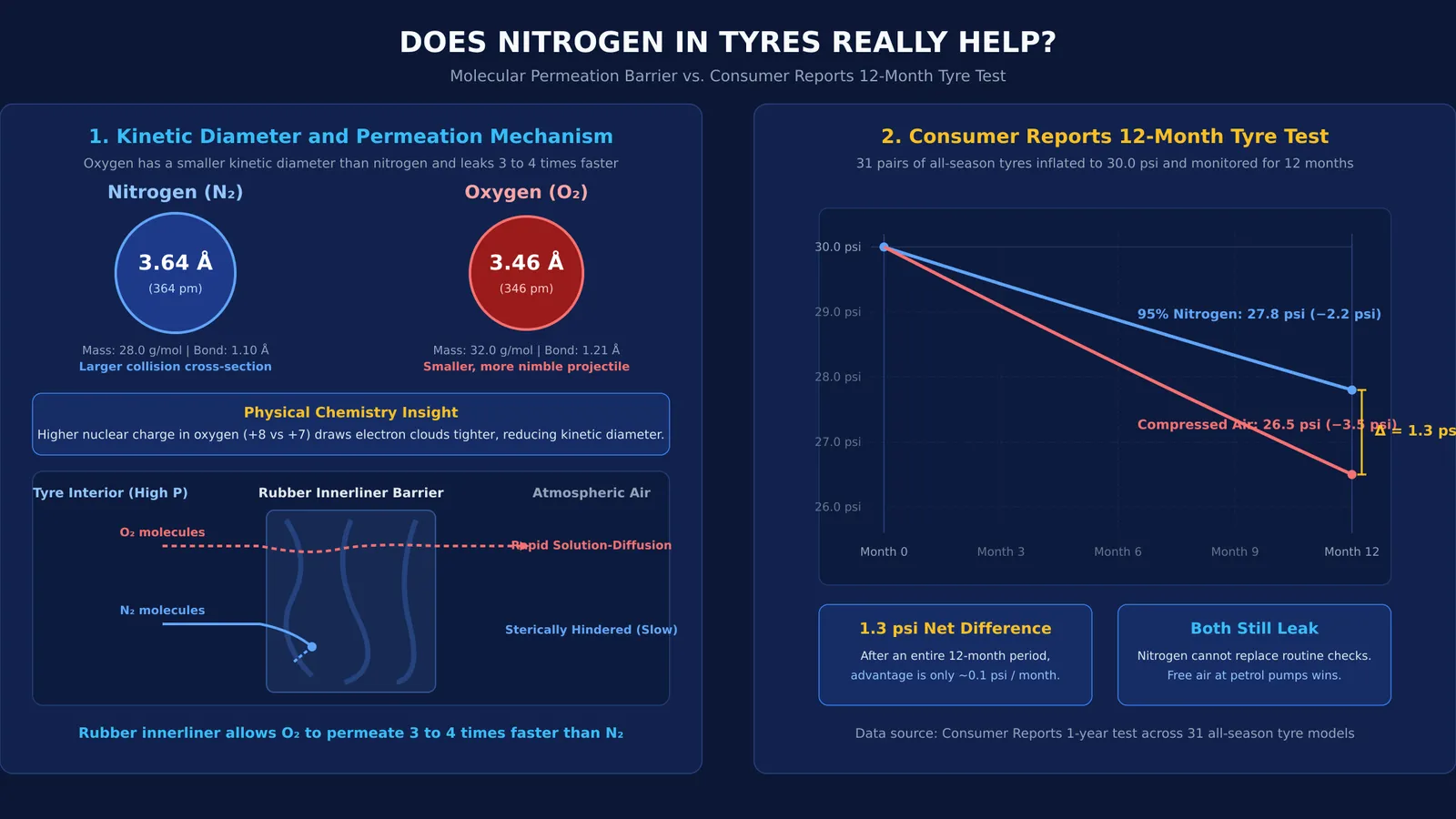
The molecular comparison holds a subtle chemical twist. Diatomic nitrogen (N₂) has a lower molar mass (28.01 g/mol) and shorter covalent bond length (1.10 Å) than oxygen (O₂, 32.00 g/mol and 1.21 Å). Yet in rubber innerliners, gas migration depends on kinetic diameter. According to research in *The Journal of Physical Chemistry A* on quantum mechanical kinetic diameters, nitrogen has an effective kinetic diameter of 3.64 Å (364 pm), whereas oxygen measures 3.46 Å (346 pm) because greater nuclear charge pulls its electrons tighter. Consequently, research in the *European Polymer Journal* on gas permeation through elastomer membranes00083-5) shows that oxygen permeates tyre rubber roughly 3 to 4 times faster than nitrogen.
How much pressure do tyres actually lose over a year?
Because oxygen escapes faster, filling tyres with 95% nitrogen slows pressure loss, but real-world savings are modest. In an extensive year-long evaluation by Consumer Reports testing nitrogen in passenger car tyres, engineers tested 31 pairs of all-season tyres inflated to 30.0 psi. Over 12 months outdoors, air-filled tyres lost an average of 3.5 psi, while nitrogen-filled tyres lost 2.2 psi—a difference of just 1.3 psi. Controlled testing by the National Highway Traffic Safety Administration (DOT HS 811 094) confirmed this trend, recording a 35% reduction in monthly leakage (2.13% for air versus 1.39% for nitrogen). However, because both sets leaked continuously, nitrogen never eliminates routine inflation checks.
Does nitrogen stop tyre pressure from rising with temperature?
Gay-Lussac's law disproves the myth that nitrogen stops tyre pressure rising with heat: dry nitrogen and ambient air both behave as ideal gases governed by P = nRT / V, as explored in ideal gas problems. For example, a tyre at 32.0 psi gauge (46.7 psi absolute) and 20 °C (293 K) that reaches 50 °C (323 K) on the highway rises to P₂ = 46.7 psi × (323 K / 293 K) = 51.5 psi absolute, or 36.8 psi gauge—a thermal rise of 4.8 psi, as documented in the NHTSA tyre aging study. Because dry nitrogen and dry air share identical thermal expansion coefficients, both expand equally. For physical concepts that are easier to see than to read, the Fermi Simulation Lab offers interactive simulations showing how molecular kinetic energy drives container pressure.
Where a difference does emerge is moisture. Garage compressors lacking refrigerated air dryers can pump water vapour into tyres, adding up to 4.5 psi of vapour pressure between 20 °C and 70 °C. Bottled commercial nitrogen avoids these non-linear swings because it is dry, as noted in the Consumer Reports tyre analysis.
Why do aeroplanes and race cars use nitrogen instead of air?
If nitrogen provides only a 1.3 psi advantage over twelve months for passenger cars, why do aeroplanes mandate it? Under Federal Aviation Administration regulation 14 CFR § 25.733, braked wheel tyres on aircraft exceeding 75,000 pounds must use nitrogen with less than 5% oxygen. During heavy braking or an aborted takeoff, carbon brakes exceed 500 °C, pyrolysing tyre rubber into volatile hydrocarbons. Ambient oxygen could ignite these vapours inside the wheel well, whereas inert nitrogen prevents auto-ignition. In professional motorsport, bone-dry nitrogen also ensures that thermal pressure expansion remains predictable across laps.
Is filling car tyres with nitrogen worth the cost?
For passenger vehicles, road tyres rarely exceed 60 °C, and tread wear retires a tyre in three to five years, long before oxygen degrades the casing. Commercial shops typically charge between ₹100 to ₹300 per car (or 5 to 10 dollars abroad per tyre) for nitrogen, whereas compressed air is available for free at petrol stations, as highlighted in the Consumer Reports tyre value guide.
To decide whether nitrogen makes sense for your vehicle, consider three practical points:
Monthly checks: Checking tyre pressures monthly with a dependable gauge delivers the full safety and fuel efficiency benefits of nitrogen using compressed air for free.
Long-term storage: For vehicles parked 6 to 12 months between uses, nitrogen's lower permeation rate preserves pressure longer.
Topping off: If a nitrogen-filled tyre is low, top it off immediately with regular air. Mixing air causes no harm; it merely dilutes purity slightly.
Understanding gas mixtures, partial pressures, and molecular kinetics turns an everyday motoring debate into an intuitive physics lesson. The Fermi Concept Library covers every concept in physics, chemistry, biology, mathematics and computing, each with its own lesson and its place in the map, alongside guides on the kinetic theory of gases.


