On this page
Try it now: run your fingers lightly along the sole of your foot. For most people it feels like touch, not like being tickled. Let someone else do exactly the same thing and you squirm. The difference is in your brain.
Why can't you tickle yourself?
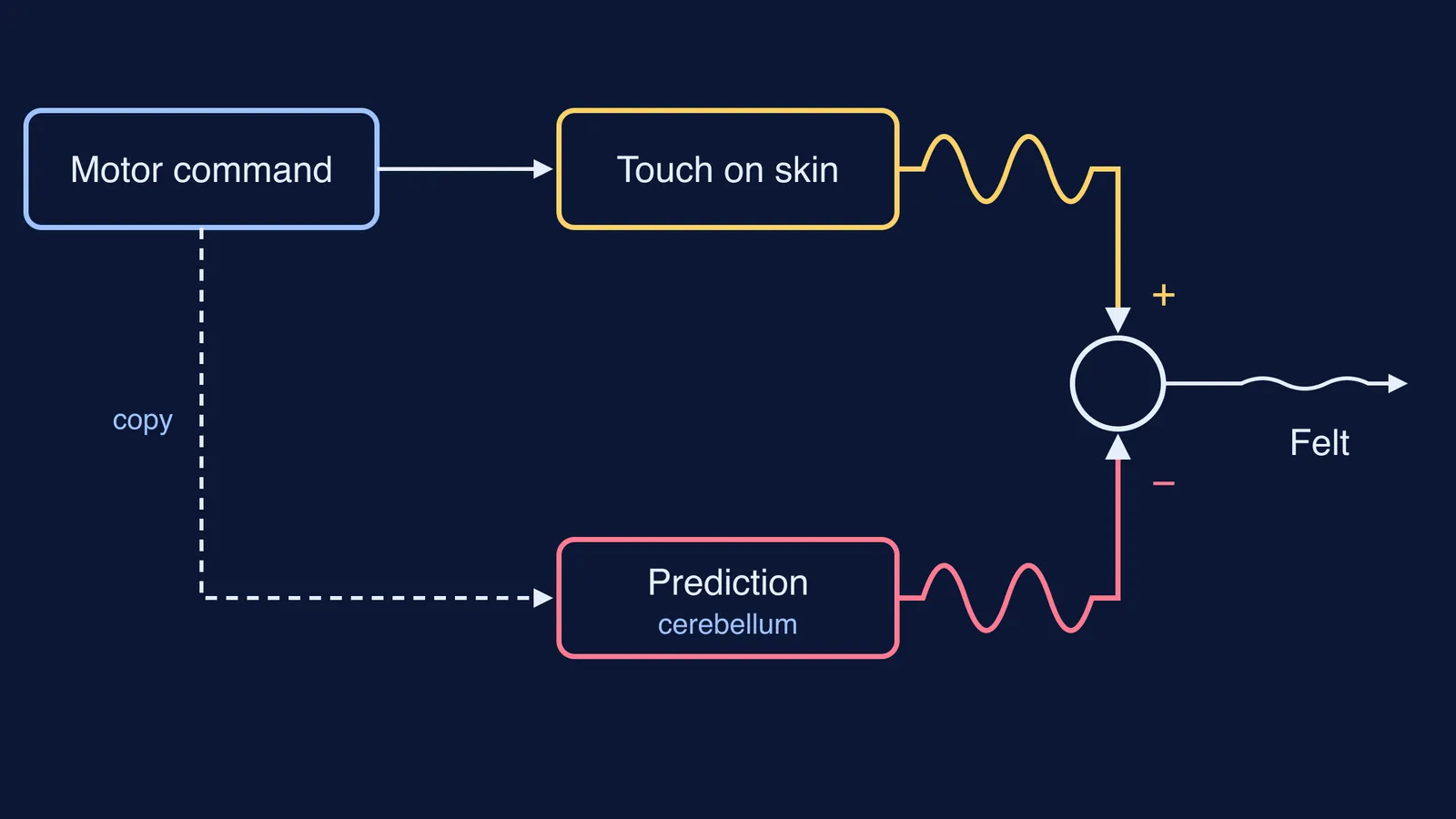
When your brain sends a command to move your hand, it keeps a copy of that command and uses it to predict what you will feel. Neuroscientists call this copy an efference copy, and the machinery that turns it into a prediction a forward model, as explained in a 1999 paper in the Journal of Cognitive Neuroscience by Blakemore, Frith and Wolpert.
The brain then compares the prediction with the touch that actually arrives. Whatever was predicted gets turned down. A tickle from your own fingers is predicted very well, so much less of it gets through.
A self-produced touch is felt as less ticklish than the same touch made by someone else, according to a 1998 fMRI study in Nature Neuroscience. In that study, the touch-processing area of the brain, the somatosensory cortex, was more active when the touch came from outside than when people produced it themselves.
Which part of the brain cancels the tickle?
The same 1998 study pointed to the cerebellum, the part of the brain you meet in school biology as the coordinator of movement and balance. It was less active when a movement produced a touch than when the same kind of movement produced none, and the authors suggested that the cerebellum is involved in predicting the specific sensory results of a movement and supplying the signal that cancels the response (Nature Neuroscience, 1998). A follow-up analysis in NeuroImage found touch-area activity tracked the cerebellum's only during self-touch.
One idea is that this prediction exists to help you control your movements, and tickle-cancelling comes along with it. The question is older than brain scanners: a short paper titled Preliminary observations on tickling oneself appeared in Nature in 1971.
What happens if your own touch arrives late?
If the brain is cancelling a prediction, a touch that does not match the prediction should get through. That is what a robot experiment found. People moved a robot arm with their left hand, and a second robot passed the movement on as a touch on their right palm, with computer-controlled delays of 0, 100, 200 and 300 milliseconds, as described in the Journal of Cognitive Neuroscience paper. Tickliness ratings rose as the delay grew from 0 to 200 milliseconds, with no further difference at 300, and rose again when the touch's path was turned 30, 60 or 90 degrees away from the hand's movement.
The authors concluded that the dulling depends on the touch matching the movement in both time and space.
Why does this matter beyond tickling?
The same prediction makes you underestimate your own force. In a 2003 study in Science, six pairs of volunteers took turns pressing on each other's finger, each told to match the force they had just received. The force rose by 38% on average with each turn. In a second test with 12 more volunteers, the authors found that a self-generated force is perceived as about half as strong as the same force from outside. When people reproduced a force through a joystick that drove a motor, instead of pressing directly, their match was much more accurate.
So when two siblings both say the other pushed harder, both may be reporting what they really felt. The authors also note the benefit: removing the predictable part of your own touch makes sensations from the outside world stand out.
Try it: a ten-minute experiment at home
This is a small version of the force-matching study in Science. You need a digital kitchen scale and a partner. Keep every press gentle.
Rest your left index finger on the scale and press tare, so the display reads zero.
Your partner presses down on your fingertip for three seconds. They note the reading and do not tell you.
Now press on your own left fingertip with your right index finger, trying to match what you felt. Note the reading.
Repeat five times, swap roles, and compare the averages.
Convert to newtons: a reading of 100 g means about 0.98 N, since force equals mass times 9.8 m/s².
If you behave like the volunteers in the Science study, your own presses will come out stronger than your partner's. Write up your hypothesis, readings and one source of error.
Some ideas are easier to see than to read; the Fermi Simulation Lab has interactive simulations for them. The Fermi Concept Library gives each biology concept its own lesson and its place in the map.
The next time someone tickles you, your brain is telling you it did not see that one coming.