On this page
Rotational motion is the chapter where many students can recite the formulas and still get the problems wrong. A simulation lets you see them, but only if you use it as an experiment rather than a video.
Why predict before you run a rotational motion simulation?
In a study in the American Journal of Physics, Crouch, Fagen, Callan and Mazur (2004) found that students who only watched a classroom demonstration understood the underlying idea no better than students who never saw it. Students who predicted the outcome before seeing it showed significantly greater understanding.
On a screen, watching a disc roll teaches little. Writing "the ring will lose, because more of its mass is far from the axis" and then being right, or wrong, teaches a lot.
The Fermi Simulation Lab has interactive simulations for the ideas that are easier to see than to read. The predictions below work in any rotational motion simulation that lets you change shape, mass and position.
What are torque, moment of inertia and angular momentum?
Torque is the turning effect of a force: its magnitude is the force times the lever arm, the perpendicular distance from the axis to the force's line of action (OpenStax University Physics, Torque).
Moment of inertia is the rotational version of mass, I = Σmr², so mass far from the axis counts for much more than mass near it (OpenStax, Moment of inertia).
Angular momentum is conserved when there is no net external torque about the point you choose (OpenStax, Conservation of angular momentum).
If you want each rotational quantity next to its linear twin, see our table of linear and rotational motion analogues.
Prediction 1: which shape wins a rolling race down a slope?
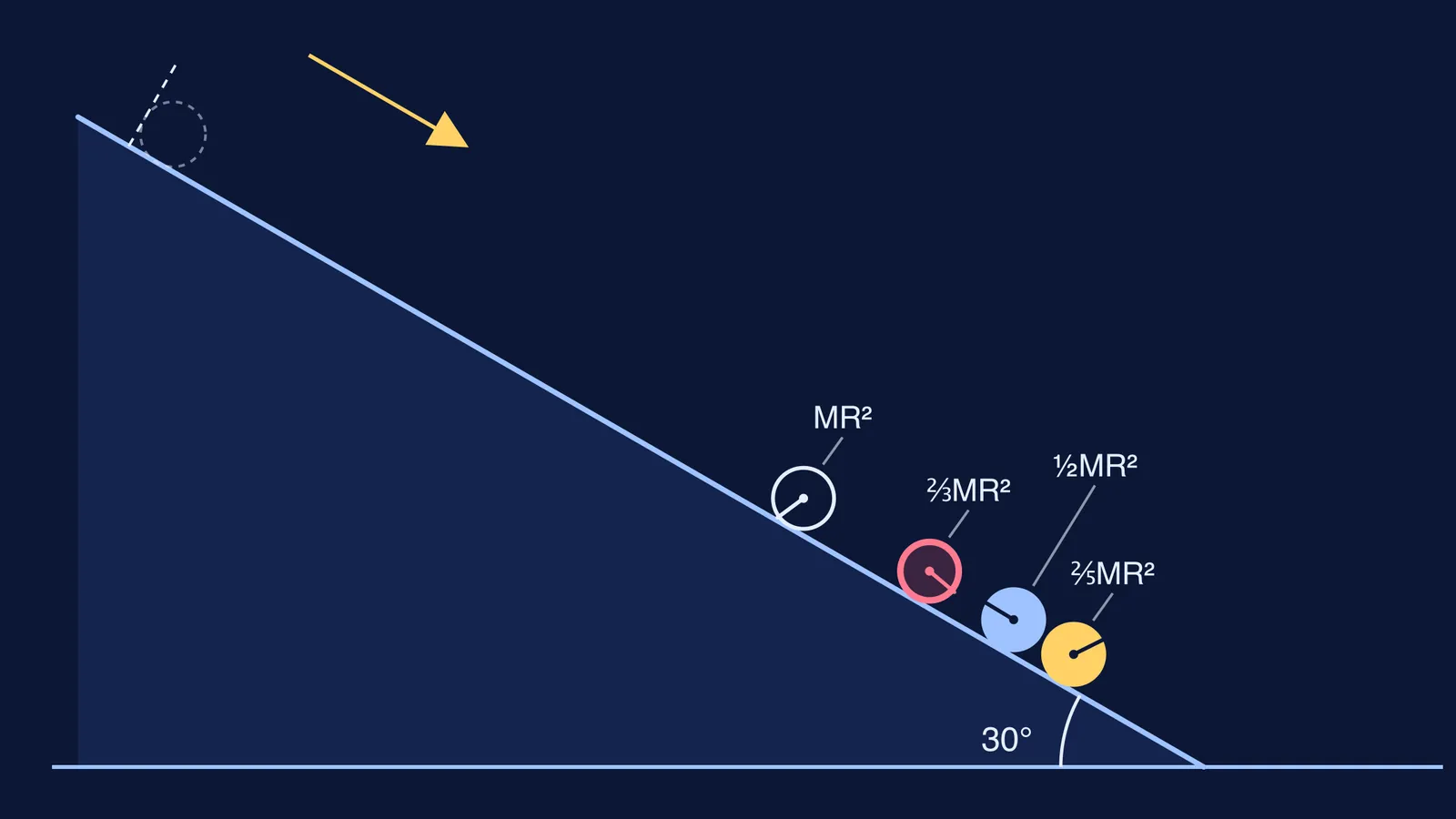
Set up a solid sphere, a solid disc, a hollow sphere and a thin ring of the same mass and radius at the top of one ramp. Predict the finishing order before you release them.
For rolling without slipping, a = g sinθ/(1 + I/MR²) (OpenStax, Rolling motion). The values of I/MR² are 2/5 for a solid sphere, 1/2 for a solid cylinder or disc, 2/3 for a thin hollow sphere and 1 for a thin hoop (OpenStax, Figure 10.20).
Worked example: a 2.0 m ramp at 30°, g = 9.8 m/s², starting from rest, using t = √(2L/a):
Solid sphere: a = 3.50 m/s², t ≈ 1.07 s
Solid disc: a = 3.27 m/s², t ≈ 1.11 s
Hollow sphere: a = 2.94 m/s², t ≈ 1.17 s
Ring: a = 2.45 m/s², t ≈ 1.28 s
A block sliding with no friction: a = 4.90 m/s², t ≈ 0.90 s
Now the twist: double the ring's mass. Mass and radius cancel in the formula, so the result should not change. For where the energy goes, read how much of a rolling body's kinetic energy is rotational.
Prediction 2: why does a spinning skater speed up?
Predict what happens to the spin rate, and to the kinetic energy, when a skater pulls in their arms.
Friction on ice is small, so the net torque is close to zero and L = Iω stays constant. A smaller I means a larger ω (OpenStax).
Worked example with round numbers: I falls from 4.0 to 1.6 kg m², and the spin rate rises from 1.0 to 2.5 rev/s. Kinetic energy is L²/2I, so it also rises 2.5 times. You might predict the energy stays the same. It does not: OpenStax notes that the work done pulling the arms in becomes extra rotational kinetic energy.
Prediction 3: where must the second child sit to balance a seesaw?
A 30 kg child sits 2.0 m from the pivot. Where must a 40 kg child sit?
For balance the net torque about the pivot is zero (OpenStax, Conditions for static equilibrium). So 30 × 2.0 = 40 × d, giving d = 1.5 m. Try it, then tilt the balanced plank and predict whether it swings back. If the pivot and both children are treated as points on one straight plank, both lever arms shrink by the same factor, so it stays wherever you leave it.
Choosing the pivot as your axis makes its force vanish from the sum. Our post on which axis to take torque about shows why that choice matters in harder problems.
How to run each test in five steps
Write your prediction and one reason before you touch anything.
Change one variable only: shape, mass, arm position or seat distance.
Note what happened, with the number if the simulation shows one.
If you were wrong, find the term in the formula that explains it.
Try a twist you have not seen yet, and predict that too.
If you get stuck on step 4, Fermi's AI tutor can run the simulation with you and check your understanding as it goes, so a wrong guess turns into a reason rather than a shrug.