

On this page
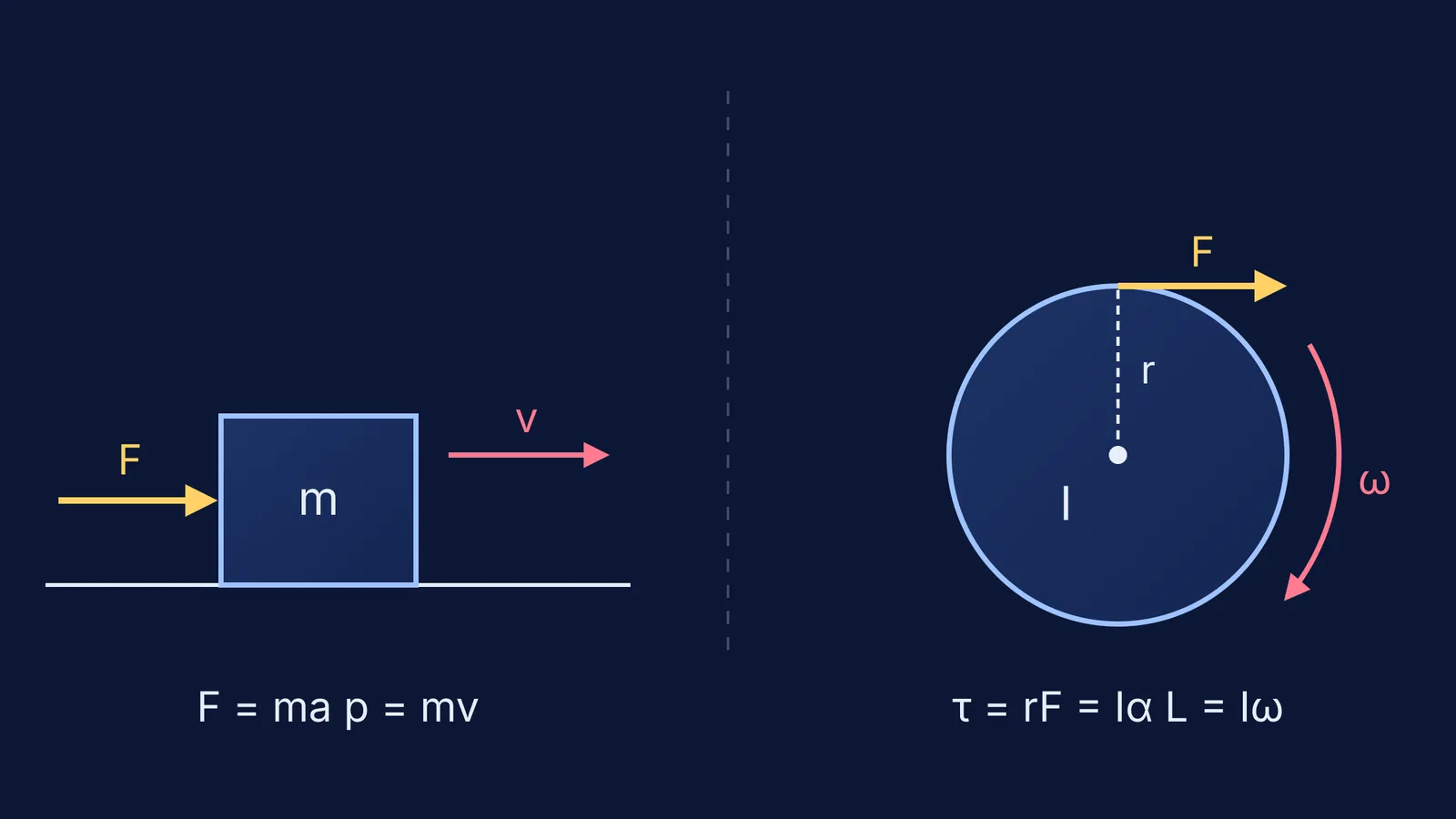
Rotational motion feels like a new chapter. It is mostly the one you already know, with the letters swapped. If you can solve a block-on-a-floor problem, you can solve a disc-on-an-axle problem, as long as you know which symbol replaces which.
What are the rotational analogues of linear quantities?
The pairs below are collected from chapters 10 and 11 of OpenStax University Physics Volume 1, a free textbook; each section is linked below.
Displacement x pairs with angular displacement θ, linked by s = rθ.
Velocity v pairs with angular velocity ω, linked by v = rω.
Acceleration a pairs with angular acceleration α, linked by a = rα.
Mass m pairs with moment of inertia I = Σmr².
Force F pairs with torque τ = rF sin θ.
Momentum p = mv pairs with angular momentum L = Iω.
Kinetic energy ½mv² pairs with rotational kinetic energy ½Iω².
Power P = Fv pairs with P = τω.
The radius r in the first three lines is the bridge: a point at radius r on a spinning wheel really moves a distance s at a speed v.
Why is moment of inertia the rotational analogue of mass?
Mass tells you how hard it is to change an object's velocity. Moment of inertia does the same job for spin: OpenStax describes it as "the quantity that tells us how easy or hard it is to change the rotational motion of an object" in its section on Newton's second law for rotation.
The difference is that I depends on where the mass sits, because each bit of mass counts as m times r². A uniform thin disc about its central axis has I = ½MR², according to the OpenStax section on calculating moments of inertia.
How do the equations match side by side?
The constant-acceleration equations have exact copies, printed in two columns in OpenStax Table 10.2, Rotational and Translational Kinematic Equations:
v = u + at becomes ω = ω₀ + αt.
x = ut + ½at² becomes θ = ω₀t + ½αt².
v² = u² + 2ax becomes ω² = ω₀² + 2αθ.
The dynamics equations match too. OpenStax Table 10.7 in its section on work and power for rotational motion pairs ΣF = ma with Στ = Iα, W = ∫F·ds with W = ∫τ dθ, and P = F·v with P = τω.
In the OpenStax angular momentum section, net torque equals the rate of change of angular momentum, dL/dt = Στ, mirroring dp/dt = ΣF.
For practice, see rotational kinematics equations for uniform angular acceleration and work and power by torque, W = τθ and P = τω.
Worked example: one push, two motions
The numbers are chosen so both answers match.
Linear: a 0.25 kg block on a smooth floor starts at rest. A 2 N force pushes it for 3 s.
a = F/m = 2/0.25 = 8 m/s².
v = at = 8 × 3 = 24 m/s.
x = ½at² = ½ × 8 × 9 = 36 m.
p = mv = 0.25 × 24 = 6 kg m/s, which equals Ft = 2 × 3.
KE = ½mv² = ½ × 0.25 × 576 = 72 J, which equals the work Fx = 2 × 36.
Rotational: a uniform disc of mass 2 kg and radius 0.5 m spins freely on a central axle. A 2 N m torque acts for 3 s from rest. Its moment of inertia is I = ½MR² = ½ × 2 × 0.25 = 0.25 kg m².
α = τ/I = 2/0.25 = 8 rad/s².
ω = αt = 24 rad/s.
θ = ½αt² = 36 rad.
L = Iω = 0.25 × 24 = 6 kg m²/s, which equals τt.
KE = ½Iω² = 72 J, which equals the work τθ.
Same arithmetic, different symbols; only the units change.
Where does the analogy break down?
Three differences matter.
I is not fixed the way mass is. OpenStax notes that "the moment of inertia for any object depends on the chosen axis" in its moment of inertia section. Always ask: about which axis?
Torque and angular momentum depend on the point you choose. Both are defined with r measured from a point, so changing the point changes the answer.
Στ = Iα in this simple form is for a fixed axis. For rolling, combine it with ΣF = ma for the centre of mass.
Our guide to rotational motion: five common JEE mistakes and their fixes works through traps like these.
If a rotation problem keeps going wrong at the same step, the Fermi Problem Library has worked problems with a step-by-step solver that explains the reasoning rather than printing an answer. If the gap is a definition, such as what moment of inertia actually measures, the Fermi Concept Library gives each physics concept its own lesson and its place in the map.
Before you solve any rotation problem, write its linear twin in the margin.


