

On this page
Work and power by torque are the linear formulas you already know with new letters: force becomes torque, distance becomes angle, speed becomes angular speed. Once you see that swap, motor, flywheel and braking questions follow the same few lines.
How do you find the work done by a torque?
The net work done on a rotating body is the integral of net torque over the angle turned, W = ∫τ dθ, as derived in OpenStax University Physics, section 10.8. When the torque is constant, the integral becomes W = τθ, the rotational version of W = Fs.
Two things trip students up here:
θ must be in radians. One revolution is 2π rad, so 10 revolutions is 20π ≈ 62.8 rad.
Sign matters. A torque in the same sense as the rotation does positive work. A braking torque opposes the rotation and does negative work.
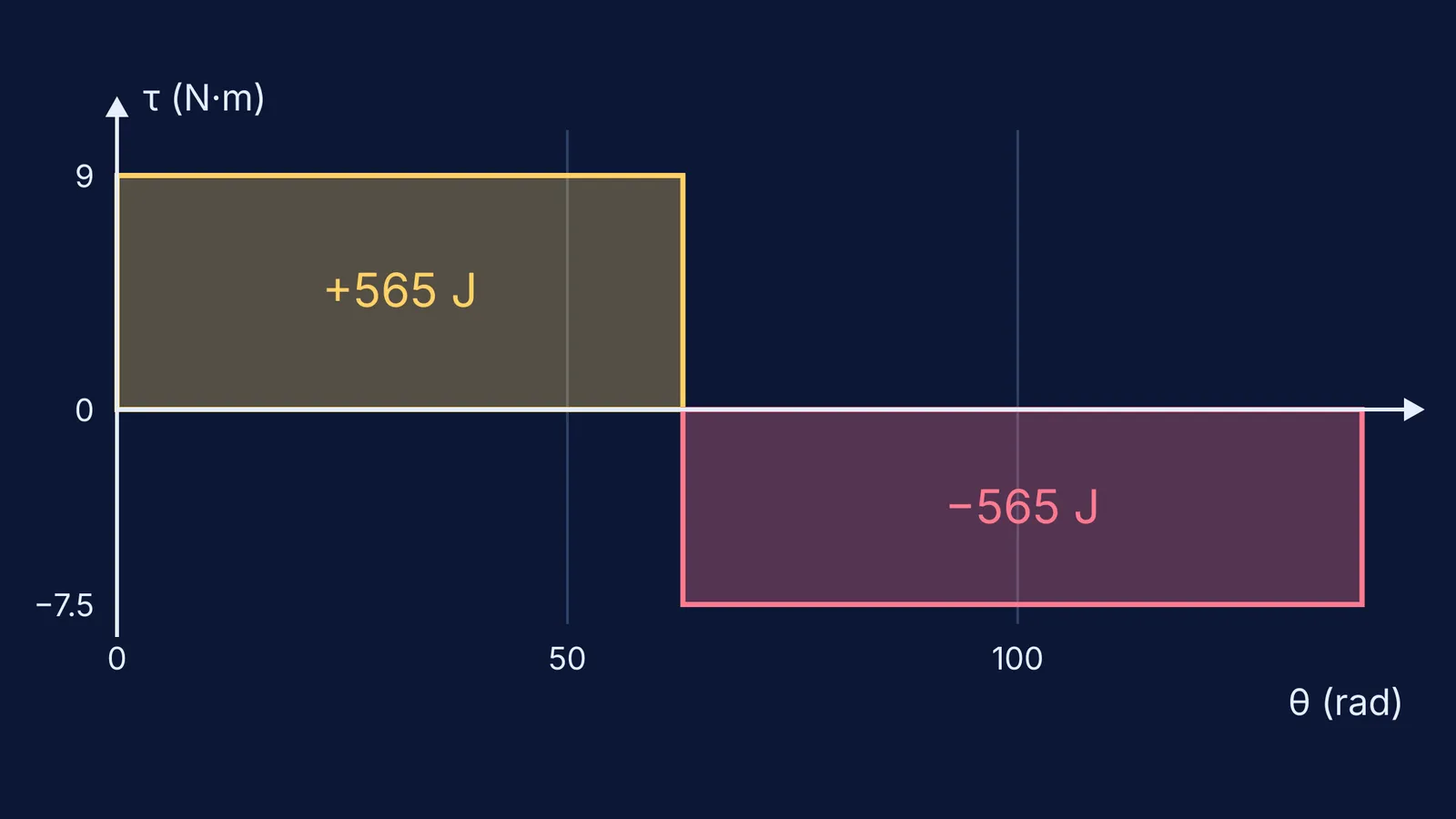
If the torque changes with angle, W is the area under the τ against θ graph, the same way work is the area under an F against x graph.
What is the power delivered by a torque?
Power is the rate of doing work, and for rotation it is P = τω, where ω is the angular velocity in rad/s (OpenStax, section 10.8). It mirrors P = Fv for a force pushing something along.
Know two of power, torque and speed and you can find the third. Convert rpm to rad/s first: multiply by 2π and divide by 60.
How does the rotational work-energy theorem work?
The net work done by all torques on a body equals the change in its rotational kinetic energy, W = ½Iω² (final) − ½Iω² (initial), as both OpenStax and HyperPhysics state. Given an angle and asked for a speed, or the reverse, you can skip angular acceleration entirely.
For a uniform solid disc about its central axis, I = ½MR² (OpenStax, section 10.5). If you want to see where that comes from, our post on finding moment of inertia by integration works it out. For the linear version of this shortcut, see the work-energy theorem for JEE problems.
Worked examples: a motor, a flywheel and a brake
The numbers below are made up for practice, chosen so the arithmetic stays clean.
Example 1, power of a motor: a motor runs at 1440 rpm and delivers a torque of 2.0 N·m. What power does it deliver?
Convert speed: ω = 1440 × 2π / 60 ≈ 150.8 rad/s.
Apply P = τω: P = 2.0 × 150.8 ≈ 302 W.
Example 2, spinning up a flywheel: a flywheel is a uniform solid disc of mass 20 kg and radius 0.30 m, starting from rest. A constant torque of 9.0 N·m acts on it for 10 revolutions. How fast is it spinning at the end?
Moment of inertia: I = ½ × 20 × 0.30² = 0.90 kg·m².
Angle: θ = 10 × 2π ≈ 62.8 rad.
Work: W = τθ = 9.0 × 62.8 ≈ 565 J.
Work-energy theorem: 565 = ½ × 0.90 × ω², so ω² ≈ 1257 and ω ≈ 35.4 rad/s, or about 339 rpm.
The power is not constant: it starts at zero and ends at P = τω = 9.0 × 35.4 ≈ 319 W. Constant torque means power grows with speed.
Example 3, braking the flywheel: now a brake pad presses on the same flywheel with a friction force of 30 N at a radius of 0.25 m. How many turns does it take to stop?
Braking torque: τ = 30 × 0.25 = 7.5 N·m, opposing the rotation.
The brake must remove all 565 J, so 7.5 × θ = 565, giving θ ≈ 75.4 rad.
In turns: 75.4 / 2π ≈ 12.0 revolutions.
The brake turns that energy into heat at P = τω: 7.5 × 35.4 ≈ 266 W at first, falling to zero. Since ω drops steadily, the average is half that, about 133 W, over roughly 4.25 s. You can check the time with the rotational kinematics equations: α = 7.5 / 0.90 ≈ 8.33 rad/s², and t = 35.4 / 8.33 ≈ 4.25 s.
What should you check before you write the answer?
Angles in radians and speeds in rad/s, never revolutions or rpm inside a formula.
The right I for the shape and axis.
A sign for every torque: driving or braking.
Net work goes into the work-energy theorem.
P = τω gives power at one instant. For average power, divide total work by total time.
If you keep picking the wrong method on questions like these, the Fermi Problem Library has worked problems with a step-by-step solver that explains the reasoning rather than printing an answer.


