On this page
Chemists sort binary hydrides into three families by the bond between hydrogen and its partner, and the family tells you how a hydride behaves. Below is the classification, a one-line electron count for the molecular hydrides, and an exam checklist.
What are the three types of hydrides?
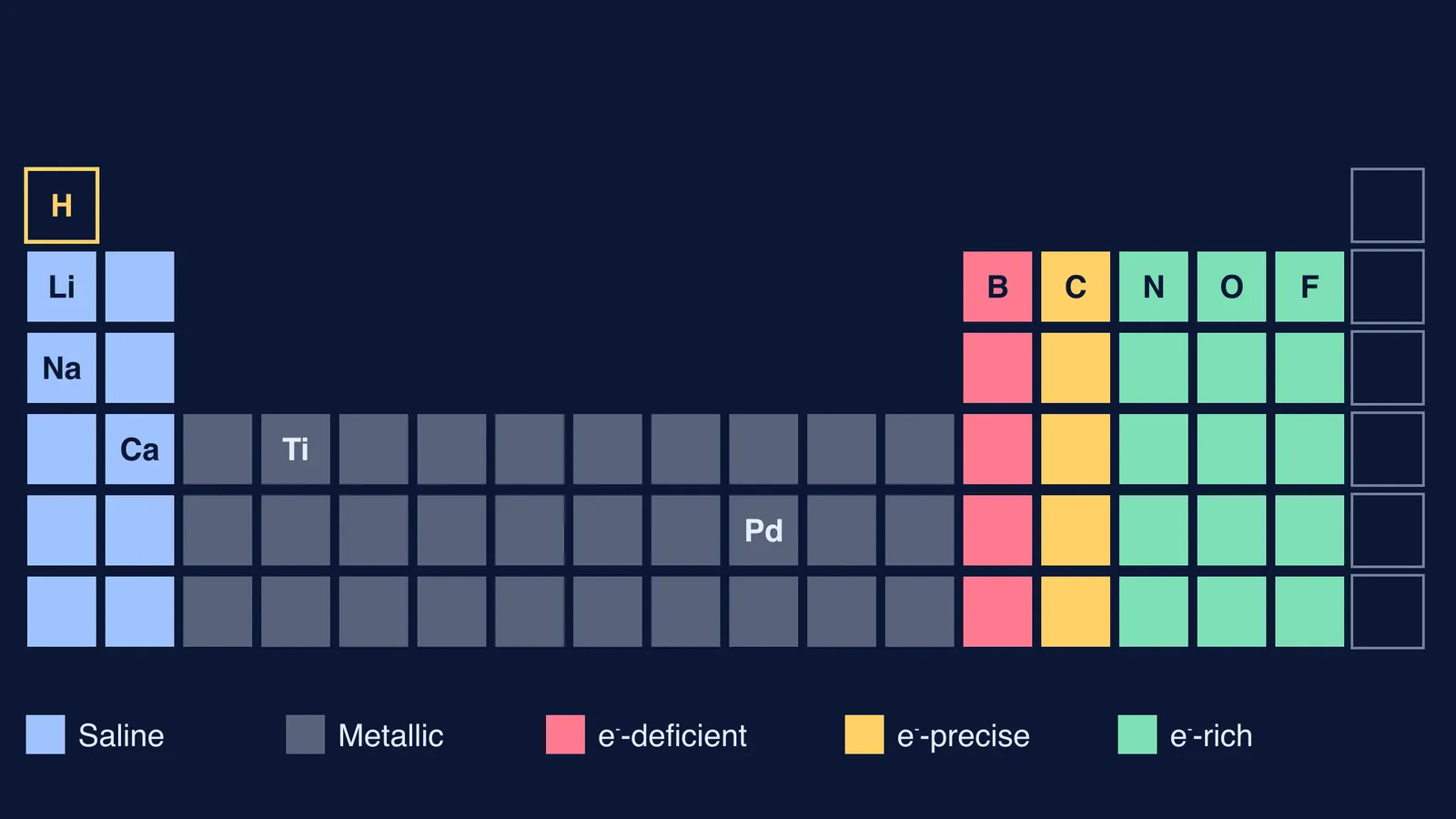
Ionic or saline hydrides form with the most active metals, the alkali and alkaline-earth metals of groups 1 and 2, and hydrogen is present as the hydride ion, H⁻ (LibreTexts, saline hydrides/10%3A_Hydrogen/10.07%3A_Binary_Hydrides_-_Classification_and_General_Properties/10.7C%3A_Saline_Hydrides)).
Covalent or molecular hydrides form when hydrogen shares electron pairs with non-metals, as in HCl and NH₃ (LibreTexts, hydrides/Descriptive_Chemistry/Main_Group_Reactions/Compounds/Hydrides)).
Metallic or interstitial hydrides form with transition metals: hydrogen fills gaps in the metal lattice, so the ratio of hydrogen atoms to metal atoms is not fixed (LibreTexts, metallic hydrides/10%3A_Hydrogen/10.07%3A_Binary_Hydrides_-_Classification_and_General_Properties/10.7B%3A_Metallic_Hydrides)).
How do we know saline hydrides contain H⁻?
The proof is an electrolysis. When molten sodium hydride is electrolysed, hydrogen gas is given off at the anode, as the NCERT answer on NaH sets out (Careers360, NCERT solution). Gas at the positive electrode means the hydrogen arrived carrying a negative charge: 2H⁻ → H₂ + 2e⁻.
Saline hydrides react vigorously with water to give hydrogen gas, for example NaH + H₂O → NaOH + H₂ (LibreTexts/10%3A_Hydrogen/10.07%3A_Binary_Hydrides_-_Classification_and_General_Properties/10.7C%3A_Saline_Hydrides)). The same page lists the enthalpy of formation of NaH as −56.3 kJ/mol against −411 kJ/mol for NaCl, so far less energy holds the hydride together than the chloride.
They are true salts in structure too. Lithium hydride crystallises in the same rock-salt arrangement as NaCl and melts at 688.7 °C (Wikipedia, lithium hydride). For how these metals behave in their other compounds, see our guide to s-block elements and their key compounds.
What are electron-deficient, electron-precise and electron-rich hydrides?
The molecular hydrides are split by one question: does the molecule have enough electrons to write a normal Lewis structure? The NCERT Class 11 answer, quoted on Careers360, gives these definitions:
Electron-deficient hydrides have fewer electrons than a conventional Lewis structure needs. All group 13 elements form them; the example is diborane, B₂H₆.
Electron-precise hydrides have exactly the electrons a conventional Lewis structure needs. All group 14 elements form them; the example is CH₄.
Electron-rich hydrides have extra electrons, present as lone pairs. Groups 15 to 17 form them: NH₃ has one lone pair and H₂O has two.
Diborane gets round its shortage with two bridging hydrogens, each holding two boron atoms together with one electron pair; our explainer on the diborane structure and its three-centre bonds draws them out.
Worked example: the one-line electron count
Count instead of memorising: spare electrons = total valence electrons − 2 × (bonds in a classical structure).
CH₄: 4 + 4 = 8 electrons; 4 C–H bonds use 8; spare 0, so electron-precise.
NH₃: 5 + 3 = 8; 3 bonds use 6; spare 2, one lone pair, so electron-rich.
H₂O: 6 + 2 = 8; 2 bonds use 4; spare 4, two lone pairs, so electron-rich.
HF: 7 + 1 = 8; 1 bond uses 2; spare 6, three lone pairs, so electron-rich.
B₂H₆: 2 × 3 + 6 = 12; an ethane-like structure needs 7 bonds, or 14 electrons; spare −2, so electron-deficient.
Lone pairs on small, electronegative N, O and F let NH₃, H₂O and HF hydrogen-bond, so they boil far higher than their heavier cousins, as our hydride boiling point graph shows.
Why are metallic hydrides non-stoichiometric?
Because hydrogen goes into holes in a metal lattice that is already there, and not every hole fills. Palladium is the textbook case: at standard temperature and pressure it can absorb up to 900 times its own volume of hydrogen, and under 1 atmosphere of hydrogen it reaches a composition of about PdH₀.₇, with hydrogen atoms randomly occupying the octahedral holes of the face-centred cubic lattice (Wikipedia, palladium hydride). The lattice swells as it fills, from 388.9 pm in pure palladium to 402.5 pm in the hydrogen-rich phase, according to the same source.
That makes them candidates for storing hydrogen fuel, but interstitial hydrides store only about 2 percent hydrogen by weight, not enough for cars (Wikipedia, hydride).
How do you classify any hydride in an exam?
Run these three checks in order:
Is the partner a group 1 or 2 metal? It is saline: an ionic solid that conducts when molten and gives H₂ with water.
Is it a d-block metal? It is metallic: expect a variable, often fractional formula.
Is it a p-block element? It is molecular: do the electron count. Group 13 is deficient, group 14 precise, groups 15 to 17 rich.
Textbooks simplify, so expect a few borderline elements. If the idea of a Lewis structure or a lone pair is the shaky step, the Fermi Concept Library covers every concept in physics, chemistry, biology, mathematics and computing. To practise, the Fermi Problem Library has worked problems with a step-by-step solver that explains the reasoning rather than printing an answer.
Try the count on SiH₄, PH₃ and H₂S before your next test, and check that the sign of each result matches its group.