

On this page
The classic evidence for hydrogen bonding is one graph: boiling point against period for the hydrides of groups 14 to 17. You can draw it from sixteen numbers, and if you predict its shape first, the places your prediction fails are the lesson.
What does the boiling point graph of group 14 to 17 hydrides show?
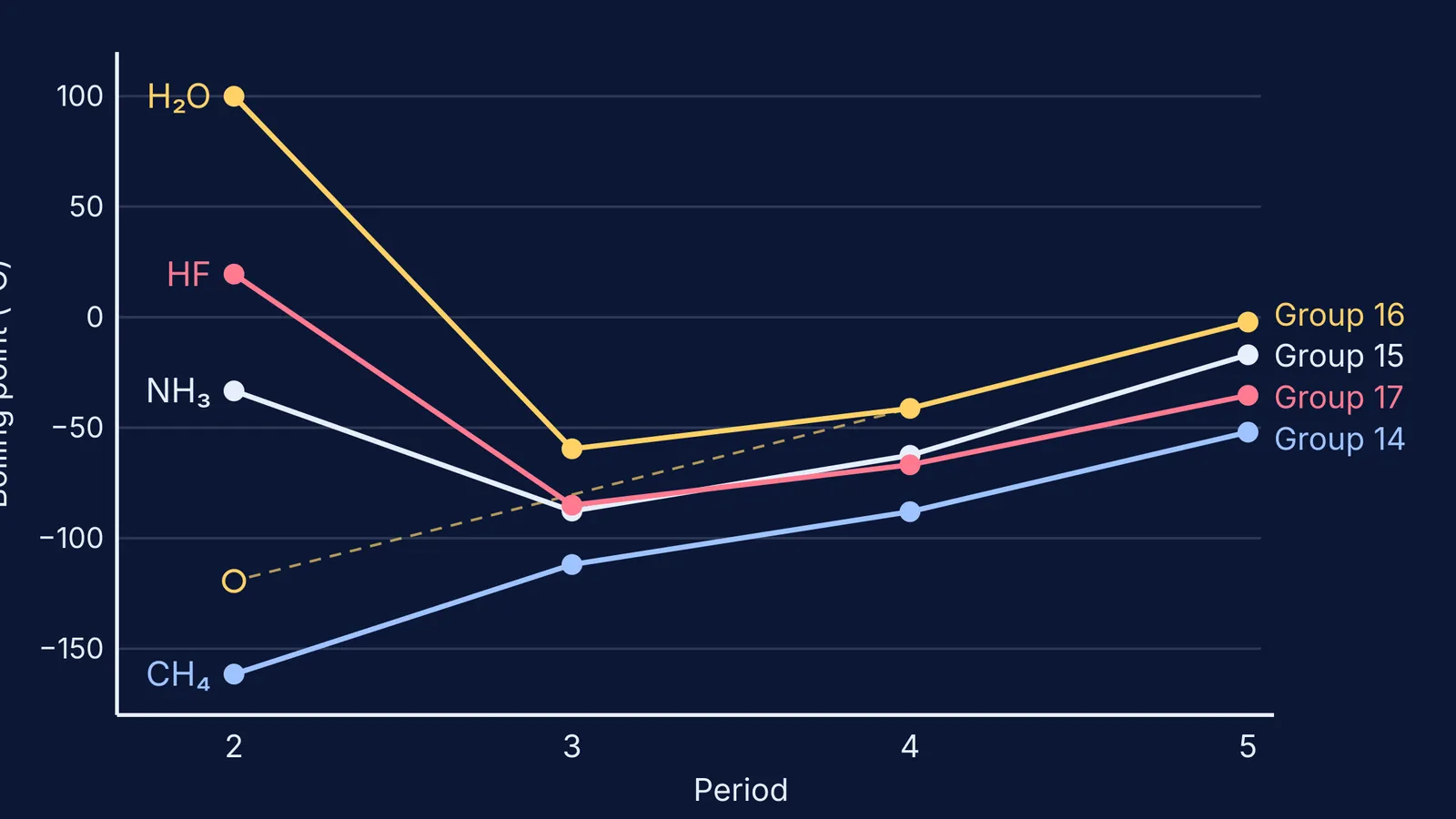
Here are the boiling points at 1 atm, rounded to the nearest degree, from each compound's reference page, in the order period 2, 3, 4, 5:
Put period on the x-axis, boiling point on the y-axis, and join each group's points. Group 14 climbs steadily. Groups 15, 16 and 17 make a tick shape: high at period 2, a drop to period 3, then a climb.
The group 14 hydrides form a series whose boiling points increase smoothly with increasing molar mass, the pattern expected when London dispersion forces are the only attraction between molecules (LibreTexts/13%3A_Solutions/13.01%3A_Solids_Liquids_and_Phase_Transitions/13.1.03%3A_Intermolecular_Forces_in_Liquids)). The same source notes that the hydrides of the lightest members of groups 15 to 17 boil more than 100 °C higher than their molar masses predict.
Which hydrides break the trend? Predict before you plot
Cover the numbers above and try this on paper.
Write the rule from group 14: bigger molecules have more electrons, stronger dispersion forces and higher boiling points, so the period 2 hydride should boil lowest.
Apply it to group 16: H₂O should boil below H₂S (about −60 °C). Extending the H₂Te–H₂Se line back to period 2 gives roughly −120 °C with these numbers; LibreTexts/13%3A_Solutions/13.01%3A_Solids_Liquids_and_Phase_Transitions/13.1.03%3A_Intermolecular_Forces_in_Liquids) gets −130 °C. The real value is 100 °C, so the rule misses by more than 200 degrees.
Repeat for groups 15 and 17. You would predict NH₃ below PH₃ (−88 °C) and HF below HCl (−85 °C). In fact NH₃ boils at −33 °C and HF at 20 °C.
Why does water boil so much higher than H₂S?
Molecules with hydrogen atoms bonded to highly electronegative atoms such as O, N and F form hydrogen bonds: strong dipole–dipole attractions between that hydrogen and a lone pair on a neighbouring molecule (LibreTexts/13%3A_Solutions/13.01%3A_Solids_Liquids_and_Phase_Transitions/13.1.03%3A_Intermolecular_Forces_in_Liquids)). Typical hydrogen bonds have dissociation energies of only 15 to 25 kJ/mol, much weaker than covalent bonds, yet they have a significant influence on physical properties, according to the same source.
In water you must break the hydrogen bonds between molecules as well as the dispersion forces, which takes more energy. Sulfur is much less electronegative than oxygen, so S–H bonds are far less polar and H₂S relies on weaker forces. A common exam slip is writing that boiling breaks O–H bonds; the covalent bonds inside each molecule stay intact. Our post on predicting boiling points and solubility from hydrogen bonding applies the same rule to other compounds.
Why does water boil higher than HF and ammonia?
Fluorine is the most electronegative element, so you might expect HF on top. The answer is how many hydrogen bonds each molecule can make. A single water molecule can take part in up to four hydrogen bonds, donating its two hydrogens and accepting two through the lone pairs on oxygen (Wikipedia: Properties of water). HF has only one hydrogen to donate, so its molecules link into zigzag chains; in the liquid these chains average only five or six molecules (Wikipedia: Hydrogen fluoride). Ammonia has three hydrogens but only one lone pair on nitrogen, and nitrogen is less electronegative than oxygen, so its hydrogen bonds are fewer and weaker.
That matches the graph: H₂O (100 °C) above HF (20 °C) above NH₃ (−33 °C). For more exceptions of this kind, see our guide to periodic trends and their exceptions.
How do you write this up in an exam answer?
For a board exam or JEE Main, three sentences cover the main points:
"Down group 16, boiling point rises from H₂S to H₂Te because larger molecules with more electrons have stronger London dispersion forces."
"H₂O breaks the trend because oxygen is highly electronegative, so the H of one molecule forms an intermolecular hydrogen bond with a lone pair on the O of a neighbour."
"Extra energy is needed to break these hydrogen bonds, so H₂O boils far above H₂S instead of below it."
Check that your answer names both kinds of force, says intermolecular, mentions electronegativity and lone pairs, and never says covalent bonds break.
To picture the bonding, our post on seeing molecules in 3D lists tools for rotating water and HF models. The Fermi Concept Library gives each chemistry concept its own lesson, and the Fermi Simulation Lab has interactive physics simulations for ideas that are easier to see than to read.
Tonight, draw the sixteen points from memory and mark the three that break the trend.


