On this page
You have a rod, a hinge and three unknowns, and the textbook solution takes torques about a point you would never have picked. Instead of asking an AI tutor for one answer, ask it to solve the problem about two different axes and compare them. Where they disagree, a term was dropped.
Which axis should you take torque about?
For a body in equilibrium, any point works. OpenStax University Physics says an object in equilibrium must be in equilibrium for all possible pivot points, so choose the one that simplifies your work most (OpenStax, Newton's second law for rotation).
Simplest usually means putting the axis where the unknown forces act: a force through the axis has zero lever arm, so its torque drops out. In the OpenStax ladder example, the pivot sits at the floor contact, where the unknown normal force and friction both act (OpenStax, examples of static equilibrium). Our guide on which point to take torque about in equilibrium problems works through more cases.
Why does τ = Iα fail about some points?
Accelerating bodies give you less freedom. Newton's second law for rotation, τ = Iα, is stated for a rigid body rotating about a fixed axis (OpenStax, Newton's second law for rotation). The other safe choice is the centre of mass: the OpenStax rolling-cylinder example calculates torques about the axis through the centre of mass, even though that point is moving (OpenStax, rolling motion).
Choose any other moving point and the simple τ = Iα form can leave out a term. The algebra still looks clean, so an AI chatbot can make this mistake confidently, much as it can miss a force (see how to check an AI free-body diagram).
Worked example: one rod, three axes
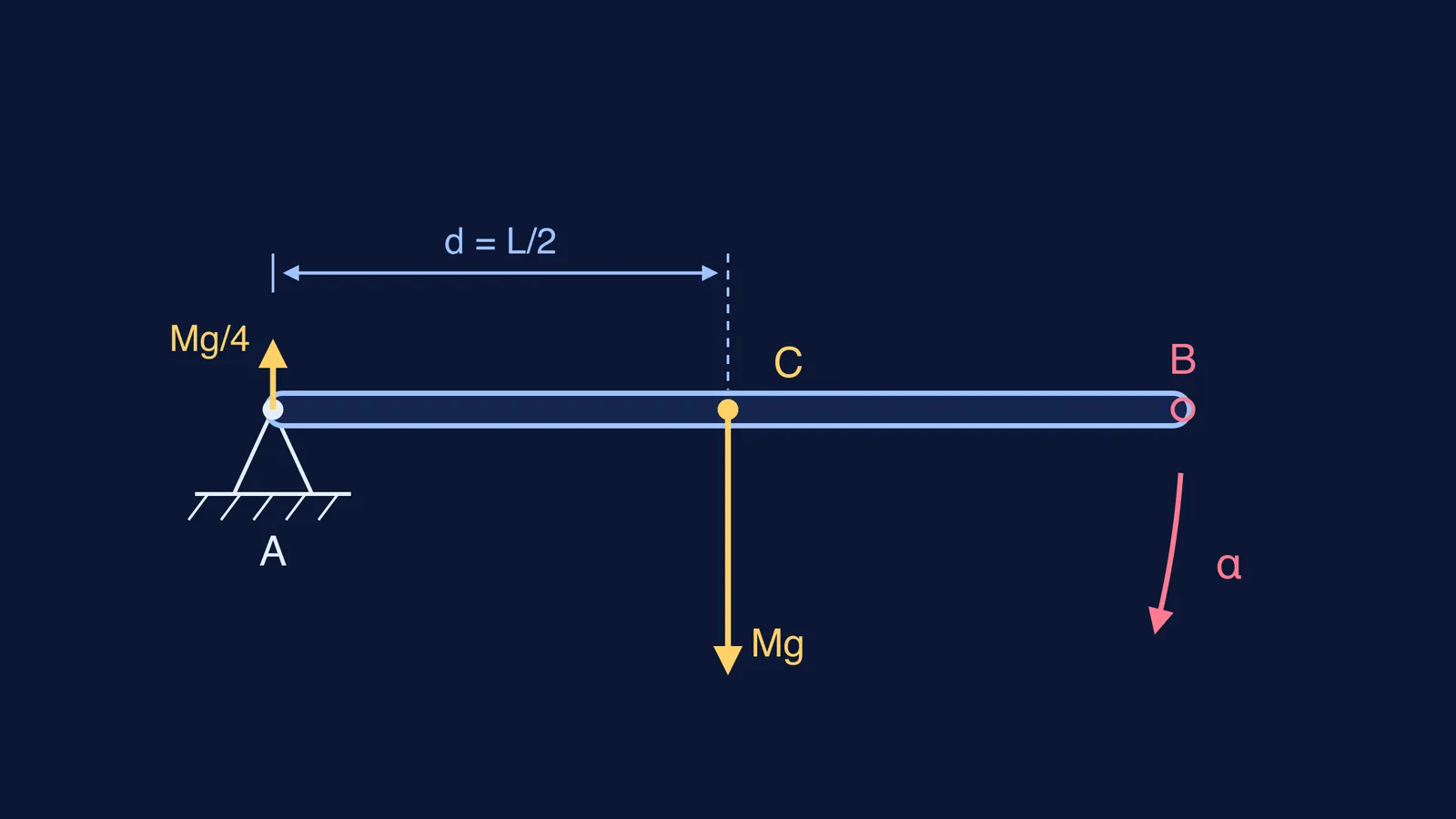
A uniform rod of mass M and length L is hinged at end A and released from rest while horizontal. Find its angular acceleration and the hinge force at that instant. C is the centre and B is the free end.
About the hinge A (a fixed axis). Only gravity has a torque about A: Mg × L/2. With I = ML²/3 about the end, α = 3g/(2L). The hinge force never appears.
About the centre C. Gravity acts through C, so now only the hinge force N has a torque: N × L/2 = (ML²/12)α. Put in α = 3g/(2L) and you get N = Mg/4.
Check with forces. The centre accelerates downward at (L/2)α = 3g/4, so Mg − N = M(3g/4), which gives N = Mg/4 again. Two axes, one answer.
About the free end B (the trap). B is accelerating and is not the centre of mass. Write τ = Iα there anyway, with N = Mg/4, and the net torque is Mg(L/2) − N × L = MgL/4, so α = 3g/(4L): half the true value, in the opposite direction.
How do you check the moment of inertia with the parallel axis theorem?
The parallel axis theorem says I about any axis equals I about a parallel axis through the centre of mass plus Md², where d is the distance between the axes (OpenStax, calculating moments of inertia).
For a uniform rod, I about the centre is ML²/12 and d = L/2, so I about the end is ML²/12 + ML²/4 = ML²/3. OpenStax notes this end value is larger by a factor of four (OpenStax, calculating moments of inertia).
The common slip is using the centre value at the hinge, which here gives α = 6g/L, four times too large. Check that the starting axis passes through the centre of mass, and remember Md² only adds. For revision, see parallel and perpendicular axis theorems.
What should you ask an AI tutor about torque?
In a randomised trial in Harvard's introductory physics course, Physical Sciences 2, with 194 eligible students, those taught by a custom AI tutor learned significantly more in less time than in an active-learning class (Kestin et al., Scientific Reports, 2025). The researchers also gave the tutor step-by-step answers, because language models answer science problems more accurately when given step-by-step solutions (Kestin et al., full text).
A general chatbot has no answer key, so make it check itself:
"Solve this about the hinge, then again about the centre of mass. Show every torque term with its lever arm."
"List every force on the body. Which ones pass through your axis, and why do they drop out?"
"Which moment of inertia did you use, and about which axis? Show the parallel axis step."
"Is your axis fixed, the centre of mass, or neither? If neither, is τ = Iα valid there?"
To compare against a worked version, the Fermi Problem Library has a step-by-step solver that explains the reasoning rather than printing an answer. Fermi's AI tutor decides whether to explain, ask or show, and draws the figure as it goes, so the axis becomes part of the conversation.
Next time a solution picks a strange point, ask why, then make the AI prove it with a second axis.